Bombay HC Limits Competent Authority's Power
Bombay HC rules on disputed RG land share, competent authority's powers
'%3E%3Crect%20width%3D'96'%20height%3D'96'%20fill%3D'%23B3261E'%2F%3E%3Ccircle%20cx%3D'30'%20cy%3D'24'%20r%3D'44'%20fill%3D'%23fff'%20opacity%3D'.12'%2F%3E%3Ccircle%20cx%3D'60'%20cy%3D'74'%20r%3D'40'%20fill%3D'%23000'%20opacity%3D'.10'%2F%3E%3C%2Fg%3E%3Cg%20fill%3D'%23fff'%3E%3Crect%20x%3D'29'%20y%3D'49'%20width%3D'8'%20height%3D'19'%20rx%3D'1'%2F%3E%3Crect%20x%3D'39'%20y%3D'40'%20width%3D'9'%20height%3D'28'%20rx%3D'1'%2F%3E%3Crect%20x%3D'50'%20y%3D'45'%20width%3D'8'%20height%3D'23'%20rx%3D'1'%2F%3E%3Crect%20x%3D'60'%20y%3D'53'%20width%3D'7'%20height%3D'15'%20rx%3D'1'%2F%3E%3Crect%20x%3D'41'%20y%3D'34'%20width%3D'5'%20height%3D'6'%2F%3E%3C%2Fg%3E%3C%2Fsvg%3E)
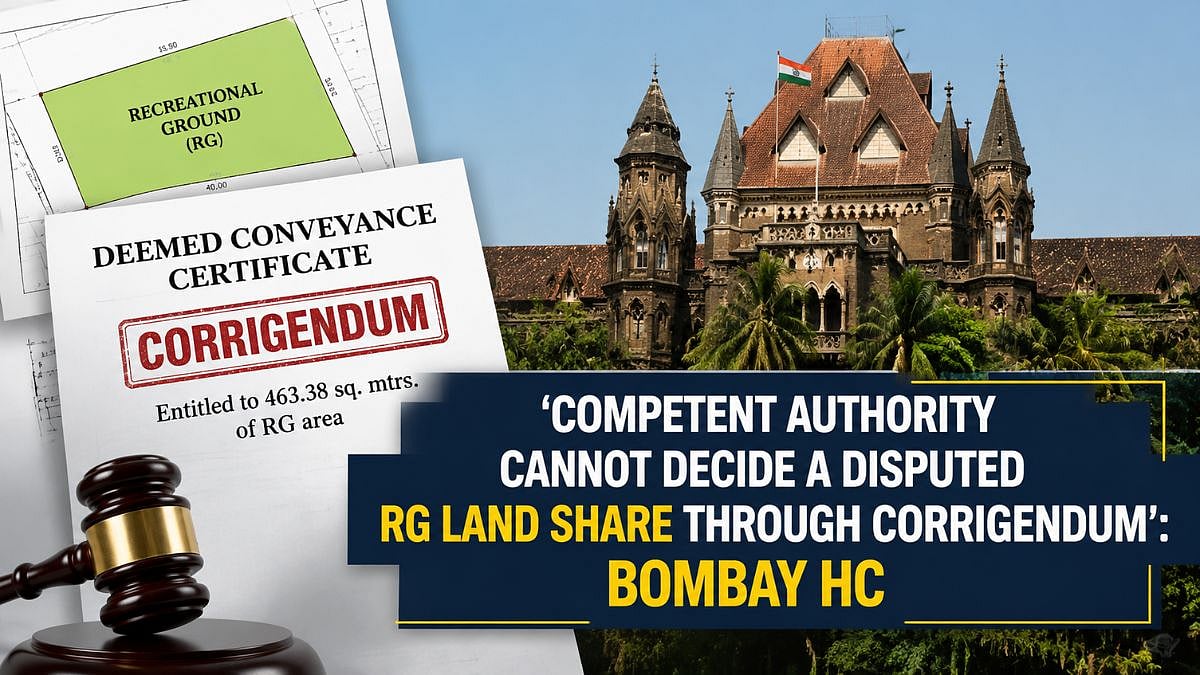
The Bombay High Court has made a significant ruling regarding the powers of a competent authority in deciding disputes over recreational ground (RG) land shares. On July 15, 2026, Justice Sandeep Marne set aside an order issued by the District Deputy Registrar and Competent Authority on January 12, 2026.
The order had modified the deemed conveyance certificate of Devendra Co-operative Housing Society Ltd., a housing society in Borivali West, by specifying its entitlement to 463.38 square metres of the RG area during the redevelopment of its building.
The dispute arose between Devendra CHSL and Shree Rasraj Heights Co-operative Housing Society Ltd., another housing society in the same layout, over the exact proportionate share of the common recreational ground. While Devendra CHSL claimed a larger share based on plot area, Shree Rasraj Heights argued that the calculation should be based on the built-up area of the buildings.
The High Court observed that although redevelopment under the Development Control and Promotion Regulations requires determination of each building's proportionate share in the RG area, the competent authority cannot decide rival claims through a corrigendum. The court stated that the competent authority had entered into the realm of exercising adjudicatory power and had not restricted itself to merely correcting an arithmetical or clerical error.
The court reiterated that a competent authority becomes functus officio after issuing a deemed conveyance order and has no power to review or substantially modify it. A corrigendum can only be used to correct obvious clerical or arithmetical mistakes arising from accidental slips or omissions.
In this case, the dispute was about the exact area of the proportionate share, which cannot be resolved by issuance of a corrigendum as it involves an adjudicatory exercise of power. The High Court, however, clarified that Devendra CHSL would not be left without a remedy and granted it liberty to separately challenge the decision.
The ruling has significant implications for housing societies and developers in Mumbai, as it clarifies the limits of the competent authority's powers in deciding disputes over RG land shares. The decision is expected to provide guidance on the proper procedure for resolving such disputes and ensure that the rights of all parties involved are protected.
The Bombay High Court's ruling is a reminder that the competent authority's powers are limited to correcting errors and not to adjudicating disputes. The court's decision is a significant step towards ensuring that the redevelopment process is fair and transparent, and that the rights of all stakeholders are respected.
In the context of Mumbai's real estate market, the ruling is particularly relevant, as it affects the redevelopment of buildings and the allocation of recreational ground spaces. The decision is expected to have a positive impact on the market, as it provides clarity and certainty on the procedures to be followed in such cases.
The ruling also highlights the importance of proper documentation and record-keeping in the redevelopment process, as well as the need for housing societies and developers to carefully review and challenge decisions that affect their rights and interests.
In conclusion, the Bombay High Court's ruling is a significant development in the realm of real estate law in Mumbai, and is expected to have far-reaching implications for housing societies, developers, and other stakeholders in the industry.
The decision is a reminder that the legal system is in place to protect the rights of all parties involved, and that the competent authority's powers are limited to ensuring that the redevelopment process is fair, transparent, and in accordance with the law.
The ruling is also a testament to the importance of the judiciary in resolving disputes and providing guidance on complex legal issues. The Bombay High Court's decision is a significant contribution to the development of real estate law in Mumbai, and is expected to have a positive impact on the industry as a whole.