Farmers' March Causes Traffic Jam in Bhopal
Farmers' march triggers traffic jam, barricading disrupts bus operations
'%3E%3Crect%20width%3D'96'%20height%3D'96'%20fill%3D'%23B3261E'%2F%3E%3Ccircle%20cx%3D'30'%20cy%3D'24'%20r%3D'44'%20fill%3D'%23fff'%20opacity%3D'.12'%2F%3E%3Ccircle%20cx%3D'60'%20cy%3D'74'%20r%3D'40'%20fill%3D'%23000'%20opacity%3D'.10'%2F%3E%3C%2Fg%3E%3Cg%20fill%3D'%23fff'%3E%3Crect%20x%3D'29'%20y%3D'49'%20width%3D'8'%20height%3D'19'%20rx%3D'1'%2F%3E%3Crect%20x%3D'39'%20y%3D'40'%20width%3D'9'%20height%3D'28'%20rx%3D'1'%2F%3E%3Crect%20x%3D'50'%20y%3D'45'%20width%3D'8'%20height%3D'23'%20rx%3D'1'%2F%3E%3Crect%20x%3D'60'%20y%3D'53'%20width%3D'7'%20height%3D'15'%20rx%3D'1'%2F%3E%3Crect%20x%3D'41'%20y%3D'34'%20width%3D'5'%20height%3D'6'%2F%3E%3C%2Fg%3E%3C%2Fsvg%3E)
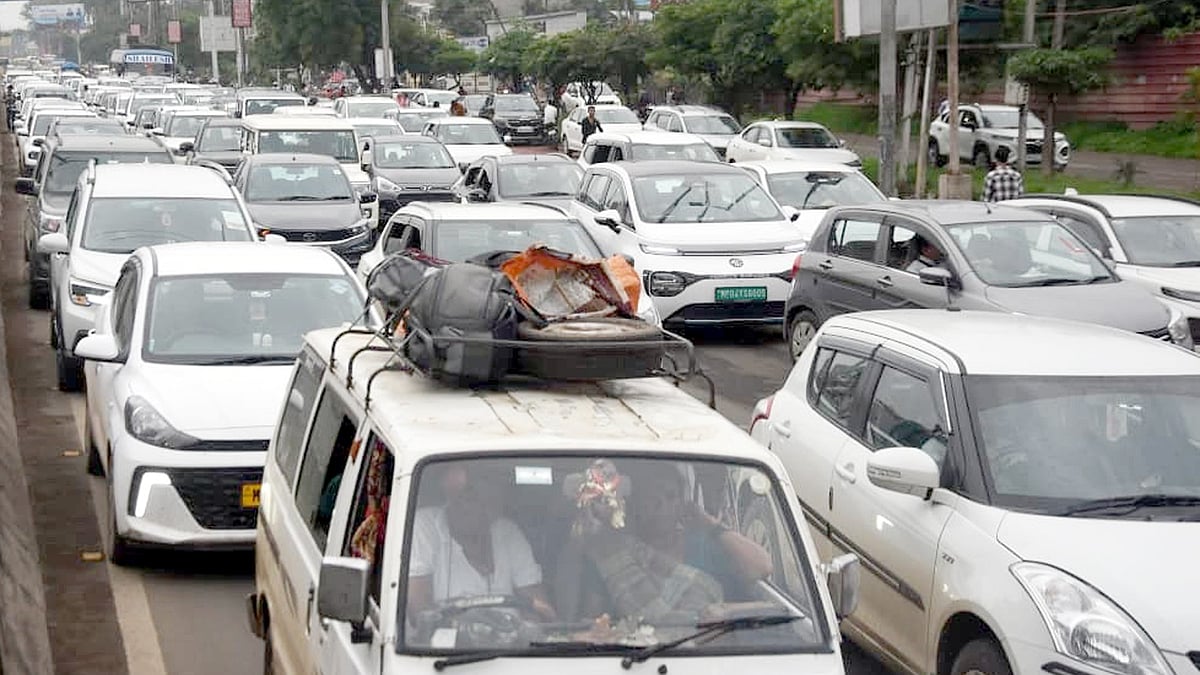
A massive traffic jam was triggered in Bhopal on Tuesday due to the farmers' march, which was demanding 100% procurement of moong at the Minimum Support Price (MSP) and other benefits. The march, which started from Narmadapuram, was headed towards Bhopal, prompting the police to erect heavy barricades at 11-Mill Tiraha to prevent the participants from entering the city.
The barricades left only a narrow passage for vehicles, severely disrupting traffic movement along the Hoshangabad Road stretch. The traffic congestion lasted for several hours, affecting public transport, including around 150 bus operations. The Bhopal City Link Ltd (BCLL) reported that 26 of its buses were affected, with 20 operating on the Bhopal-Mandideep route and six on other routes.
The Motor Transport Association claimed that the barricading disrupted around 150 bus operations, including city bus services. Govind Sharma, general secretary of the association, stated that the congestion affected not only city buses but also long-distance passenger buses operating from the Inter-State Bus Terminal (ISBT) towards Hoshangabad and Mandideep.
School buses were also stuck in the congestion, causing inconvenience to students and parents. To ease the congestion, vehicles were diverted to alternate routes, and traffic police personnel were deployed at key intersections. However, the heavy traffic volume and road restrictions resulted in slow-moving traffic along the Hoshangabad Road stretch for several hours.
Residents of the area reported that the congestion brought traffic to a near standstill on the Hoshangabad Road stretch. Sunil Upadhyaya, a resident of Sriram Colony, said that the heavy barricading and police restrictions due to the ongoing farmers' march triggered severe traffic congestion, slowing vehicular movement to a crawl on key arterial roads.
Fuel station operators in the area also reported severe congestion during the restrictions. Ajay Singh, president of the Petrol Pump Dealers Association, stated that the heavy traffic congestion due to the barricading and the narrow passage created by police deployment severely slowed traffic, with vehicles heading towards Mandideep being the worst affected.
The farmers' march was demanding several benefits, including the scrapping of the e-token system and fertiliser distribution based on land records. The police had tightened security at entry points to the state capital and closely monitored the farmers' movement.
The traffic congestion caused by the farmers' march highlights the need for effective traffic management and coordination between the police and other stakeholders to minimize disruptions to public life. The incident also underscores the importance of addressing the grievances of farmers and finding a solution to their demands to prevent such disruptions in the future.
In conclusion, the farmers' march in Bhopal caused significant traffic congestion and disruptions to public transport, highlighting the need for effective traffic management and coordination between the police and other stakeholders. The incident also emphasizes the importance of addressing the grievances of farmers and finding a solution to their demands to prevent such disruptions in the future.
Frequently asked questions
What was the cause of the traffic jam in Bhopal?
The traffic jam was caused by the farmers' march, which was demanding 100% procurement of moong at the Minimum Support Price (MSP) and other benefits.
How many bus operations were affected by the barricading?
Around 150 bus operations, including city bus services, were affected by the barricading.