Kharge Dares BJP on Vande Mataram
Congress leader Kharge challenges BJP, references Gandhi and Nehru.
'%3E%3Crect%20width%3D'96'%20height%3D'96'%20fill%3D'%231A5276'%2F%3E%3Ccircle%20cx%3D'30'%20cy%3D'24'%20r%3D'44'%20fill%3D'%23fff'%20opacity%3D'.12'%2F%3E%3Ccircle%20cx%3D'60'%20cy%3D'74'%20r%3D'40'%20fill%3D'%23000'%20opacity%3D'.10'%2F%3E%3C%2Fg%3E%3Cg%20fill%3D'%23fff'%3E%3Cpath%20d%3D'M31%2041%20L48%2031%20L65%2041%20Z'%2F%3E%3Crect%20x%3D'33'%20y%3D'43'%20width%3D'4'%20height%3D'17'%2F%3E%3Crect%20x%3D'41'%20y%3D'43'%20width%3D'4'%20height%3D'17'%2F%3E%3Crect%20x%3D'51'%20y%3D'43'%20width%3D'4'%20height%3D'17'%2F%3E%3Crect%20x%3D'59'%20y%3D'43'%20width%3D'4'%20height%3D'17'%2F%3E%3Crect%20x%3D'30'%20y%3D'62'%20width%3D'36'%20height%3D'4'%20rx%3D'1'%2F%3E%3C%2Fg%3E%3C%2Fsvg%3E)
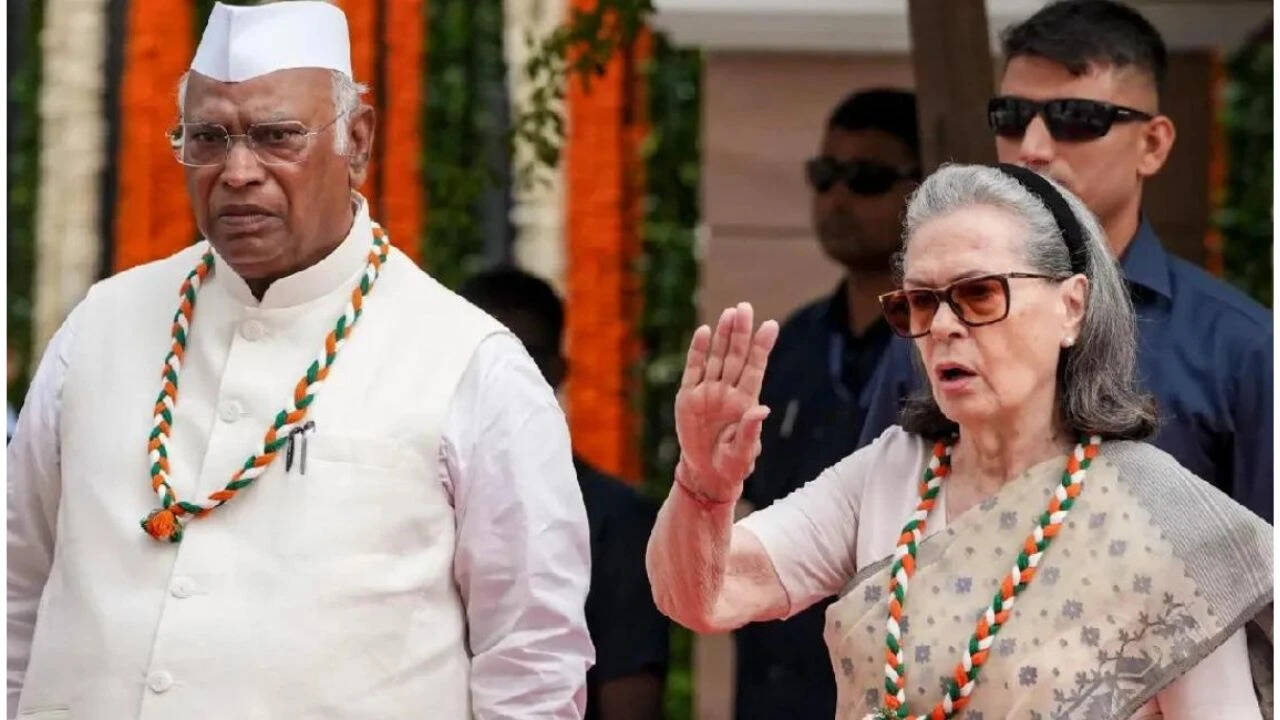
Congress leader Mallikarjun Kharge has dared the Bharatiya Janata Party (BJP) to take action against former Indian leaders Mahatma Gandhi and Jawaharlal Nehru for their stance on the national song Vande Mataram.
Kharge's statement comes as a response to the ongoing debate surrounding the song, which has been a point of contention between the BJP and the opposition parties. The Congress leader's dare is seen as a move to counter the BJP's claims of being the sole guardians of Indian nationalism.
The BJP has been pushing for the widespread adoption of Vande Mataram as a symbol of national pride, while the opposition parties have raised concerns about the song's origins and its potential to create divisions within the country. Kharge's reference to Gandhi and Nehru is significant, as both leaders have been revered for their role in India's struggle for independence.
Gandhi and Nehru had expressed reservations about the song's potential to create communal tensions, given its origins in a novel that was seen as anti-Muslim. The song has been a subject of debate since the early 20th century, with some arguing that it is a symbol of Indian nationalism, while others see it as a divisive force.
The Congress party has been critical of the BJP's attempts to impose its own brand of nationalism on the country, and Kharge's dare is seen as a part of this larger critique. The party has argued that the BJP's nationalism is exclusionary and divisive, and that it seeks to erase the contributions of other parties and leaders to India's independence movement.
The debate surrounding Vande Mataram is likely to continue, with the BJP and the opposition parties locked in a bitter struggle for control of the national narrative. Kharge's dare has added a new dimension to this debate, and it remains to be seen how the BJP will respond to the Congress leader's challenge.
In the larger context, the debate surrounding Vande Mataram reflects the deeper divisions within Indian society, with different parties and groups having competing visions of what it means to be Indian. The song has become a symbol of these divisions, with some seeing it as a unifying force, while others view it as a source of tension and conflict.
As the debate continues, it is clear that the issue of Vande Mataram will remain a contentious one, with different parties and groups seeking to impose their own interpretation of the song's meaning and significance. The outcome of this debate will have significant implications for Indian society and politics, and it remains to be seen how the different parties and groups will navigate this complex and sensitive issue.
The significance of Kharge's dare lies in its ability to highlight the complexities and nuances of the debate surrounding Vande Mataram. By referencing Gandhi and Nehru, Kharge has sought to shift the focus of the debate away from the BJP's simplistic and exclusionary nationalism, and towards a more nuanced and inclusive understanding of Indian nationalism.
In conclusion, Kharge's dare to the BJP on Vande Mataram has added a new dimension to the ongoing debate surrounding the song. The debate reflects the deeper divisions within Indian society, and it remains to be seen how the different parties and groups will navigate this complex and sensitive issue. The outcome of this debate will have significant implications for Indian society and politics, and it is likely to continue to be a major point of contention in the days and weeks to come.
Frequently asked questions
What is the controversy surrounding Vande Mataram?
The controversy surrounds the song's origins and its potential to create communal tensions.
Why did Kharge reference Gandhi and Nehru?
Kharge referenced Gandhi and Nehru to highlight their reservations about the song's potential to create communal tensions and to counter the BJP's claims of being the sole guardians of Indian nationalism.