Supreme Court Clears Manmohan Singh in Coal Block Case
Former PM Manmohan Singh cleared, 2015 summons set aside. CBI clean chit accepted.
'%3E%3Crect%20width%3D'96'%20height%3D'96'%20fill%3D'%231A5276'%2F%3E%3Ccircle%20cx%3D'30'%20cy%3D'24'%20r%3D'44'%20fill%3D'%23fff'%20opacity%3D'.12'%2F%3E%3Ccircle%20cx%3D'60'%20cy%3D'74'%20r%3D'40'%20fill%3D'%23000'%20opacity%3D'.10'%2F%3E%3C%2Fg%3E%3Cg%20fill%3D'%23fff'%3E%3Cpath%20d%3D'M31%2041%20L48%2031%20L65%2041%20Z'%2F%3E%3Crect%20x%3D'33'%20y%3D'43'%20width%3D'4'%20height%3D'17'%2F%3E%3Crect%20x%3D'41'%20y%3D'43'%20width%3D'4'%20height%3D'17'%2F%3E%3Crect%20x%3D'51'%20y%3D'43'%20width%3D'4'%20height%3D'17'%2F%3E%3Crect%20x%3D'59'%20y%3D'43'%20width%3D'4'%20height%3D'17'%2F%3E%3Crect%20x%3D'30'%20y%3D'62'%20width%3D'36'%20height%3D'4'%20rx%3D'1'%2F%3E%3C%2Fg%3E%3C%2Fsvg%3E)
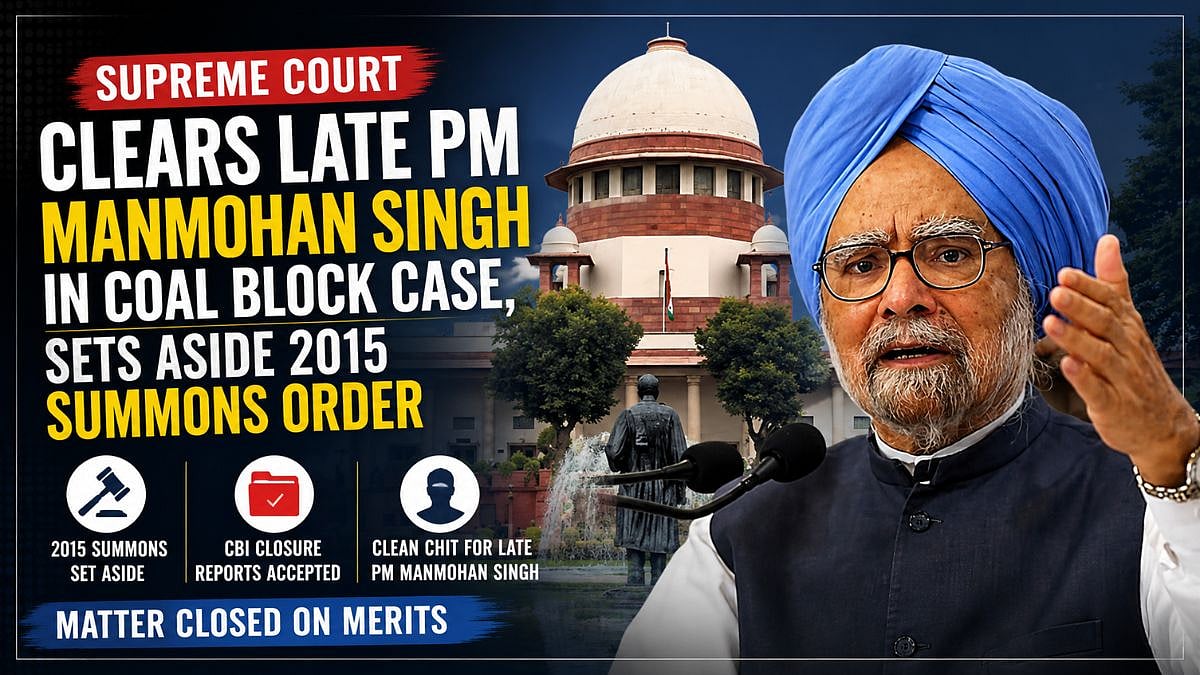
The Supreme Court has set aside a 2015 order of a Special CBI Court that had summoned former Prime Minister Manmohan Singh in a coal block allocation case. The apex court accepted the CBI's closure reports that had given Singh a clean chit and held that there was no justification for the trial court to reject those reports and take cognisance against him.
A Bench comprising Chief Justice of India Surya Kant, Justice Joymalya Bagchi and Justice V. Mohan allowed Singh's appeal and closed the proceedings. Although Singh died on December 26, 2024, the Court decided to examine the legality of the trial court's order because it contained adverse observations against the former Prime Minister.
The Court observed that while Singh's appeal could technically have become infructuous following his demise, it was necessary to examine whether the Special Judge was justified in summoning him despite the CBI's findings. Senior Advocate Kapil Sibal, appearing for the late former Prime Minister, argued that the trial court's adverse remarks should not remain on record.
The CBI had filed two closure reports after investigation that exonerated Singh, but the Special Judge had rejected those reports and proceeded to summon the former Prime Minister. The Supreme Court held that the Special Judge had failed to apply the settled legal principles governing acceptance of closure reports filed by investigating agencies.
The Bench said it was satisfied that there were no compelling reasons to reject the CBI's findings and take cognisance against Singh. It accordingly set aside the Special Judge's order, accepted the CBI's closure reports and closed the matter on merits.
The coal block allocation case dates back to 2015, when the CBI had filed a chargesheet against several individuals, including Singh, for alleged irregularities in the allocation of coal blocks. However, the CBI had later filed closure reports, stating that there was no evidence to prosecute Singh.
The Supreme Court's decision is significant, as it clears the name of the former Prime Minister and sets aside the adverse observations made against him. The ruling also highlights the importance of following settled legal principles in accepting closure reports filed by investigating agencies.
The case has been closely watched, given the high-profile nature of the individuals involved and the allegations of corruption that had been made. The Supreme Court's decision brings closure to the matter, and provides a sense of vindication for the late former Prime Minister.
In conclusion, the Supreme Court's decision to clear Manmohan Singh's name in the coal block allocation case is a significant development, and one that highlights the importance of upholding the law and following due process. The ruling is a testament to the independence and integrity of the judiciary, and provides a sense of closure to a case that had been pending for several years.
The decision also has implications for the wider context of corruption cases in India, and the need for investigating agencies to follow due process and for the judiciary to uphold the law. The Supreme Court's ruling sets an important precedent, and one that will be closely watched in the coming days and weeks.
Overall, the Supreme Court's decision to clear Manmohan Singh's name is a significant development, and one that provides a sense of vindication for the late former Prime Minister. The ruling is a testament to the importance of upholding the law and following due process, and provides a sense of closure to a case that had been pending for several years.
Frequently asked questions
What was the outcome of the Supreme Court's decision in the coal block allocation case?
The Supreme Court set aside the 2015 order of the Special CBI Court that had summoned former Prime Minister Manmohan Singh and accepted the CBI's closure reports that had given him a clean chit.
Why did the Supreme Court decide to examine the legality of the trial court's order despite Manmohan Singh's death?
The Court decided to examine the legality of the trial court's order because it contained adverse observations against the former Prime Minister, which warranted judicial intervention.