Veggie Prices Plummet In Indore, Farmers Struggle
Bottle gourd at ₹2/kg, potatoes from ₹2/kg. Farmers concerned about low wholesale rates.
'%3E%3Crect%20width%3D'96'%20height%3D'96'%20fill%3D'%23C2185B'%2F%3E%3Ccircle%20cx%3D'30'%20cy%3D'24'%20r%3D'44'%20fill%3D'%23fff'%20opacity%3D'.12'%2F%3E%3Ccircle%20cx%3D'60'%20cy%3D'74'%20r%3D'40'%20fill%3D'%23000'%20opacity%3D'.10'%2F%3E%3C%2Fg%3E%3Cpath%20fill%3D'%23fff'%20d%3D'M48%2031%20l4.6%2010.2%2011.2%201%20-8.4%207.5%202.5%2011%20-9.9%20-5.8%20-9.9%205.8%202.5%20-11%20-8.4%20-7.5%2011.2%20-1%20z'%2F%3E%3C%2Fsvg%3E)
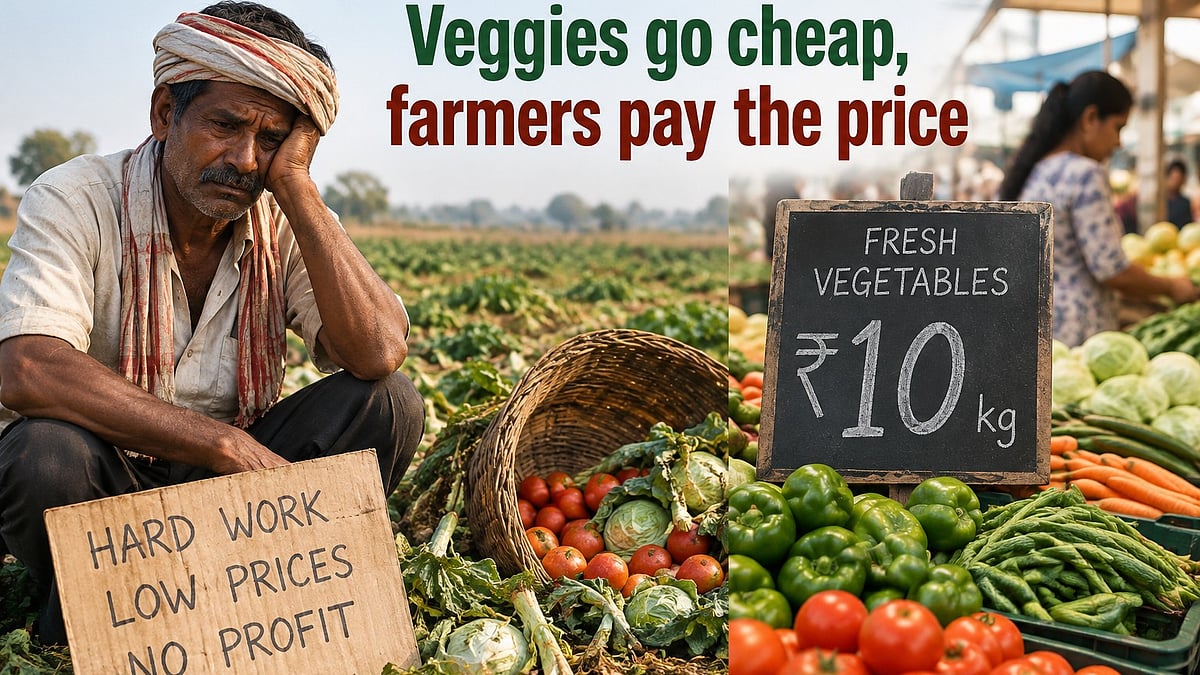
A surge in vegetable supplies at Indore's wholesale market has led to a significant drop in prices, bringing relief to consumers. The increased arrivals of bottle gourd, potato, onion, and tomato have resulted in lower wholesale rates.
According to traders, the wholesale price of bottle gourd has fallen to around ₹2-3 per kg, while potatoes are available at ₹2-6 per kg, depending on the quality. Other vegetables such as cabbage, brinjal, cucumber, peas, tomato, coriander, and chilli are also selling at relatively lower wholesale prices.
The prices of these vegetables are as follows: cabbage at ₹2-3 per kg, brinjal at ₹4-6, cucumber at ₹5-8, peas at ₹8-15, tomato at ₹10-15, coriander at ₹8-10, and chilli at ₹8-12 per kg. However, garlic remains comparatively expensive at ₹25-40 per kg.
Traders attribute the fall in rates to the increased arrivals of vegetables. While consumers are benefiting from the lower prices, farmers are concerned about the declining wholesale rates. Farmers need to recover their production, labor, and transportation costs, and a sharp fall in mandi prices could affect their earnings.
Market operators advise consumers to compare prices at different retail shops and vegetable stalls, as wholesale price reductions may not immediately translate into an equivalent fall in retail rates. This is because transportation and other costs can affect the final price of the vegetables.
The situation highlights the challenges faced by farmers in India, who often struggle to make a profit due to fluctuating market prices. The drop in wholesale rates may provide short-term relief to consumers, but it can have a negative impact on the livelihoods of farmers.
In recent years, India has witnessed significant fluctuations in vegetable prices, affecting both consumers and farmers. The government has implemented various initiatives to support farmers, including minimum support prices and agricultural subsidies. However, more needs to be done to ensure that farmers receive a fair price for their produce.
As the vegetable prices continue to fluctuate, consumers and farmers alike are keeping a close eye on the market trends. While the current drop in prices may be beneficial for consumers, it is essential to consider the long-term implications for farmers and the agricultural sector as a whole.
In conclusion, the drop in vegetable prices in Indore's wholesale market has brought relief to consumers, but it has also raised concerns among farmers. The situation highlights the need for a more sustainable and equitable agricultural market, where both consumers and farmers can benefit.
The Indian government and agricultural experts are working together to find solutions to the challenges faced by farmers. Initiatives such as farm-to-table programs, agricultural cooperatives, and price support mechanisms are being explored to ensure that farmers receive a fair price for their produce.
As the agricultural sector continues to evolve, it is essential to prioritize the needs of both consumers and farmers. By working together, we can create a more sustainable and equitable food system that benefits everyone involved.
The current situation in Indore's wholesale market serves as a reminder of the complexities of the agricultural sector. While the drop in vegetable prices may be beneficial for consumers, it is crucial to consider the long-term implications for farmers and the agricultural sector as a whole.
In the end, finding a balance between consumer needs and farmer livelihoods is essential for creating a sustainable and equitable food system. By understanding the challenges faced by farmers and consumers, we can work towards creating a better future for the agricultural sector.
Frequently asked questions
What is the current price of bottle gourd in Indore's wholesale market?
The wholesale price of bottle gourd is around ₹2-3 per kg.
Why are farmers concerned about the drop in vegetable prices?
Farmers are concerned because they need to recover their production, labor, and transportation costs, and a sharp fall in mandi prices could affect their earnings.