Mahasweta Devi Remembered on Birth Centenary
Mahasweta Devi's stories continue to inspire, 10 years after her passing. Her writing and activism remain relevant today.
'%3E%3Crect%20width%3D'96'%20height%3D'96'%20fill%3D'%23C2185B'%2F%3E%3Ccircle%20cx%3D'30'%20cy%3D'24'%20r%3D'44'%20fill%3D'%23fff'%20opacity%3D'.12'%2F%3E%3Ccircle%20cx%3D'60'%20cy%3D'74'%20r%3D'40'%20fill%3D'%23000'%20opacity%3D'.10'%2F%3E%3C%2Fg%3E%3Cpath%20fill%3D'%23fff'%20d%3D'M48%2031%20l4.6%2010.2%2011.2%201%20-8.4%207.5%202.5%2011%20-9.9%20-5.8%20-9.9%205.8%202.5%20-11%20-8.4%20-7.5%2011.2%20-1%20z'%2F%3E%3C%2Fsvg%3E)
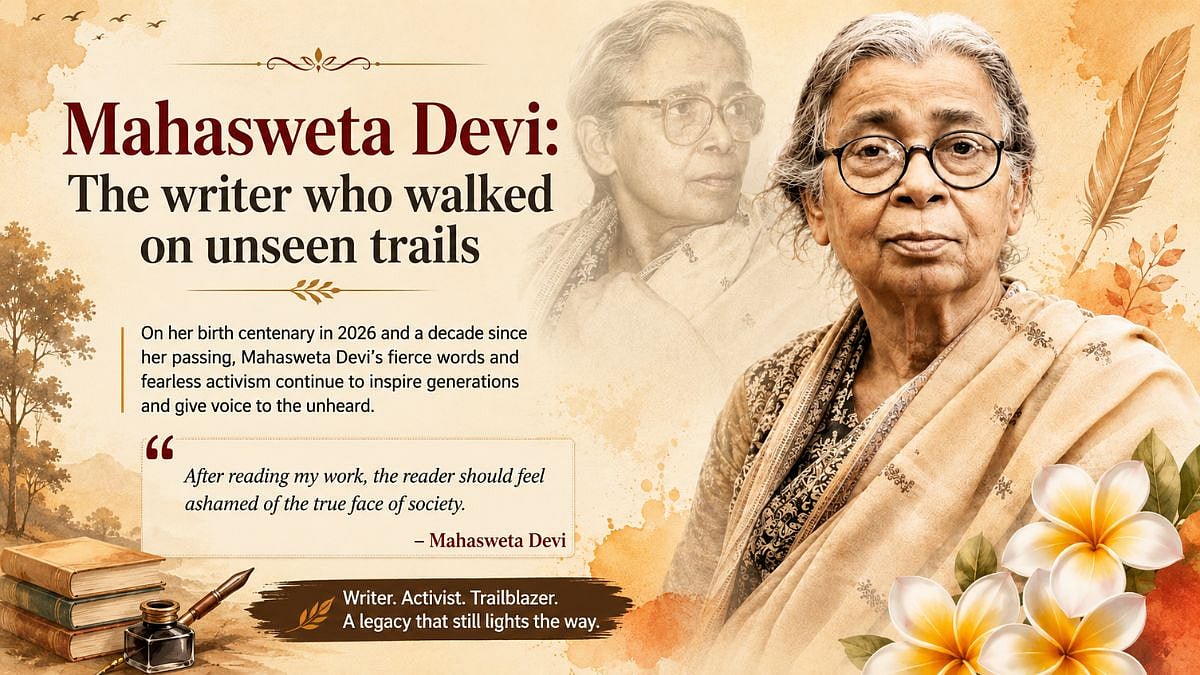
July 28 marked ten years since the passing of renowned writer and activist Mahasweta Devi. This year also happens to be her birth centenary, and fans of her work have been revisiting her powerful stories. Mahasweta Devi's writing was deeply connected to the lives of the underprivileged and oppressed, and her words continue to inspire and provoke readers.
For Mahasweta Devi, literature was not just a form of entertainment, but a tool for social change. Her stories often highlighted the struggles of marginalized communities, and her characters were frequently drawn from the real lives of people she had met and worked with. One of her most famous stories, 'Dopdi' (also known as 'Draupadi'), tells the tale of a Santhal tribal woman who is hunted by state forces and subjected to brutal violence.
The story of Dopdi is a powerful exploration of the themes of oppression, resistance, and shame. The protagonist, a poor tribal woman, is captured and gang-raped by the police, but instead of cowering in shame, she refuses to cover her brutalized body and walks out naked towards her tormentors. This act of defiance challenges the patriarchal concept of shame that is imposed on women, and the sexual violence used to subdue them.
Mahasweta Devi's work has also been adapted into films. In 1968, her story 'Layli Asmaner Ayna' was adapted into the film 'Sunghursh', directed by H.S. Rawail. The film starred Dilip Kumar, Vyjayanthimala, and Sanjeev Kumar, and was set in mid-19th-century Varanasi. Much later, in 1993, Kalpana Lajmi adapted her story 'Rudaali' into a film of the same name. The film tells the story of a lower-caste woman who is hired as a professional mourner at the funerals of upper-caste landowners, and explores the iniquities of feudalism and the caste system.
Mahasweta Devi's writing and activism continue to be relevant today, in a time of great political turmoil and apathy towards the rights of marginalized people. Her stories remain a powerful reminder of the importance of resistance and defiance in the face of oppression. As we remember Mahasweta Devi on her birth centenary, we are also reminded of the enduring power of her words to inspire and provoke us.
Mahasweta Devi's legacy is a testament to the impact that one person can have on the world. Through her writing and activism, she was able to bring attention to the struggles of marginalized communities and to challenge the social and economic systems that perpetuate inequality. Her work continues to inspire new generations of writers, activists, and readers, and her stories remain a powerful reminder of the importance of compassion, empathy, and resistance.
In a world where the rights of marginalized people are increasingly under threat, Mahasweta Devi's writing and activism are more relevant than ever. Her stories remind us of the importance of standing up against oppression and of fighting for justice and equality. As we celebrate her birth centenary, we are also reminded of the need to continue her work and to strive for a more just and equitable world.
Mahasweta Devi's writing is a powerful reminder of the importance of literature as a tool for social change. Her stories are not just entertaining tales, but also powerful explorations of the human condition. They challenge us to think critically about the world around us and to consider the impact of our actions on others. As we remember Mahasweta Devi, we are also reminded of the importance of using our words and actions to make a positive difference in the world.
In conclusion, Mahasweta Devi's legacy is a powerful reminder of the impact that one person can have on the world. Her writing and activism continue to inspire and provoke us, and her stories remain a powerful reminder of the importance of compassion, empathy, and resistance. As we celebrate her birth centenary, we are also reminded of the need to continue her work and to strive for a more just and equitable world.
Frequently asked questions
What is Mahasweta Devi's most famous story?
Mahasweta Devi's most famous story is probably 'Dopdi' (also known as 'Draupadi'), which tells the tale of a Santhal tribal woman who is hunted by state forces and subjected to brutal violence.
How has Mahasweta Devi's work been adapted into films?
Mahasweta Devi's work has been adapted into films, including 'Sunghursh' (1968) and 'Rudaali' (1993), which explore themes of oppression, resistance, and social justice.