India Seeks Global Education Partnerships With UK, Ireland, Canada, Japan
India discusses international academic collaboration with diplomats, academics and industry leaders. Global partnerships to boost higher education, research and innovation.
'%3E%3Crect%20width%3D'96'%20height%3D'96'%20fill%3D'%234A235A'%2F%3E%3Ccircle%20cx%3D'30'%20cy%3D'24'%20r%3D'44'%20fill%3D'%23fff'%20opacity%3D'.12'%2F%3E%3Ccircle%20cx%3D'60'%20cy%3D'74'%20r%3D'40'%20fill%3D'%23000'%20opacity%3D'.10'%2F%3E%3C%2Fg%3E%3Cg%20fill%3D'none'%20stroke%3D'%23fff'%20stroke-width%3D'3'%3E%3Ccircle%20cx%3D'48'%20cy%3D'48'%20r%3D'16'%2F%3E%3Cellipse%20cx%3D'48'%20cy%3D'48'%20rx%3D'6.5'%20ry%3D'16'%2F%3E%3Cline%20x1%3D'32'%20y1%3D'42'%20x2%3D'64'%20y2%3D'42'%2F%3E%3Cline%20x1%3D'32'%20y1%3D'54'%20x2%3D'64'%20y2%3D'54'%2F%3E%3C%2Fg%3E%3C%2Fsvg%3E)
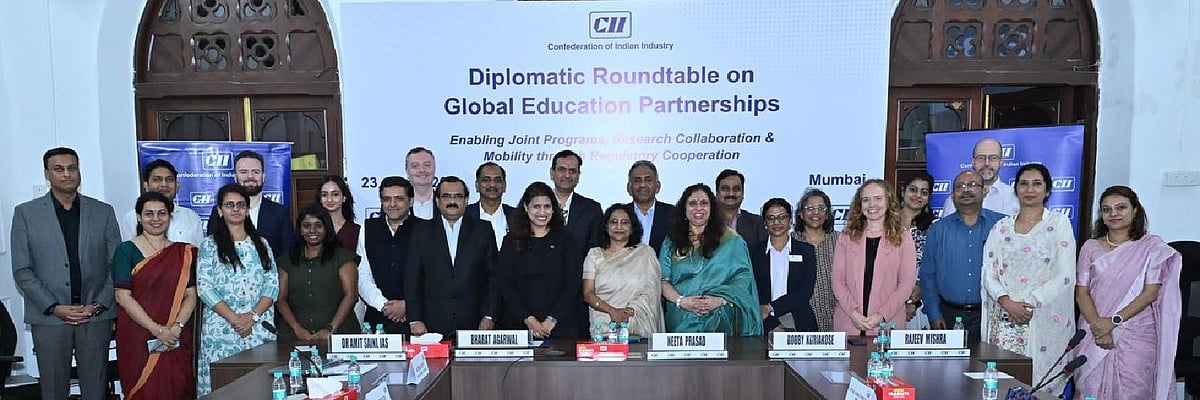
India has taken a significant step towards strengthening its global higher education partnerships with the participation of diplomats from the United Kingdom, Ireland, Canada, and Japan in the CII Regional Diplomatic Roundtable on Global Education Partnerships.
The roundtable, organised in collaboration with Ratan Tata Maharashtra State Skills University (RTMSSU), brought together senior government officials, academic leaders, and industry representatives to discuss ways to expand joint degree programmes, research partnerships, student and faculty mobility, and create an enabling regulatory framework for global collaboration.
Ms Neeta Prasad, Senior Advisor (Research) at the Press Information Bureau (PIB), Ministry of Information & Broadcasting, highlighted the importance of internationalisation in India's higher education reforms under the National Education Policy (NEP) 2020. She noted that the SPARC initiative has facilitated research collaborations with institutions across 28 countries and stressed the need to strengthen institutional capacity and international engagement.
Mr Bharat Agarwal, Chairman of the CII Western Region Subcommittee on Education and President of Vishwakarma University, emphasized the need for global partnerships to extend beyond student mobility to include faculty exchange, collaborative research, innovation, and industry linkages.
Representatives from Ireland, Canada, Japan, and the British Council shared international best practices in higher education collaboration, while industry leaders from L&T EduTech, Forbes Marshall, and Tech Mahindra Foundation highlighted the growing role of industry in curriculum design, skill development, and employability.
The discussions concluded with a consensus on the need for stronger regulatory support, enhanced research collaboration, reciprocal mobility, and deeper industry-academia partnerships to position India as a global hub for higher education and innovation.
The participation of diplomats from the UK, Ireland, Canada, and Japan in the roundtable underscores the growing interest of these countries in collaborating with India in the field of higher education. The roundtable also highlighted the importance of creating an enabling regulatory framework to facilitate global collaboration and the need for stronger institutional capacity to support internationalisation.
The National Education Policy (NEP) 2020 has made internationalisation a key pillar of India's higher education reforms, and the SPARC initiative has facilitated research collaborations with institutions across 28 countries. The roundtable discussions emphasized the need to build on these initiatives and create a more enabling environment for global collaboration.
In conclusion, the CII Regional Diplomatic Roundtable on Global Education Partnerships marked an important step towards strengthening India's global higher education partnerships. The participation of diplomats, academics, and industry leaders from around the world highlighted the growing interest in collaborating with India and the need for stronger regulatory support, enhanced research collaboration, and deeper industry-academia partnerships.
The outcome of the roundtable is expected to have significant implications for India's higher education sector, with a potential increase in joint degree programmes, research partnerships, and student and faculty mobility. The creation of an enabling regulatory framework and the strengthening of institutional capacity will be critical to supporting these initiatives and positioning India as a global hub for higher education and innovation.
Overall, the roundtable discussions emphasized the need for a collaborative approach to internationalisation, with a focus on creating mutually beneficial partnerships that support the development of India's higher education sector. The participation of diplomats, academics, and industry leaders from around the world underscored the growing interest in collaborating with India and the potential for India to become a major player in the global higher education landscape.
The roundtable also highlighted the importance of industry-academia partnerships in supporting the development of India's higher education sector. The participation of industry leaders from L&T EduTech, Forbes Marshall, and Tech Mahindra Foundation emphasized the growing role of industry in curriculum design, skill development, and employability.
In the coming years, India is expected to see a significant increase in global higher education partnerships, with a focus on creating mutually beneficial partnerships that support the development of India's higher education sector. The creation of an enabling regulatory framework, the strengthening of institutional capacity, and the development of deeper industry-academia partnerships will be critical to supporting these initiatives and positioning India as a global hub for higher education and innovation.
The implications of the roundtable discussions are far-reaching, with the potential to support the development of India's higher education sector and position India as a major player in the global higher education landscape. The participation of diplomats, academics, and industry leaders from around the world underscored the growing interest in collaborating with India and the potential for India to become a global hub for higher education and innovation.
In conclusion, the CII Regional Diplomatic Roundtable on Global Education Partnerships marked an important step towards strengthening India's global higher education partnerships. The roundtable discussions emphasized the need for a collaborative approach to internationalisation, with a focus on creating mutually beneficial partnerships that support the development of India's higher education sector.
The roundtable also highlighted the importance of creating an enabling regulatory framework to facilitate global collaboration and the need for stronger institutional capacity to support internationalisation. The participation of diplomats, academics, and industry leaders from around the world underscored the growing interest in collaborating with India and the potential for India to become a major player in the global higher education landscape.
The outcome of the roundtable is expected to have significant implications for India's higher education sector, with a potential increase in joint degree programmes, research partnerships, and student and faculty mobility. The creation of an enabling regulatory framework and the strengthening of institutional capacity will be critical to supporting these initiatives and positioning India as a global hub for higher education and innovation.
Overall, the roundtable discussions emphasized the need for a collaborative approach to internationalisation, with a focus on creating mutually beneficial partnerships that support the development of India's higher education sector. The participation of diplomats, academics, and industry leaders from around the world underscored the growing interest in collaborating with India and the potential for India to become a major player in the global higher education landscape.
What it means for Mumbai and India is that the country is taking significant steps towards strengthening its global higher education partnerships, which could lead to increased collaboration and innovation in the field of higher education. This could have a positive impact on the country's economy and society, as well as its reputation as a global hub for higher education and innovation.
Frequently asked questions
What is the National Education Policy 2020
The National Education Policy 2020 is a policy that makes internationalisation a key pillar of India's higher education reforms.
What is the SPARC initiative
The SPARC initiative is a programme that facilitates research collaborations with institutions across 28 countries.