Centre Introduces Bill For Stricter Birth, Death Registrations
New bill proposes judicial approval for delayed registrations, stricter rules
'%3E%3Crect%20width%3D'96'%20height%3D'96'%20fill%3D'%231A5276'%2F%3E%3Ccircle%20cx%3D'30'%20cy%3D'24'%20r%3D'44'%20fill%3D'%23fff'%20opacity%3D'.12'%2F%3E%3Ccircle%20cx%3D'60'%20cy%3D'74'%20r%3D'40'%20fill%3D'%23000'%20opacity%3D'.10'%2F%3E%3C%2Fg%3E%3Cg%20fill%3D'%23fff'%3E%3Cpath%20d%3D'M31%2041%20L48%2031%20L65%2041%20Z'%2F%3E%3Crect%20x%3D'33'%20y%3D'43'%20width%3D'4'%20height%3D'17'%2F%3E%3Crect%20x%3D'41'%20y%3D'43'%20width%3D'4'%20height%3D'17'%2F%3E%3Crect%20x%3D'51'%20y%3D'43'%20width%3D'4'%20height%3D'17'%2F%3E%3Crect%20x%3D'59'%20y%3D'43'%20width%3D'4'%20height%3D'17'%2F%3E%3Crect%20x%3D'30'%20y%3D'62'%20width%3D'36'%20height%3D'4'%20rx%3D'1'%2F%3E%3C%2Fg%3E%3C%2Fsvg%3E)
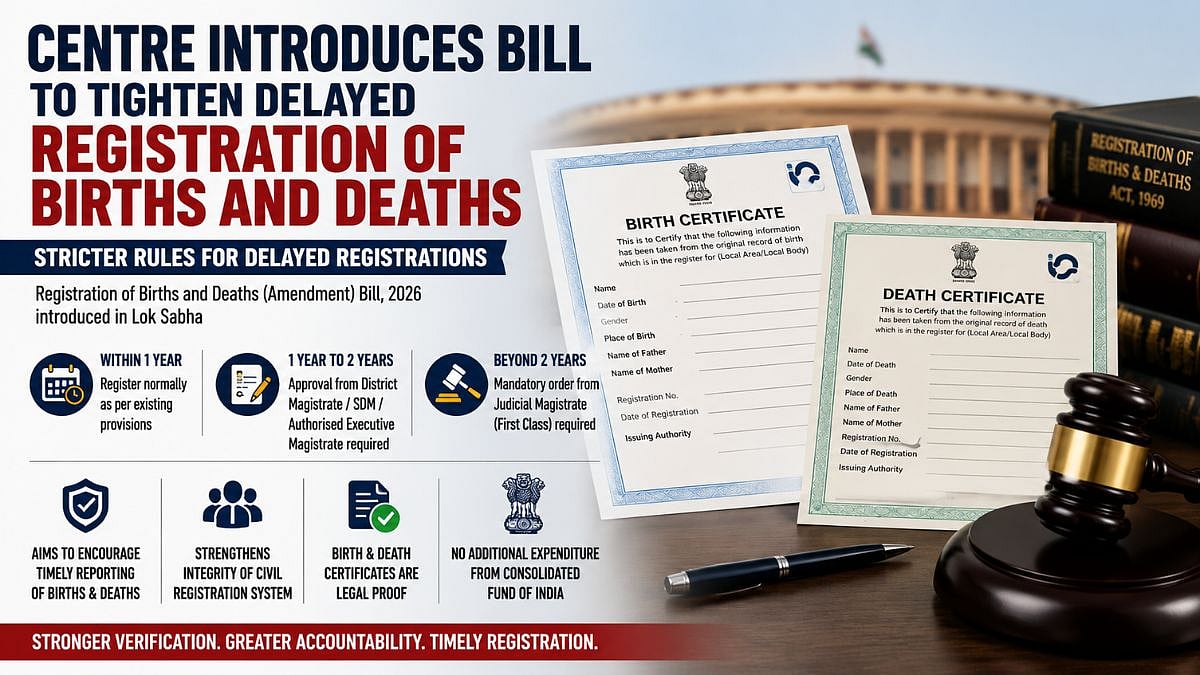
The Centre introduced the Registration of Births and Deaths (Amendment) Bill, 2026, in the Lok Sabha on Wednesday, aiming to make delayed birth and death registrations more stringent.
The Bill proposes to amend the Registration of Births and Deaths Act, 1969, to require an order from a Judicial Magistrate First Class for registering a birth or death reported more than two years after the event.
Minister of State for Home Nityanand Rai introduced the Bill amid protests from Opposition members. The proposed legislation seeks to encourage people to report births and deaths within the prescribed time and strengthen the integrity of the civil registration system.
Under the existing law, registrations delayed by more than one year require approval from a District Magistrate, Sub-Divisional Magistrate or an authorised Executive Magistrate. The proposed amendment retains this process for applications made after one year but within two years of the birth or death.
However, for cases reported after two years, the Bill proposes a higher level of scrutiny, requiring an order from a Judicial Magistrate First Class. This replaces the current administrative approval process for these cases.
The government maintains that the amendments are intended to encourage timely reporting of vital events and improve compliance while ensuring greater verification in cases where births or deaths are reported long after they occur.
The Registration of Births and Deaths Act, 1969, makes the registration of births and deaths mandatory across the country. Birth and death certificates issued under the law serve as legal proof of identity and are admissible as evidence for establishing a person's birth or death.
The Act was amended in 2023, with the revised provisions coming into force on October 1 that year. The new Bill also updates legal terminology by replacing references to the Code of Criminal Procedure, 1973, with the Bharatiya Nagarik Suraksha Sanhita, 2023, in relation to Executive Magistrates.
The introduction of the Bill is a significant step towards strengthening the civil registration system in India. The proposed amendments aim to improve the accuracy and reliability of birth and death records, which are essential for various purposes, including identity verification, social welfare schemes, and demographic analysis.
The Bill's emphasis on judicial approval for delayed registrations is expected to reduce the scope for errors and fraudulent activities. By making the registration process more stringent, the government hopes to encourage people to report births and deaths in a timely manner, which will help maintain the integrity of the civil registration system.
In conclusion, the Registration of Births and Deaths (Amendment) Bill, 2026, is a significant legislative proposal that aims to strengthen the civil registration system in India. The proposed amendments are expected to improve the accuracy and reliability of birth and death records, reduce errors and fraudulent activities, and encourage timely reporting of vital events.
The Bill's passage is likely to have a positive impact on the country's demographic analysis, social welfare schemes, and identity verification processes. It is essential for the government to ensure that the proposed amendments are implemented effectively, and the civil registration system is strengthened to maintain the trust of the citizens.
Frequently asked questions
What is the purpose of the Registration of Births and Deaths (Amendment) Bill, 2026?
The Bill aims to make delayed birth and death registrations more stringent and strengthen the integrity of the civil registration system.
What is the proposed change in the registration process for delayed registrations?
The Bill proposes to require an order from a Judicial Magistrate First Class for registering a birth or death reported more than two years after the event.