Beijing Hosts World Humanoid Robot Games
Humanoid robots compete in Olympic-style events, surpassing human records
'%3E%3Crect%20width%3D'96'%20height%3D'96'%20fill%3D'%231B5E20'%2F%3E%3Ccircle%20cx%3D'30'%20cy%3D'24'%20r%3D'44'%20fill%3D'%23fff'%20opacity%3D'.12'%2F%3E%3Ccircle%20cx%3D'60'%20cy%3D'74'%20r%3D'40'%20fill%3D'%23000'%20opacity%3D'.10'%2F%3E%3C%2Fg%3E%3Cg%3E%3Ccircle%20cx%3D'48'%20cy%3D'48'%20r%3D'15'%20fill%3D'%23fff'%2F%3E%3Cpath%20d%3D'M43%2034%20Q50%2048%2043%2062'%20fill%3D'none'%20stroke%3D'%238a94a6'%20stroke-width%3D'2.4'%2F%3E%3Cpath%20d%3D'M47%2033%20Q54%2048%2047%2063'%20fill%3D'none'%20stroke%3D'%238a94a6'%20stroke-width%3D'1.8'%20stroke-dasharray%3D'1.5%203'%2F%3E%3C%2Fg%3E%3C%2Fsvg%3E)
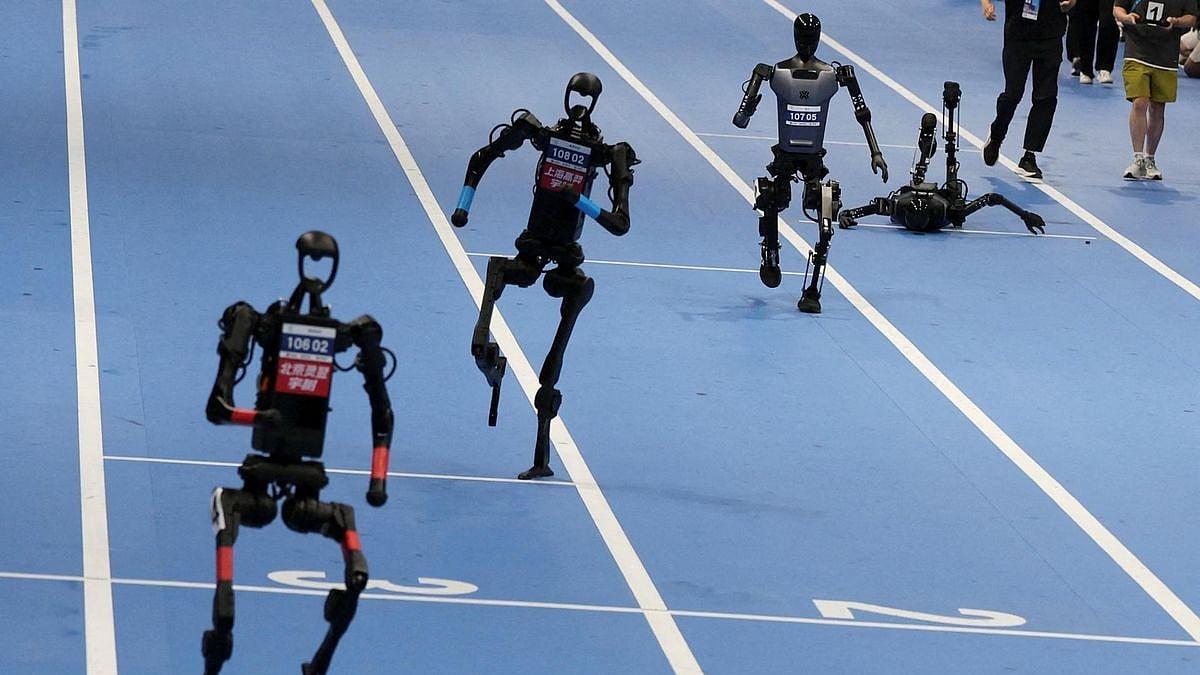
The second edition of the World Humanoid Robot Games (WHRG) is currently underway in Beijing, featuring humanoid robots competing in various events.
The Games, which run from August 22 to 26, have drawn robots from 16 countries across six continents, with 666 teams and 2,056 robots participating.
This represents a significant increase from the inaugural event, which saw 280 teams and roughly 500 robots.
The WHRG is described as the world's first comprehensive science and technology sports event with humanoid robots as the primary competitors.
The event is co-hosted by several organizations, including the People's Government of Beijing Municipality and the World Robot Cooperation Organisation.
Robots compete in two broad categories: traditional sporting events such as track and field, and real-world scenario tasks such as hotel services and emergency rescue simulations.
The format is designed to test not just physical athleticism but also practical, everyday capabilities that robots would need to function alongside humans.
The Games were conceived as a public stress test for humanoid robotics, aiming to showcase and pressure-test the technology outside of controlled lab environments.
China has positioned humanoid robotics as a strategic industry, with plans for mass deployment in manufacturing, healthcare, and elderly care by the end of the decade.
The first Games generated over 1.33 billion views on social media, with coverage from outlets in more than 80 countries.
This year's event has expanded sharply, with 51 events comprising 30 competitive sporting contests and 21 real-world scenario tasks.
One of the most notable achievements came in the sprint events, where a humanoid robot named Tien Kung Ultra won the large-group 400-metre final in 38.15 seconds, faster than the men's 400m world record.
The WHRG demonstrates the rapid advancement of humanoid robotics, with robots now capable of surpassing human records in certain events.
The event highlights the potential of humanoid robots to function alongside humans in various tasks, from manufacturing to healthcare.
As the technology continues to advance, it is likely that we will see more widespread adoption of humanoid robots in various industries.
Frequently asked questions
What is the World Humanoid Robot Games?
The World Humanoid Robot Games is an Olympic-style sporting competition for humanoid robots, featuring events such as track and field and real-world scenario tasks.
Which robot won the 400-metre final?
The humanoid robot Tien Kung Ultra won the large-group 400-metre final in 38.15 seconds, faster than the men's 400m world record.