Columbia River Gets 4 New Islands
New islands formed for salmon habitat, engineers use dredged sediment
'%3E%3Crect%20width%3D'96'%20height%3D'96'%20fill%3D'%231B5E20'%2F%3E%3Ccircle%20cx%3D'30'%20cy%3D'24'%20r%3D'44'%20fill%3D'%23fff'%20opacity%3D'.12'%2F%3E%3Ccircle%20cx%3D'60'%20cy%3D'74'%20r%3D'40'%20fill%3D'%23000'%20opacity%3D'.10'%2F%3E%3C%2Fg%3E%3Cg%3E%3Ccircle%20cx%3D'48'%20cy%3D'48'%20r%3D'15'%20fill%3D'%23fff'%2F%3E%3Cpath%20d%3D'M43%2034%20Q50%2048%2043%2062'%20fill%3D'none'%20stroke%3D'%238a94a6'%20stroke-width%3D'2.4'%2F%3E%3Cpath%20d%3D'M47%2033%20Q54%2048%2047%2063'%20fill%3D'none'%20stroke%3D'%238a94a6'%20stroke-width%3D'1.8'%20stroke-dasharray%3D'1.5%203'%2F%3E%3C%2Fg%3E%3C%2Fsvg%3E)
A groundbreaking environmental project has led to the formation of four new islands in the Columbia River, aiming to restore habitats for wildlife, particularly juvenile salmon. The islands were created by engineers who carefully placed dredged sediment along the river to construct the islands and adjacent channels.
The project's primary goal is to provide a safe and nurturing environment for juvenile salmon to grow and thrive. By creating these man-made islands, researchers hope to enhance the biodiversity of the area and support the local ecosystem.
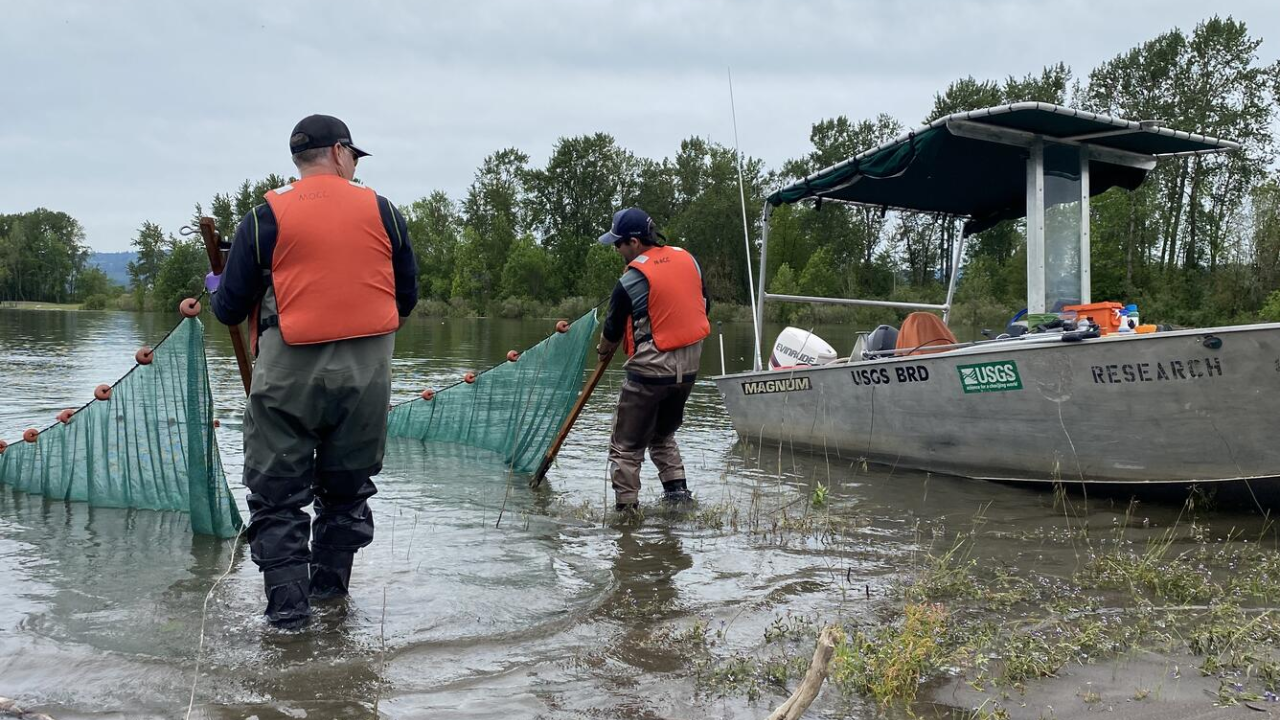
Researchers are closely monitoring the newly formed islands to assess their effectiveness in supporting wildlife. The project's success could have significant implications for future restoration ecology efforts, providing a model for similar initiatives in other regions.
The use of dredged sediment to create new islands is a pioneering technique that offers a sustainable solution for habitat restoration. By repurposing sediment that would otherwise be discarded, the project reduces waste and promotes environmental conservation.
The Columbia River, a vital waterway in the Pacific Northwest, supports a wide range of wildlife, including salmon, birds, and other aquatic species. The formation of these new islands is expected to enhance the river's ecosystem, providing a habitat for juvenile salmon to feed, grow, and migrate.
The project's outcome will be crucial in determining the effectiveness of this technique in restoration ecology. If successful, it could pave the way for similar initiatives in other regions, promoting environmental conservation and supporting biodiversity.
The creation of these new islands is a significant step towards restoring and preserving the natural habitats of the Columbia River. As researchers continue to monitor the project's progress, the potential for this technique to be applied in other areas is vast, offering a promising solution for environmental conservation.
In the coming years, the project's impact on the local ecosystem will be closely watched, and its success could have far-reaching implications for restoration ecology efforts worldwide.
The formation of these new islands in the Columbia River is a testament to the innovative approaches being taken to address environmental challenges. By embracing sustainable solutions and pioneering new techniques, researchers and engineers are working together to protect and preserve the natural world.
In conclusion, the creation of four new islands in the Columbia River is a significant environmental initiative that aims to restore habitats for wildlife, particularly juvenile salmon. The project's success could have a lasting impact on the local ecosystem and provide a model for future restoration ecology efforts.
Frequently asked questions
What is the purpose of the new islands in the Columbia River?
The new islands are aimed at restoring habitats for wildlife, particularly juvenile salmon.
How were the new islands formed?
The islands were created by engineers who carefully placed dredged sediment along the river to construct the islands and adjacent channels.