Nandan Nilekani: Small Businesses Can Protect Jobs From AI
Infosys Chairman Nandan Nilekani says small businesses can help India tackle AI job disruption. He spoke at the Global Fintech Fest in Mumbai.
'%3E%3Crect%20width%3D'96'%20height%3D'96'%20fill%3D'%23B3261E'%2F%3E%3Ccircle%20cx%3D'30'%20cy%3D'24'%20r%3D'44'%20fill%3D'%23fff'%20opacity%3D'.12'%2F%3E%3Ccircle%20cx%3D'60'%20cy%3D'74'%20r%3D'40'%20fill%3D'%23000'%20opacity%3D'.10'%2F%3E%3C%2Fg%3E%3Cg%20fill%3D'%23fff'%3E%3Crect%20x%3D'29'%20y%3D'49'%20width%3D'8'%20height%3D'19'%20rx%3D'1'%2F%3E%3Crect%20x%3D'39'%20y%3D'40'%20width%3D'9'%20height%3D'28'%20rx%3D'1'%2F%3E%3Crect%20x%3D'50'%20y%3D'45'%20width%3D'8'%20height%3D'23'%20rx%3D'1'%2F%3E%3Crect%20x%3D'60'%20y%3D'53'%20width%3D'7'%20height%3D'15'%20rx%3D'1'%2F%3E%3Crect%20x%3D'41'%20y%3D'34'%20width%3D'5'%20height%3D'6'%2F%3E%3C%2Fg%3E%3C%2Fsvg%3E)
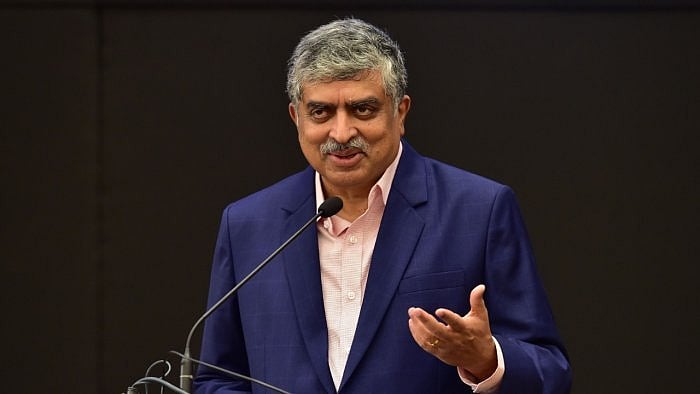
Nandan Nilekani, Chairman of Infosys, has stated that India can better mitigate the employment risks posed by artificial intelligence by promoting the growth of millions of small businesses. He made this statement while speaking at the Global Fintech Fest in Mumbai, emphasizing that large corporations may use AI to improve efficiency while reducing their workforce.
Nilekani argued that this makes it necessary to expand the base of businesses capable of generating employment. He expressed concern about the impact of AI on jobs, stating that large companies can apply AI effectively to reduce jobs. However, he noted that creating an economy that generates jobs is not necessarily done by having a few big companies, but rather by having millions of small companies.
According to Nilekani, spreading employment across smaller enterprises could make the economy more resilient as AI transforms conventional workforce requirements. He suggested that jobs created by smaller businesses could be safer and help AI-proof an economy. Nilekani also highlighted the importance of digital infrastructure in allowing small businesses to access sophisticated capabilities at relatively low cost.
He emphasized that technology should enable smaller firms to compete more effectively with larger companies. Nilekani stressed the need for inclusive digital infrastructure, stating that systems must be built to reach everybody, not just a few. He also backed public-chain infrastructure for creating global markets for tokenized assets and noted that ecosystem design would be critical for regulated assets and liquidity.
Nilekani's comments come at a time when India is experiencing significant growth in the fintech sector. The country is home to a large number of startups and small businesses, and the government has been actively promoting the development of digital infrastructure. By encouraging the growth of small businesses, India may be able to create a more resilient economy that is better equipped to withstand the challenges posed by AI.
The use of AI is becoming increasingly prevalent in India, with many large companies already leveraging the technology to improve efficiency. However, this has raised concerns about the impact on employment, particularly in sectors where jobs are likely to be automated. Nilekani's comments suggest that promoting the growth of small businesses could be a key strategy for mitigating this risk and creating a more sustainable economy.
In conclusion, Nandan Nilekani's statement highlights the importance of promoting small businesses in India to protect jobs from AI disruption. By creating a more inclusive and resilient economy, India can better equip itself to withstand the challenges posed by AI and create a more sustainable future for its workforce.
The Indian government has been actively promoting the development of digital infrastructure, including initiatives such as Digital India and Startup India. These initiatives aim to promote the growth of startups and small businesses, and to create a more favorable environment for entrepreneurship. By supporting these initiatives and promoting the growth of small businesses, India can create a more resilient economy that is better equipped to withstand the challenges posed by AI.
Overall, Nilekani's comments emphasize the need for a more nuanced approach to addressing the challenges posed by AI. Rather than relying solely on large corporations, India should promote the growth of small businesses and create a more inclusive and resilient economy. This approach can help to mitigate the risks posed by AI and create a more sustainable future for India's workforce.
In the context of India's economic development, the growth of small businesses is critical. Small businesses are often more agile and innovative than large corporations, and they can play a key role in creating jobs and driving economic growth. By promoting the growth of small businesses, India can create a more diverse and resilient economy that is better equipped to withstand the challenges posed by AI.
Nilekani's statement also highlights the importance of digital infrastructure in promoting the growth of small businesses. Digital infrastructure can provide small businesses with access to sophisticated capabilities at relatively low cost, enabling them to compete more effectively with larger companies. This can help to level the playing field and create a more inclusive economy.
In conclusion, Nandan Nilekani's statement emphasizes the importance of promoting small businesses in India to protect jobs from AI disruption. By creating a more inclusive and resilient economy, India can better equip itself to withstand the challenges posed by AI and create a more sustainable future for its workforce.
The significance of Nilekani's statement lies in its emphasis on the need for a more nuanced approach to addressing the challenges posed by AI. Rather than relying solely on large corporations, India should promote the growth of small businesses and create a more inclusive and resilient economy. This approach can help to mitigate the risks posed by AI and create a more sustainable future for India's workforce.
Frequently asked questions
What did Nandan Nilekani say about AI and jobs?
Nandan Nilekani said that India can better mitigate the employment risks posed by artificial intelligence by promoting the growth of millions of small businesses.
Why are small businesses important for India's economy?
Small businesses are important for India's economy because they can create jobs and drive economic growth, and can help to mitigate the risks posed by AI.