Couple Faces 11-Year Social Boycott Over Same-Gotra Marriage
A couple in Indore faces social boycott and penalty for marrying in same gotra. High Court seeks replies.
'%3E%3Crect%20width%3D'96'%20height%3D'96'%20fill%3D'%231A5276'%2F%3E%3Ccircle%20cx%3D'30'%20cy%3D'24'%20r%3D'44'%20fill%3D'%23fff'%20opacity%3D'.12'%2F%3E%3Ccircle%20cx%3D'60'%20cy%3D'74'%20r%3D'40'%20fill%3D'%23000'%20opacity%3D'.10'%2F%3E%3C%2Fg%3E%3Cg%20fill%3D'%23fff'%3E%3Cpath%20d%3D'M31%2041%20L48%2031%20L65%2041%20Z'%2F%3E%3Crect%20x%3D'33'%20y%3D'43'%20width%3D'4'%20height%3D'17'%2F%3E%3Crect%20x%3D'41'%20y%3D'43'%20width%3D'4'%20height%3D'17'%2F%3E%3Crect%20x%3D'51'%20y%3D'43'%20width%3D'4'%20height%3D'17'%2F%3E%3Crect%20x%3D'59'%20y%3D'43'%20width%3D'4'%20height%3D'17'%2F%3E%3Crect%20x%3D'30'%20y%3D'62'%20width%3D'36'%20height%3D'4'%20rx%3D'1'%2F%3E%3C%2Fg%3E%3C%2Fsvg%3E)
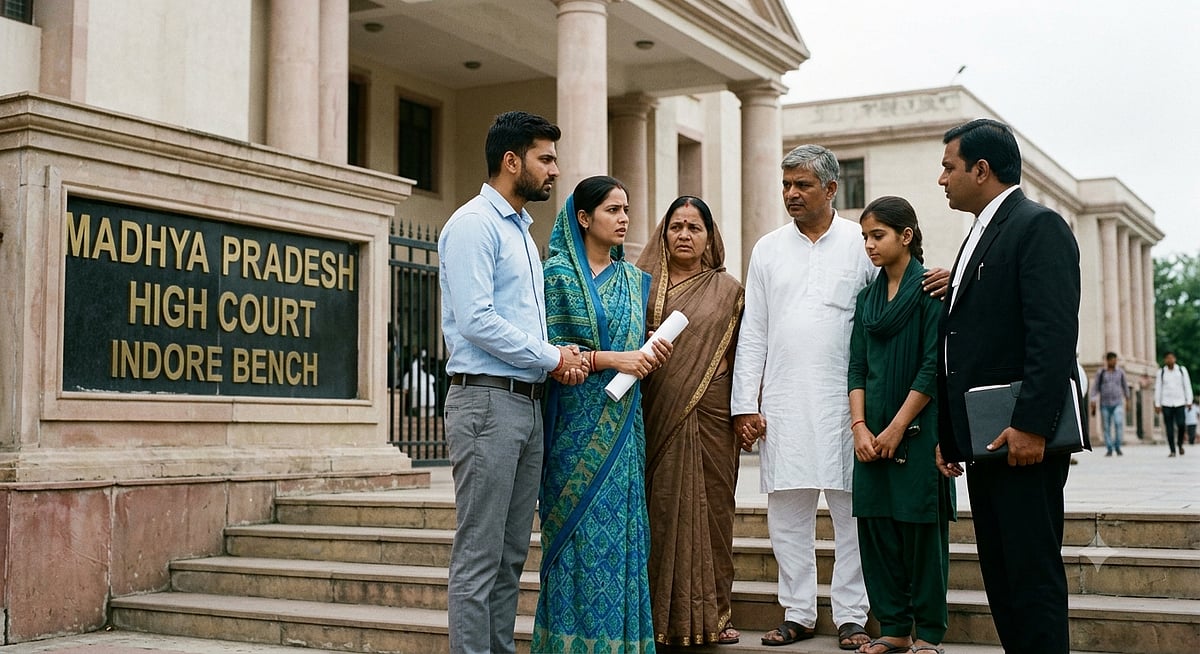
A couple in Indore, Madhya Pradesh, has approached the High Court, alleging that a community organisation imposed an 11-year social boycott and levied a penalty of ₹51,000 on their families. The penalty was imposed after they entered into a lawful marriage within the same gotra.
The couple and their family members claim that the Kshatriya Kushwah Samaj Sangathan, operating in Barwani, Dhar, and Khargone districts, passed resolutions enforcing the social boycott and monetary penalties. The organisation also threatened those who attended the marriage with social ostracism and disciplinary action.
A Division Bench of the Indore Bench of the Madhya Pradesh High Court, comprising Justice Subodh Abhyankar and Justice Alok Awasthi, has issued notices to the State Government, district authorities, police officials, and private respondents, directing them to file their replies. The Bench has also observed that the concerned police authorities must take immediate steps to ensure the protection of the petitioners and their family members if they face any threat or intimidation.
The appeal, filed through advocate Abhinav Dhanodkar, states that despite repeated representations to the police and district administration seeking protection and preventive action, no effective measures were taken. The appellants claim they continue to face intimidation, unlawful social pressure, and fear for their safety, forcing them to approach the High Court.
The petition raises important constitutional questions relating to the right of two consenting adults to marry a person of their choice, the legality of social boycott by community organisations, and the State's duty to safeguard fundamental rights under Articles 14, 19, and 21 of the Constitution. It also relies on Supreme Court judgments, including Shakti Vahini v. Union of India and Arumugam Servai v. State of Tamil Nadu, which strongly condemn interference by caste bodies and extra-constitutional community mechanisms in lawful marriages.
The issue of social boycott and penalties imposed by community organisations is not new in India. Many couples have faced similar challenges in the past, particularly in cases of inter-caste or same-gotra marriages. The Supreme Court has consistently held that the right to marry a person of one's choice is a fundamental right, and any interference by community organisations or individuals is unconstitutional.
The Madhya Pradesh High Court's decision to seek replies from the respondents is a significant step towards addressing the issue. The court's observation that the police authorities must take immediate steps to ensure the protection of the petitioners and their family members is also a welcome move.
The case highlights the need for greater awareness and education about the rights of individuals, particularly in rural areas where community organisations and caste bodies often wield significant influence. It also underscores the importance of the State's role in safeguarding fundamental rights and preventing unlawful social pressure and intimidation.
The matter will now be heard after the respondents file their replies. The outcome of the case is likely to have significant implications for the rights of individuals, particularly in cases of same-gotra or inter-caste marriages.
In conclusion, the case of the couple in Indore facing social boycott and penalty for marrying in the same gotra is a significant one, highlighting the challenges faced by individuals in exercising their fundamental rights. The Madhya Pradesh High Court's decision to intervene in the matter is a welcome move, and the outcome of the case is likely to have important implications for the rights of individuals in India.
The incident also raises questions about the effectiveness of the law enforcement agencies in preventing such incidents and protecting the rights of individuals. The fact that the couple had to approach the High Court despite repeated representations to the police and district administration highlights the need for greater accountability and sensitivity on the part of the authorities.
Overall, the case is a significant one, and its outcome is likely to have important implications for the rights of individuals in India. It highlights the need for greater awareness, education, and sensitivity about the rights of individuals, particularly in cases of same-gotra or inter-caste marriages.
The Madhya Pradesh High Court's decision to seek replies from the respondents is a significant step towards addressing the issue, and the outcome of the case is likely to be closely watched by human rights activists and organisations across the country.
In the end, the case is a reminder that the rights of individuals, particularly in cases of same-gotra or inter-caste marriages, need to be protected and safeguarded by the State and the law enforcement agencies. It is only through such efforts that we can create a more just and equitable society, where individuals are free to exercise their fundamental rights without fear of intimidation or social pressure.
The couple's bravery in approaching the High Court despite facing significant challenges is commendable, and their case is likely to inspire others to stand up for their rights. The outcome of the case is likely to be a significant milestone in the struggle for individual rights and freedoms in India.
As the case progresses, it is likely to generate significant interest and debate across the country. The fact that the High Court has decided to intervene in the matter is a significant development, and the outcome of the case is likely to have important implications for the rights of individuals in India.
In conclusion, the case of the couple in Indore facing social boycott and penalty for marrying in the same gotra is a significant one, highlighting the challenges faced by individuals in exercising their fundamental rights. The Madhya Pradesh High Court's decision to intervene in the matter is a welcome move, and the outcome of the case is likely to have important implications for the rights of individuals in India.
What it means for India is that the country still has a long way to go in protecting the rights of individuals, particularly in cases of same-gotra or inter-caste marriages. The fact that community organisations and caste bodies continue to wield significant influence in many parts of the country is a challenge that needs to be addressed. The case is a reminder that the State and the law enforcement agencies have a critical role to play in safeguarding fundamental rights and preventing unlawful social pressure and intimidation.