India Becomes Key Diesel Supplier To Europe
India supplies 60% of diesel to Europe, Russian exports decline
'%3E%3Crect%20width%3D'96'%20height%3D'96'%20fill%3D'%234A235A'%2F%3E%3Ccircle%20cx%3D'30'%20cy%3D'24'%20r%3D'44'%20fill%3D'%23fff'%20opacity%3D'.12'%2F%3E%3Ccircle%20cx%3D'60'%20cy%3D'74'%20r%3D'40'%20fill%3D'%23000'%20opacity%3D'.10'%2F%3E%3C%2Fg%3E%3Cg%20fill%3D'none'%20stroke%3D'%23fff'%20stroke-width%3D'3'%3E%3Ccircle%20cx%3D'48'%20cy%3D'48'%20r%3D'16'%2F%3E%3Cellipse%20cx%3D'48'%20cy%3D'48'%20rx%3D'6.5'%20ry%3D'16'%2F%3E%3Cline%20x1%3D'32'%20y1%3D'42'%20x2%3D'64'%20y2%3D'42'%2F%3E%3Cline%20x1%3D'32'%20y1%3D'54'%20x2%3D'64'%20y2%3D'54'%2F%3E%3C%2Fg%3E%3C%2Fsvg%3E)
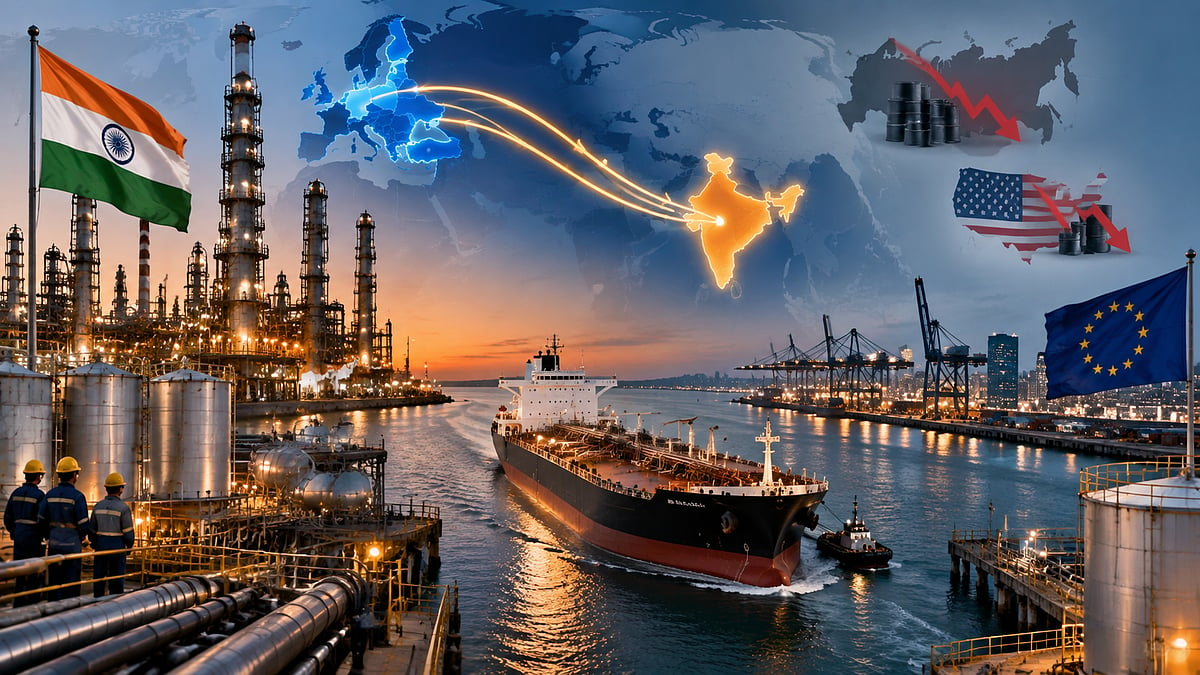
India has emerged as a crucial source of diesel for Europe, with its refineries supplying about 60% of the fuel transiting the Bab-el-Mandeb to the region in August. This development comes as Russian exports remain severely constrained and US shipments begin to weaken.
According to data from Vortexa, a real-time data and advanced analytics provider for energy and freight, about 200,000 barrels per day of diesel transited the Bab-el-Mandeb in August on vessels bound for Europe. This volume is close to year-earlier levels, after flows through the key shipping route nearly stalled in March and April.
India's refineries have become an increasingly important source of Europe's eastern diesel supply, with the country supplying roughly 60% of the volume. As the world's fourth-largest refiner, India has an installed capacity of 258.1 million tonnes per annum, which exceeds domestic fuel demand by a margin.
In the 2025-26 fiscal year, India exported 61.5 million tonnes of petroleum products, making it one of the largest exporters of refined products globally. These fuels are now finding a market in Europe and other regions. However, there are concerns about whether this flow can be maintained, given the decline in crude and condensate shipments into India.
Russian diesel exports, which were once a major source of European supply, have remained largely absent. Russia's seaborne diesel and gasoil exports averaged only about 150,000 barrels per day in the first 25 days of August, down about 610,000 barrels per day from a year earlier and 81% below the five-year seasonal average.
The decline in Russian exports is attributed to the ongoing conflict with Ukraine, which has disrupted Russian refining and export infrastructure. Ukrainian drone strikes have continued to disrupt Russian refineries, with 32 attacks recorded across July and August. An attack on the 260,000-barrel-per-day Perm refinery left only about 28% of its crude distillation capacity operational.
The impact of these disruptions extends to export terminals, with the Black Sea accounting for about 44% of Russia's diesel and gasoil exports last year. However, port and refinery disruptions have reduced available volumes, and no diesel cargoes have been exported from Tuapse since a May strike.
As a result, Russia is increasingly turning to imports to compensate for domestic refining disruptions. Its seaborne gasoline imports surged to a record roughly 125,000 barrels per day in August, equivalent to about 470,000 tonnes for the month.
The development of India as a key diesel supplier to Europe is significant, given the ongoing energy crisis in the region. As the global energy landscape continues to evolve, India's refineries are likely to play an increasingly important role in meeting the demand for diesel and other petroleum products.
In conclusion, India's emergence as a key diesel supplier to Europe is a significant development, driven by the decline in Russian exports and the growth of India's refining capacity. As the global energy market continues to shift, India's refineries are likely to play a crucial role in meeting the demand for diesel and other petroleum products.
The implications of this development are far-reaching, with potential impacts on the global energy market and the economies of Europe and India. As the situation continues to unfold, it will be important to monitor the developments in the global energy market and the role that India plays in meeting the demand for diesel and other petroleum products.
Overall, the growth of India's refining capacity and its emergence as a key diesel supplier to Europe is a significant development, with potential implications for the global energy market and the economies of Europe and India.
Frequently asked questions
What percentage of diesel does India supply to Europe?
India supplies about 60% of diesel to Europe.
Why have Russian diesel exports declined?
Russian diesel exports have declined due to the ongoing conflict with Ukraine, which has disrupted Russian refining and export infrastructure.