
Ekadashi Fast Open to Married Women
Married women can observe Ekadashi, spiritual leaders say. No scriptural ban exists.
'%3E%3Crect%20width%3D'96'%20height%3D'96'%20fill%3D'%236A1B9A'%2F%3E%3Ccircle%20cx%3D'30'%20cy%3D'24'%20r%3D'44'%20fill%3D'%23fff'%20opacity%3D'.12'%2F%3E%3Ccircle%20cx%3D'60'%20cy%3D'74'%20r%3D'40'%20fill%3D'%23000'%20opacity%3D'.10'%2F%3E%3C%2Fg%3E%3Cg%20fill%3D'%23fff'%3E%3Cpath%20d%3D'M56%2033%20a16%2016%200%201%200%201%2030%20a12.5%2012.5%200%201%201%20-1%20-30%20z'%2F%3E%3Cpath%20d%3D'M39%2040%20l1.1%202.4%202.6%20.2%20-2%201.8%20.6%202.6%20-2.3%20-1.3%20-2.3%201.3%20.6%20-2.6%20-2%20-1.8%202.6%20-.2%20z'%2F%3E%3C%2Fg%3E%3C%2Fsvg%3E)
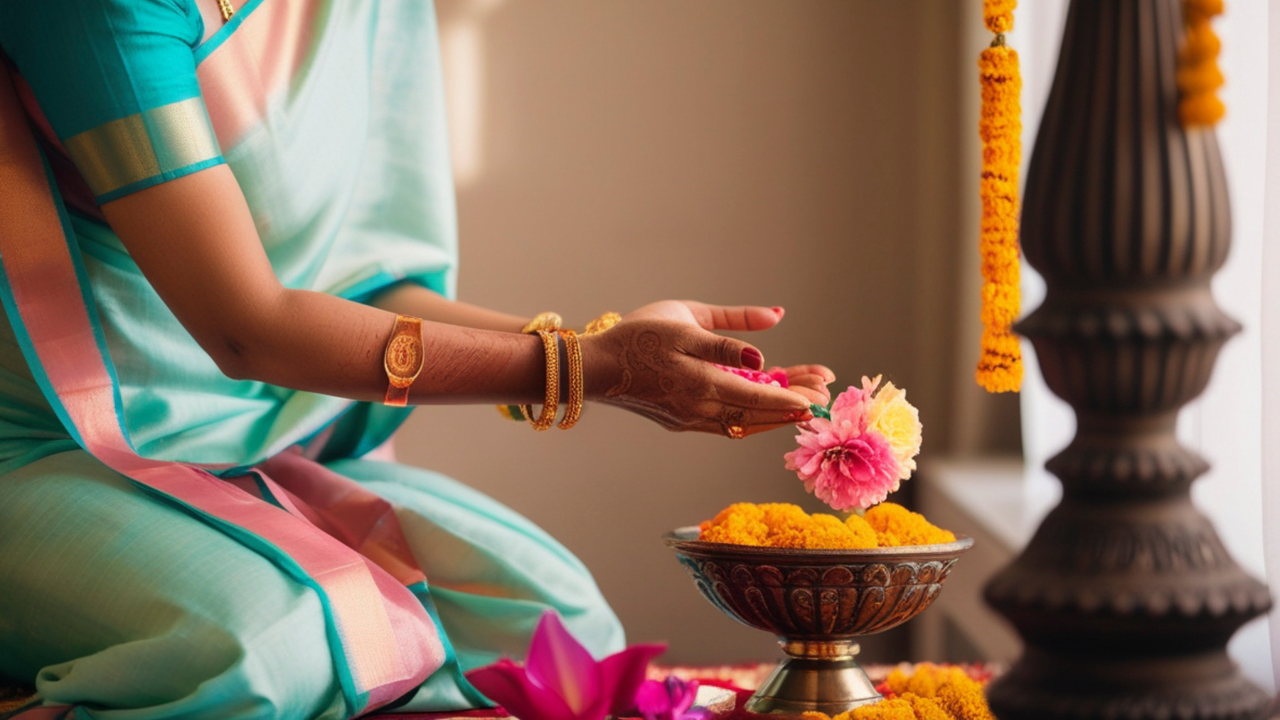
Married women in Hindu households often face questions about their decision to observe the Ekadashi fast, a significant ritual in Hinduism. However, spiritual leaders and scholars emphasize that there is no basis in Hindu scriptures for prohibiting married women from keeping this fast.
The stories of King Ambarisha and Rukmanga, found in ancient Hindu texts, highlight the importance of devotion and faith, showing that true spiritual commitment knows no boundaries of marital status. These narratives underscore the idea that the pursuit of spiritual growth and connection with the divine is accessible to all, regardless of their marital status.
Over time, societal customs and traditions can sometimes be misconstrued as religious commandments, leading to confusion and misinformation. In the context of Ekadashi, this has resulted in some believing that married women should avoid the fast. However, a closer examination of Hindu scriptures reveals no such prohibition.
Ekadashi, which falls on the eleventh day of each fortnight in the Hindu lunar calendar, is a day of spiritual significance, marked by fasting, reflection, and worship. The essence of Ekadashi is about deepening one's spiritual practice, cultivating self-discipline, and seeking a closer connection with the divine. It is a period for personal introspection, prayer, and renewal.
Spiritual leaders and scholars encourage individuals, including married women, to approach Ekadashi with an understanding of its true significance and the values it embodies, rather than being swayed by societal misconceptions. By doing so, they can reap the spiritual benefits of this sacred day, unencumbered by unnecessary restrictions.
In essence, the decision to observe Ekadashi should be guided by personal faith, spiritual aspirations, and a genuine desire for self-improvement, rather than by societal expectations or misconstrued traditions. As Hinduism is a religion that values the pursuit of knowledge, self-realization, and spiritual growth, it is essential to distinguish between scriptural teachings and societal norms.
Ultimately, the observance of Ekadashi is a personal choice that should be respected and supported, regardless of one's marital status. By embracing the true spirit of Ekadashi, individuals can foster a deeper sense of spirituality, community, and personal growth.
The significance of Ekadashi extends beyond the individual to the community, promoting a sense of unity and shared spiritual purpose. As such, it is crucial to approach this sacred day with an open heart and mind, unencumbered by misconceptions and societal pressures.
In conclusion, married women, like all individuals, are free to observe the Ekadashi fast as a means of deepening their spiritual practice and connection with the divine. The emphasis should be on the personal and spiritual significance of this day, rather than on societal norms or misconstrued traditions.
The pursuit of spiritual growth and self-realization is a fundamental aspect of Hinduism, and Ekadashi offers a powerful opportunity for individuals to embark on this journey. By understanding and respecting the true essence of Ekadashi, we can foster a more inclusive and spiritually vibrant community.
As we reflect on the significance of Ekadashi, it is essential to remember that spiritual growth and devotion are accessible to all, regardless of marital status or societal expectations. The stories of King Ambarisha and Rukmanga serve as powerful reminders of the importance of faith, devotion, and personal spiritual practice.
In the end, the observance of Ekadashi is a personal and spiritual choice that should be guided by one's faith, values, and aspirations. By embracing the true spirit of Ekadashi, we can cultivate a deeper sense of spirituality, community, and personal growth, and promote a more inclusive and compassionate understanding of Hindu traditions.
The message of Ekadashi is one of unity, spiritual growth, and personal transformation. As we observe this sacred day, we are reminded of the importance of faith, devotion, and self-discipline in our pursuit of spiritual knowledge and self-realization.
For married women, and indeed for all individuals, Ekadashi offers a powerful opportunity for spiritual growth, self-reflection, and connection with the divine. By approaching this day with an open heart and mind, and by understanding its true significance, we can reap the spiritual benefits of Ekadashi and foster a deeper sense of community and shared spiritual purpose.
In Hinduism, the pursuit of spiritual knowledge and self-realization is considered a fundamental aspect of human life. Ekadashi, as a sacred day of fasting, reflection, and worship, offers a unique opportunity for individuals to deepen their spiritual practice and connection with the divine.
As we explore the significance of Ekadashi, it is essential to distinguish between scriptural teachings and societal norms. By doing so, we can promote a more inclusive and spiritually vibrant community, where individuals are free to observe this sacred day without unnecessary restrictions or misconceptions.
The essence of Ekadashi is about spiritual growth, self-discipline, and devotion. It is a day for personal introspection, prayer, and renewal, and its observance should be guided by personal faith, spiritual aspirations, and a genuine desire for self-improvement.
In conclusion, the observance of Ekadashi is a personal and spiritual choice that should be respected and supported, regardless of one's marital status. By embracing the true spirit of Ekadashi, we can foster a deeper sense of spirituality, community, and personal growth, and promote a more inclusive and compassionate understanding of Hindu traditions.
What it means for Mumbai and India is that individuals, regardless of their marital status, can observe Ekadashi and deepen their spiritual practice, contributing to a more spiritually vibrant and inclusive community.
Frequently asked questions
Can married women keep Ekadashi fast?
Yes, married women can observe Ekadashi, as there is no scriptural prohibition.
What is the significance of Ekadashi?
Ekadashi is a day of spiritual significance, marked by fasting, reflection, and worship, and is about deepening one's spiritual practice and connection with the divine.