Ujjain Unearths 42 Ancient Skeletons
42 skeletons found in Ujjain, shell jewelry and urns discovered, awaiting analysis
'%3E%3Crect%20width%3D'96'%20height%3D'96'%20fill%3D'%23B3261E'%2F%3E%3Ccircle%20cx%3D'30'%20cy%3D'24'%20r%3D'44'%20fill%3D'%23fff'%20opacity%3D'.12'%2F%3E%3Ccircle%20cx%3D'60'%20cy%3D'74'%20r%3D'40'%20fill%3D'%23000'%20opacity%3D'.10'%2F%3E%3C%2Fg%3E%3Cg%20fill%3D'%23fff'%3E%3Crect%20x%3D'29'%20y%3D'49'%20width%3D'8'%20height%3D'19'%20rx%3D'1'%2F%3E%3Crect%20x%3D'39'%20y%3D'40'%20width%3D'9'%20height%3D'28'%20rx%3D'1'%2F%3E%3Crect%20x%3D'50'%20y%3D'45'%20width%3D'8'%20height%3D'23'%20rx%3D'1'%2F%3E%3Crect%20x%3D'60'%20y%3D'53'%20width%3D'7'%20height%3D'15'%20rx%3D'1'%2F%3E%3Crect%20x%3D'41'%20y%3D'34'%20width%3D'5'%20height%3D'6'%2F%3E%3C%2Fg%3E%3C%2Fsvg%3E)
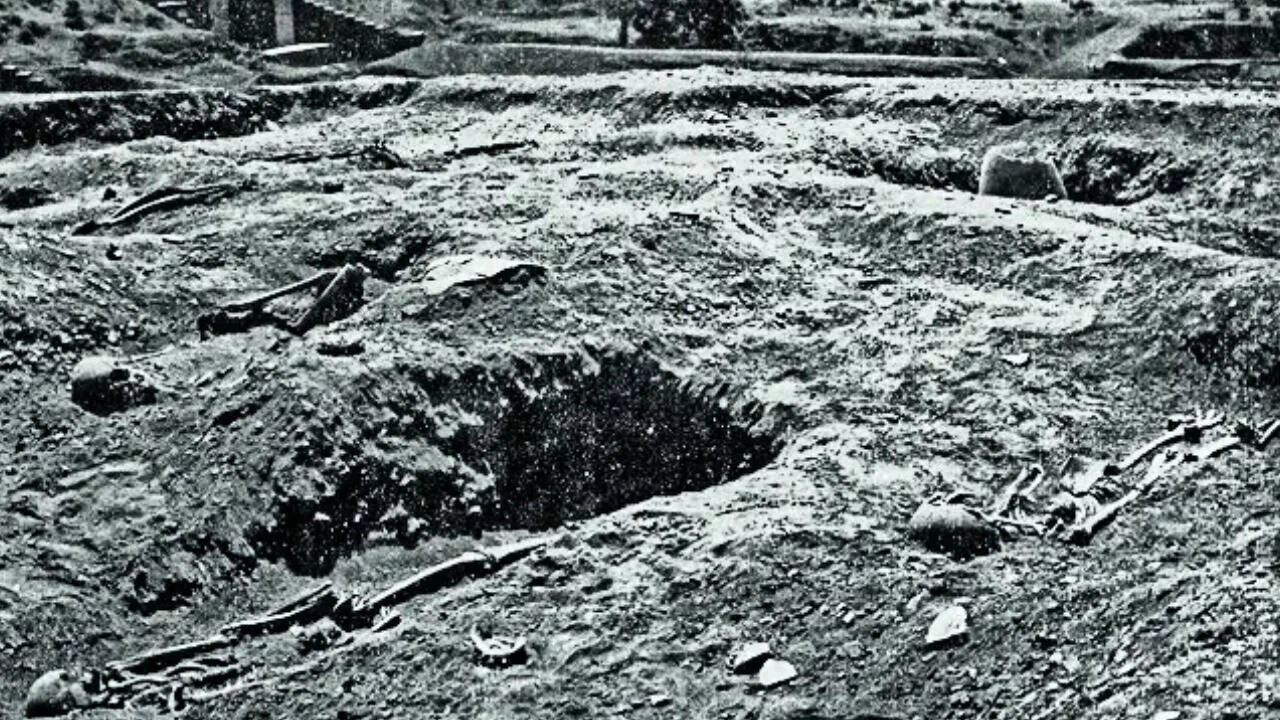
In a significant archaeological discovery, 42 skeletons have been unearthed at Kumhar Tekri in Ujjain, a city in the Indian state of Madhya Pradesh. The remains, which were found nearly nine decades ago, are estimated to date back to around the 3rd century BC.
The skeletons were discovered along with shell jewelry and urns, which has sparked the interest of archaeologists and historians. The site where the skeletons were found is being compared to the ancient city of Pompeii, which was frozen in time by the devastating volcanic eruption of Mount Vesuvius.
Archaeologists are now seeking permission to excavate a nearby site, which features a large stupa, a Buddhist monument, in the hopes of gaining more context about the ancient community that once inhabited the area. By studying the stupa and the surrounding area, researchers hope to uncover more information about the people who lived in Ujjain over 2,000 years ago.
The use of modern scientific methods, such as DNA analysis and radiocarbon dating, could provide valuable insights into the identity of the ancient community. These techniques could help researchers determine the origins, diet, and lifestyle of the people who lived in Ujjain during that time period.
The discovery of the 42 skeletons is a significant find, not only because of the number of remains but also due to the excellent condition in which they were found. The skeletons are twisted and contorted, suggesting that the individuals may have died suddenly, possibly due to a natural disaster or an attack.
The excavation of the nearby site with the stupa is expected to provide more clues about the ancient community. The stupa, which is a large monument, is believed to have been built during the same time period as the skeletons. By studying the stupa and the surrounding area, researchers hope to gain a better understanding of the culture, religion, and way of life of the people who lived in Ujjain over 2,000 years ago.
The discovery of the 42 skeletons in Ujjain is an important archaeological find, one that could shed new light on the history of the region. As researchers continue to study the remains and the surrounding area, they hope to uncover more secrets about the ancient community that once thrived in Ujjain.
The significance of this discovery lies in its potential to provide new insights into the history of India, particularly during the 3rd century BC. The use of modern scientific methods, combined with traditional archaeological techniques, could help researchers reconstruct the lives of the people who lived in Ujjain over 2,000 years ago.
In conclusion, the discovery of the 42 skeletons in Ujjain is an exciting archaeological find, one that has the potential to shed new light on the history of the region. As researchers continue to study the remains and the surrounding area, they hope to uncover more secrets about the ancient community that once thrived in Ujjain.
Frequently asked questions
Where were the 42 skeletons found?
The 42 skeletons were found at Kumhar Tekri in Ujjain, Madhya Pradesh.
What is the estimated age of the skeletons?
The skeletons are estimated to date back to around the 3rd century BC.