Maharashtra Bans Analogue Paneer For One Year
Maharashtra government bans analogue paneer due to quality issues. 35.4% of samples failed FDA tests.
'%3E%3Crect%20width%3D'96'%20height%3D'96'%20fill%3D'%23B3261E'%2F%3E%3Ccircle%20cx%3D'30'%20cy%3D'24'%20r%3D'44'%20fill%3D'%23fff'%20opacity%3D'.12'%2F%3E%3Ccircle%20cx%3D'60'%20cy%3D'74'%20r%3D'40'%20fill%3D'%23000'%20opacity%3D'.10'%2F%3E%3C%2Fg%3E%3Cg%20fill%3D'%23fff'%3E%3Crect%20x%3D'29'%20y%3D'49'%20width%3D'8'%20height%3D'19'%20rx%3D'1'%2F%3E%3Crect%20x%3D'39'%20y%3D'40'%20width%3D'9'%20height%3D'28'%20rx%3D'1'%2F%3E%3Crect%20x%3D'50'%20y%3D'45'%20width%3D'8'%20height%3D'23'%20rx%3D'1'%2F%3E%3Crect%20x%3D'60'%20y%3D'53'%20width%3D'7'%20height%3D'15'%20rx%3D'1'%2F%3E%3Crect%20x%3D'41'%20y%3D'34'%20width%3D'5'%20height%3D'6'%2F%3E%3C%2Fg%3E%3C%2Fsvg%3E)
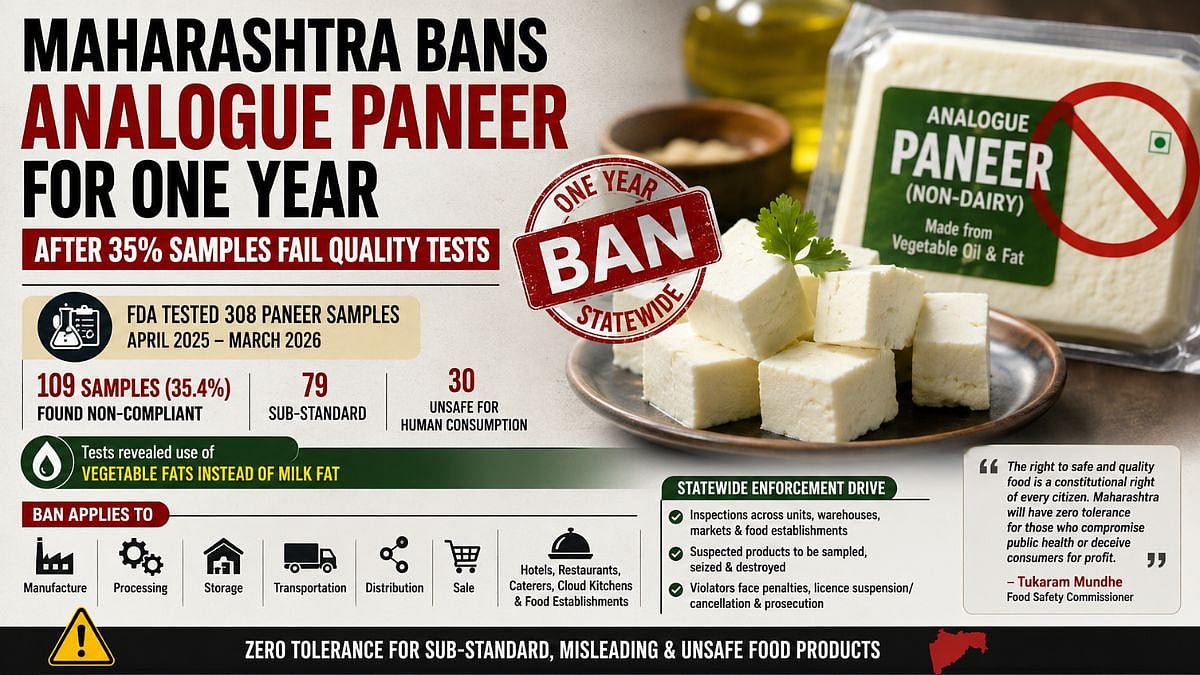
The Maharashtra government has imposed a one-year ban on the manufacture, processing, storage, transportation, distribution, and sale of analogue paneer across the state. This decision comes after laboratory tests found that more than one-third of samples failed to meet prescribed quality standards.
The ban was imposed after an analysis of 308 paneer samples collected across Maharashtra between April 2025 and March 2026. The Food and Drug Administration (FDA) found 109 samples (35.4 per cent) to be non-compliant, including 79 sub-standard and 30 unsafe for human consumption. Laboratory analysis revealed that several samples contained vegetable fats in place of natural milk fat.
According to Food Safety Commissioner Tukaram Mundhe, the order has been issued under Section 30(2)(a) of the Food Safety and Standards Act, 2006, based on laboratory findings and representations received from public representatives, in the interest of public health. FDA officials said some manufacturers were producing paneer-like products using vegetable oils, vegetable fats, and other non-dairy ingredients and marketing them as paneer, thereby misleading consumers.
The ban also applies to hotels, restaurants, caterers, cloud kitchens, and other food service establishments, which have been prohibited from using, storing, or serving analogue paneer. Inspections revealed that many establishments were serving analogue paneer without informing customers, amounting to consumer deception and a violation of food safety laws.
The FDA has launched a statewide enforcement drive, with Food Safety Officers, Assistant Commissioners, and other enforcement officials directed to inspect manufacturing units, warehouses, transport networks, wholesale markets, retail outlets, and food service establishments. Suspected products will be sampled, seized, and destroyed wherever necessary, while violators will face penalties, suspension or cancellation of licences, and prosecution under the Food Safety and Standards Act.
The Maharashtra government has emphasized its commitment to ensuring public health and safety. As stated by Mundhe, the right to safe and quality food is a constitutional right of every citizen, and the state will have zero tolerance for those who compromise public health or deceive consumers for profit.
The ban on analogue paneer is a significant step towards regulating the food industry and protecting consumers from sub-standard and misleading products. With the enforcement drive in place, the state aims to ensure that all food products, including paneer, meet the required quality standards.
In the context of food safety, the ban on analogue paneer highlights the importance of effective regulation and enforcement. The lack of statutory quality standards for analogue paneer had made it difficult for authorities to regulate the product, but the state government has taken a proactive approach to address the issue.
The implications of the ban are far-reaching, with consumers set to benefit from safer and more regulated food products. The move is also expected to promote fair business practices and prevent consumer deception. As the state government continues to prioritize public health and safety, the ban on analogue paneer serves as a significant milestone in the efforts to ensure that all citizens have access to safe and quality food.
In conclusion, the ban on analogue paneer in Maharashtra is a crucial step towards protecting public health and promoting fair business practices. With the statewide enforcement drive in place, the state government aims to ensure that all food products meet the required quality standards, and consumers can enjoy safe and healthy food options.
Frequently asked questions
Why has Maharashtra banned analogue paneer?
The ban was imposed due to quality issues, with 35.4% of samples failing FDA tests.
What is the duration of the ban on analogue paneer?
The ban is in place for one year.