MP Transco Installs Bird-Safe Devices on Power Lines
MP Transco protects birds and grid reliability with new devices. Bird collisions reduced.
'%3E%3Crect%20width%3D'96'%20height%3D'96'%20fill%3D'%23B3261E'%2F%3E%3Ccircle%20cx%3D'30'%20cy%3D'24'%20r%3D'44'%20fill%3D'%23fff'%20opacity%3D'.12'%2F%3E%3Ccircle%20cx%3D'60'%20cy%3D'74'%20r%3D'40'%20fill%3D'%23000'%20opacity%3D'.10'%2F%3E%3C%2Fg%3E%3Cg%20fill%3D'%23fff'%3E%3Crect%20x%3D'29'%20y%3D'49'%20width%3D'8'%20height%3D'19'%20rx%3D'1'%2F%3E%3Crect%20x%3D'39'%20y%3D'40'%20width%3D'9'%20height%3D'28'%20rx%3D'1'%2F%3E%3Crect%20x%3D'50'%20y%3D'45'%20width%3D'8'%20height%3D'23'%20rx%3D'1'%2F%3E%3Crect%20x%3D'60'%20y%3D'53'%20width%3D'7'%20height%3D'15'%20rx%3D'1'%2F%3E%3Crect%20x%3D'41'%20y%3D'34'%20width%3D'5'%20height%3D'6'%2F%3E%3C%2Fg%3E%3C%2Fsvg%3E)
Madhya Pradesh Power Transmission Company (MP Transco) has initiated a project to install bird flight diverters, bird guards, and bird preventers on high-voltage transmission lines and towers in the Malwa region. The move aims to protect birds from collisions with power infrastructure while preventing bird-related faults and breakdowns that can affect grid reliability.
The devices are being installed on 132 kV, 220 kV, and 400 kV transmission lines passing through ecologically sensitive areas, including Yashwant Sagar, Sirpur Lake, the Narmada Valley, and Gandhi Sagar Reservoir. These areas attract large populations of resident and migratory birds, particularly during seasonal migration.
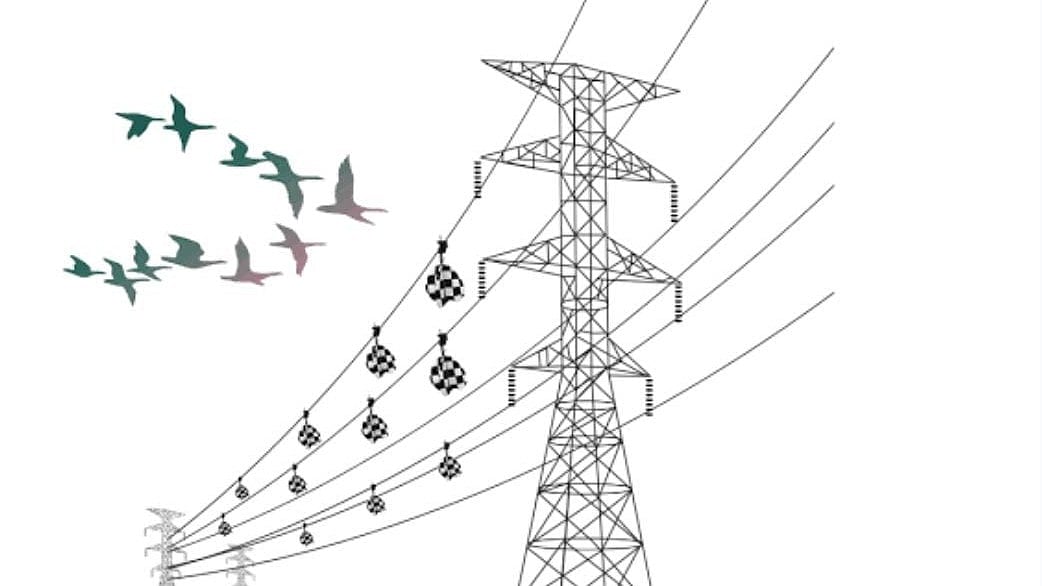
Bird flight diverters are high-visibility devices fitted on earth or shield wires of transmission lines, making them more visible to birds and helping them avoid collisions. Bird guards and bird preventers are being installed at strategic locations on towers, insulator strings, and other critical components to discourage birds from perching on electrical infrastructure.
The need for bird protection is particularly important in wetland and reservoir areas, where bird activity is significantly higher. Yashwant Sagar and Sirpur Lake are among the important bird habitats around Indore, attracting thousands of waterfowl and migratory birds during different seasons.
Bird activity can pose a technical challenge to transmission infrastructure, as bird droppings accumulating on insulators can create conductive paths that may result in flashovers, leakage currents, earth faults, and line trippings. By reducing bird perching on critical structures and limiting contamination of insulation surfaces, bird guards and preventers can help lower such risks and improve the operational reliability of transmission lines.
Preliminary assessments by MP Transco indicate that transmission lines and towers equipped with these protective devices are witnessing a reduction in bird-related disturbances and breakdowns. The initiative is consequently helping improve transmission-line availability, grid reliability, and the stability of power supply across the region.
MP Transco plans to expand the installation of bird flight diverters, bird guards, and bird preventers across more transmission corridors located in bird-sensitive areas. The initiative serves as a model for sustainable transmission infrastructure, combining biodiversity conservation with grid reliability.
The project's success has significant implications for the region's power supply and ecosystem. By protecting birds and preventing bird-related faults, MP Transco is ensuring a reliable and stable power supply to the region. The initiative also highlights the importance of considering environmental factors in infrastructure development.
In conclusion, MP Transco's efforts to make power lines bird-safe are a step in the right direction. The project's success demonstrates the possibility of combining biodiversity conservation with grid reliability, setting an example for other regions to follow.
The initiative is expected to have a positive impact on the region's ecosystem and power supply. With the installation of bird flight diverters, bird guards, and bird preventers, MP Transco is ensuring a safer and more reliable power supply to the region, while also protecting the local bird population.
Overall, the project is a significant step towards sustainable transmission infrastructure, and its success is expected to have far-reaching implications for the region's ecosystem and power supply.
Frequently asked questions
What is the purpose of bird flight diverters?
Bird flight diverters are high-visibility devices that make power lines more visible to birds, helping them avoid collisions.
How do bird guards and preventers work?
Bird guards and preventers discourage birds from perching on electrical infrastructure, reducing the possibility of bird-related disturbances and improving grid reliability.