Bombay HC Rejects Plea For More Time To Phase Out PoP Idols
Bombay HC questions Maharashtra government, PoP idol manufacturers over request for more time. Court says one-year extension already granted.
'%3E%3Crect%20width%3D'96'%20height%3D'96'%20fill%3D'%23B3261E'%2F%3E%3Ccircle%20cx%3D'30'%20cy%3D'24'%20r%3D'44'%20fill%3D'%23fff'%20opacity%3D'.12'%2F%3E%3Ccircle%20cx%3D'60'%20cy%3D'74'%20r%3D'40'%20fill%3D'%23000'%20opacity%3D'.10'%2F%3E%3C%2Fg%3E%3Cg%20fill%3D'%23fff'%3E%3Crect%20x%3D'29'%20y%3D'49'%20width%3D'8'%20height%3D'19'%20rx%3D'1'%2F%3E%3Crect%20x%3D'39'%20y%3D'40'%20width%3D'9'%20height%3D'28'%20rx%3D'1'%2F%3E%3Crect%20x%3D'50'%20y%3D'45'%20width%3D'8'%20height%3D'23'%20rx%3D'1'%2F%3E%3Crect%20x%3D'60'%20y%3D'53'%20width%3D'7'%20height%3D'15'%20rx%3D'1'%2F%3E%3Crect%20x%3D'41'%20y%3D'34'%20width%3D'5'%20height%3D'6'%2F%3E%3C%2Fg%3E%3C%2Fsvg%3E)
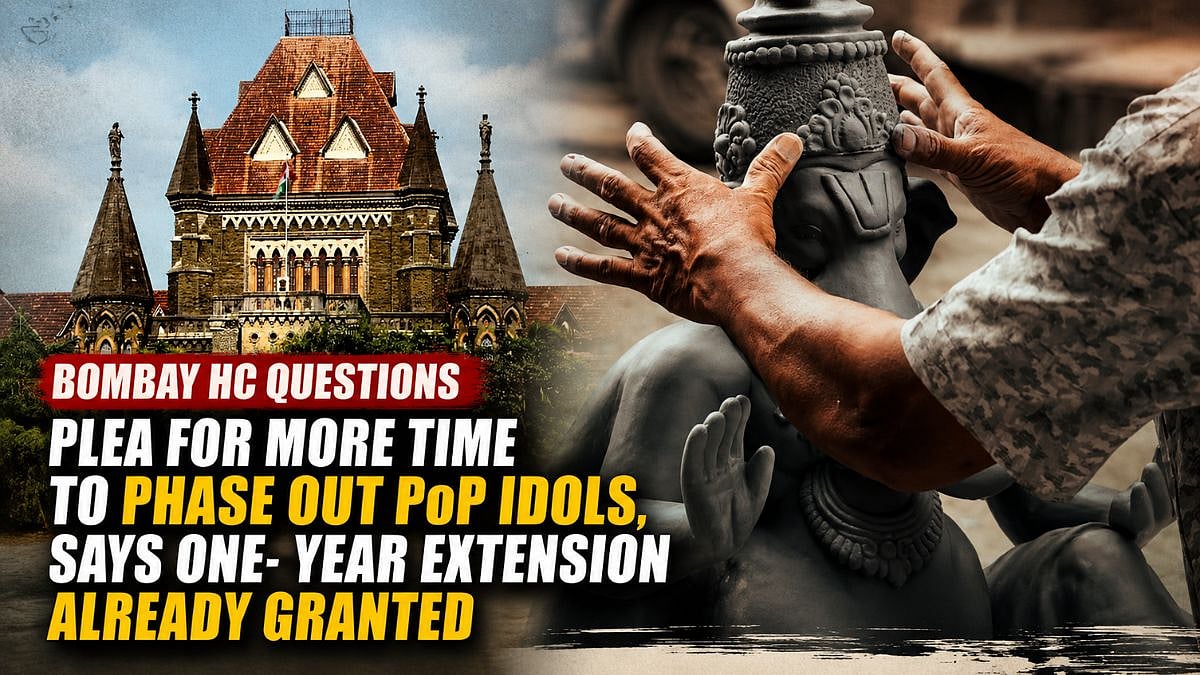
The Bombay High Court on Thursday questioned the Maharashtra government and Plaster of Paris (PoP) idol manufacturers over their request for more time to transition to clay idols. The court observed that they had already been granted a one-year extension last year to phase out PoP idols.
A Division Bench of Justices Ajey Gadkari and Kamal Khata said all stakeholders were aware of the Central Pollution Control Board's (CPCB) 2020 guidelines and the court's 2025 directions and should have acted within the time granted. The Bench remarked that the stakeholders should have stopped using PoP idols by now, as they were given a one-year notice.
The court was hearing a batch of petitions by environmentalist Rohit Joshi seeking strict implementation of the CPCB guidelines prohibiting immersion of PoP idols in natural water bodies. The state government filed an affidavit stating that the number of idols taller than six feet had reduced.
Advocate General Milind Sathe submitted that under the existing policy, only idols above six feet are permitted to be immersed in natural water bodies, while smaller idols must be immersed in artificial ponds. The state sought permission to continue allowing immersion of idols above six feet in natural water bodies, saying it was conducting a pilot project to collect PoP after immersion, process it and recycle the material.
However, the PoP idol manufacturers sought more time for a gradual transition, arguing that there was no practical alternative for immersing idols above six feet. They sought one to two more years for the transition, saying that a mindset shift was required.
The Bench, however, stressed that public attitudes towards environmental protection must change. The court observed that when people go abroad, they see clean water, and the same mindset needs to change in India.
Advocate Mihir Desai, appearing for Joshi, argued that despite judicial directions since 2013, implementation remained inadequate. He said that clay idols, including those of Lalbaugcha Raja, were used for decades before PoP became popular because it was cheaper.
The state government said it had directed all local authorities to strictly implement the revised immersion guidelines and standard operating procedure. It had also constituted an expert committee on PoP recycling and launched pilot recycling projects at six locations.
The court's decision comes as a significant step towards protecting the environment and natural water bodies from pollution caused by PoP idols. The use of PoP idols has been a major concern for environmentalists, as they do not dissolve in water and cause harm to aquatic life.
The Maharashtra government and PoP idol manufacturers will now have to comply with the court's directions and phase out PoP idols within the given timeframe. The court's decision is expected to have a positive impact on the environment and promote the use of eco-friendly clay idols.
In recent years, there has been a growing awareness about the need to protect the environment and promote sustainable practices. The court's decision is a significant step in this direction and is expected to inspire other states to take similar measures.
The Bombay High Court's decision is a reminder that the protection of the environment is a collective responsibility and requires the cooperation of all stakeholders. The court's directions are expected to have a positive impact on the environment and promote a culture of sustainability in the state.
In conclusion, the Bombay High Court's decision to reject the plea for more time to phase out PoP idols is a significant step towards protecting the environment and promoting sustainable practices. The decision is expected to have a positive impact on the environment and inspire other states to take similar measures.