Sensex, Nifty Trade Flat Amid West Asia Uncertainty
Indian equity markets start positive, slip due to West Asia tensions. Sensex, Nifty trade lower.
'%3E%3Crect%20width%3D'96'%20height%3D'96'%20fill%3D'%230B6E4F'%2F%3E%3Ccircle%20cx%3D'30'%20cy%3D'24'%20r%3D'44'%20fill%3D'%23fff'%20opacity%3D'.12'%2F%3E%3Ccircle%20cx%3D'60'%20cy%3D'74'%20r%3D'40'%20fill%3D'%23000'%20opacity%3D'.10'%2F%3E%3C%2Fg%3E%3Cg%20fill%3D'none'%20stroke%3D'%23fff'%20stroke-width%3D'3.2'%20stroke-linecap%3D'round'%20stroke-linejoin%3D'round'%3E%3Cpolyline%20points%3D'31%2C59%2041%2C49%2049%2C54%2063%2C37'%2F%3E%3Cpolyline%20points%3D'55%2C37%2063%2C37%2063%2C45'%2F%3E%3C%2Fg%3E%3C%2Fsvg%3E)
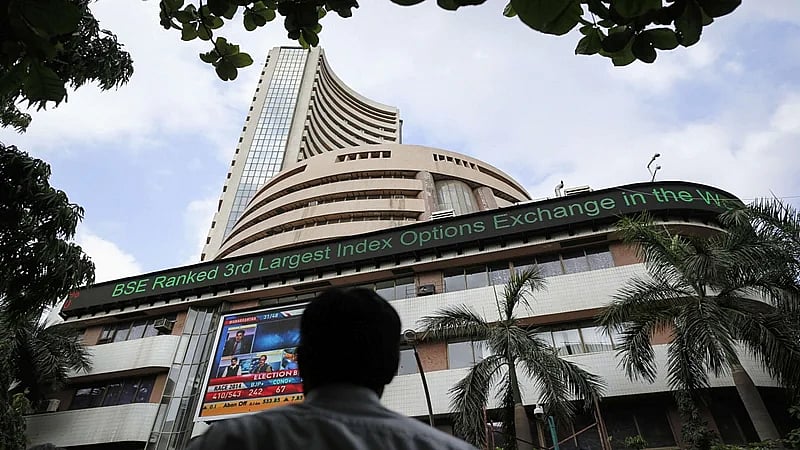
The Indian equity markets began Thursday's session on a positive note but soon slipped into the red due to heightened tensions in West Asia. At around 10:30 AM, the Sensex was trading 82 points lower, while the Nifty was down 10 points compared to the previous closing levels.
However, during the early trade hours, both indices were trading higher, supported by strong buying in information technology stocks, foreign institutional investor (FII) inflows, and a decline in global crude oil prices. The 30-share BSE Sensex had gained 75.71 points to trade at 77,726.62 during early deals, while the NSE Nifty50 had advanced 26.90 points to 24,275.85.
IT stocks led the market gains, with major technology companies providing support to the indices. From the Sensex basket, Infosys, Tech Mahindra, HCL Technologies, and Tata Consultancy Services were among the leading performers. Mahindra & Mahindra and Sun Pharma also traded higher.
However, some stocks witnessed selling pressure. Adani Ports, Asian Paints, Eternal, and Bharat Electronics were among the major laggards in early trade. Investor sentiment received support from foreign fund activity, with Foreign Institutional Investors purchasing equities worth ₹2,981.87 crore on Wednesday, according to exchange data.
Brent crude, the global benchmark, declined 1.26% to $89.60 per barrel. Lower oil prices are generally positive for India as the country imports a significant portion of its crude requirements, helping ease inflation and external pressure.
Asian markets showed a mixed trend, with South Korea's KOSPI, Shanghai's SSE Composite, and Hong Kong's Hang Seng trading lower, while Japan's Nikkei 225 moved higher. Meanwhile, US markets ended sharply lower on Wednesday following concerns over the Federal Reserve's policy outlook.
In the previous session on Wednesday, Indian markets had posted strong gains. The Sensex surged 888.68 points, or 1.16%, to close at 77,654.60, while the Nifty climbed 264.85 points, or 1.10%, to settle at 24,250.20.
The uncertainty in West Asia has gripped investors, leading to a cautious approach in the markets. The Indian equity markets are closely watching the developments in the region, which could impact the global economy and, in turn, affect the Indian markets.
The decline in global crude oil prices has provided some relief to the Indian markets, as lower oil prices can help ease inflation and external pressure. However, the uncertainty in West Asia and the concerns over the Federal Reserve's policy outlook have led to a mixed trend in the Asian markets.
Overall, the Indian equity markets are expected to remain volatile in the short term, driven by global cues and domestic factors. Investors are advised to remain cautious and keep a close watch on the developments in the region.
The Indian markets are also expected to be influenced by the foreign institutional investor (FII) inflows, which have been supporting the markets in recent times. The FII inflows have been driven by the attractive valuations of Indian stocks and the positive outlook for the Indian economy.
In conclusion, the Indian equity markets are trading flat amid uncertainty in West Asia, with the Sensex and Nifty trading lower due to selling pressure in some stocks. However, the decline in global crude oil prices and the FII inflows have provided some relief to the markets. The Indian markets are expected to remain volatile in the short term, driven by global cues and domestic factors.
The uncertainty in West Asia is a significant concern for the Indian markets, as it can impact the global economy and, in turn, affect the Indian markets. The Indian government and the Reserve Bank of India (RBI) are closely watching the developments in the region and are taking steps to mitigate the impact of the uncertainty on the Indian economy.
The Indian markets are also expected to be influenced by the domestic factors, such as the upcoming earnings season and the macroeconomic data. The earnings season is expected to be positive, with many companies expected to report strong earnings growth. The macroeconomic data, such as the GDP growth rate and the inflation rate, are also expected to be positive, with the Indian economy expected to grow at a faster pace in the coming quarters.
In the long term, the Indian equity markets are expected to remain positive, driven by the strong fundamentals of the Indian economy and the attractive valuations of Indian stocks. The Indian economy is expected to grow at a faster pace in the coming quarters, driven by the government's initiatives to boost economic growth and the positive outlook for the Indian industry.
The attractive valuations of Indian stocks are also expected to support the markets in the long term. The price-to-earnings ratio of the Indian markets is lower compared to the other emerging markets, making Indian stocks attractive to foreign investors.
Overall, the Indian equity markets are expected to remain volatile in the short term, driven by global cues and domestic factors. However, in the long term, the markets are expected to remain positive, driven by the strong fundamentals of the Indian economy and the attractive valuations of Indian stocks.
The Indian government and the RBI are taking steps to mitigate the impact of the uncertainty in West Asia on the Indian economy. The government has announced several initiatives to boost economic growth, such as the reduction in corporate tax rates and the increase in public spending. The RBI has also taken steps to support the economy, such as the reduction in interest rates and the increase in liquidity.
The Indian markets are also expected to be influenced by the global cues, such as the US Federal Reserve's policy outlook and the trade tensions between the US and China. The US Federal Reserve's policy outlook is expected to be positive, with the Fed expected to keep interest rates low in the coming quarters. The trade tensions between the US and China are also expected to be positive, with the two countries expected to reach a trade deal in the coming quarters.
In conclusion, the Indian equity markets are trading flat amid uncertainty in West Asia, with the Sensex and Nifty trading lower due to selling pressure in some stocks. However, the decline in global crude oil prices and the FII inflows have provided some relief to the markets. The Indian markets are expected to remain volatile in the short term, driven by global cues and domestic factors. However, in the long term, the markets are expected to remain positive, driven by the strong fundamentals of the Indian economy and the attractive valuations of Indian stocks.
What it means for Mumbai and India is that the uncertainty in West Asia can have a significant impact on the Indian economy and the Indian markets. The Indian government and the RBI are taking steps to mitigate the impact of the uncertainty on the Indian economy. The Indian markets are expected to remain volatile in the short term, driven by global cues and domestic factors. However, in the long term, the markets are expected to remain positive, driven by the strong fundamentals of the Indian economy and the attractive valuations of Indian stocks.
The Indian economy is expected to grow at a faster pace in the coming quarters, driven by the government's initiatives to boost economic growth and the positive outlook for the Indian industry. The attractive valuations of Indian stocks are also expected to support the markets in the long term. The price-to-earnings ratio of the Indian markets is lower compared to the other emerging markets, making Indian stocks attractive to foreign investors.
Overall, the Indian equity markets are expected to remain volatile in the short term, driven by global cues and domestic factors. However, in the long term, the markets are expected to remain positive, driven by the strong fundamentals of the Indian economy and the attractive valuations of Indian stocks. The Indian government and the RBI are taking steps to mitigate the impact of the uncertainty in West Asia on the Indian economy, and the Indian markets are expected to remain positive in the long term.
Frequently asked questions
What is the current trend in the Indian equity markets?
The Indian equity markets are trading flat amid uncertainty in West Asia, with the Sensex and Nifty trading lower due to selling pressure in some stocks.
What is the impact of the decline in global crude oil prices on the Indian markets?
The decline in global crude oil prices has provided some relief to the Indian markets, as lower oil prices can help ease inflation and external pressure.