BRICS Nations Unite Against Western Order
BRICS Leaders Summit concludes with New Delhi Declaration, challenging Western dominance, supporting Palestine
'%3E%3Crect%20width%3D'96'%20height%3D'96'%20fill%3D'%234A235A'%2F%3E%3Ccircle%20cx%3D'30'%20cy%3D'24'%20r%3D'44'%20fill%3D'%23fff'%20opacity%3D'.12'%2F%3E%3Ccircle%20cx%3D'60'%20cy%3D'74'%20r%3D'40'%20fill%3D'%23000'%20opacity%3D'.10'%2F%3E%3C%2Fg%3E%3Cg%20fill%3D'none'%20stroke%3D'%23fff'%20stroke-width%3D'3'%3E%3Ccircle%20cx%3D'48'%20cy%3D'48'%20r%3D'16'%2F%3E%3Cellipse%20cx%3D'48'%20cy%3D'48'%20rx%3D'6.5'%20ry%3D'16'%2F%3E%3Cline%20x1%3D'32'%20y1%3D'42'%20x2%3D'64'%20y2%3D'42'%2F%3E%3Cline%20x1%3D'32'%20y1%3D'54'%20x2%3D'64'%20y2%3D'54'%2F%3E%3C%2Fg%3E%3C%2Fsvg%3E)
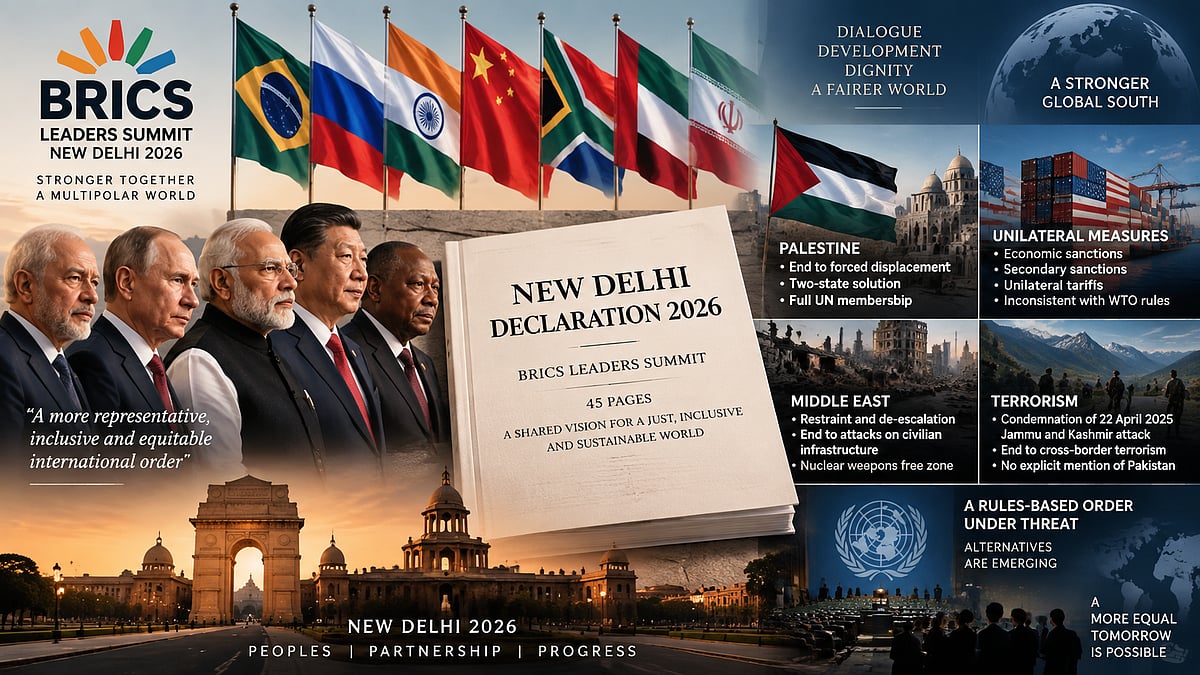
The 45-page New Delhi Declaration 2026, adopted at the BRICS Leaders Summit,
has sent a strong message to the Western world.
The document, though carefully worded,
makes several key points that are likely to be noted by the US and its allies.
One of the main focuses of the declaration is on Palestine,
where it expresses firm opposition to the forced displacement of the Palestinian population.
It also endorses a two-state solution and Palestine's full membership to the UN.
This move is significant,
given the upcoming high-level debate at the UN General Assembly in New York.
The declaration also touches on the issue of unilateral coercive measures,
such as economic sanctions and tariff measures,
which are seen as a challenge to the Western-dominated global order.
Notably, the document does not mention the US by name,
but the language used is seen as a clear reference to the country's policies.
The tone was set by President Putin,
who spoke about the need for new leaders and a more multipolar world.
The declaration also seeks to address the concerns of both Iran and the UAE,
by calling for maximum restraint and an end to actions that could aggravate the situation.
The absence of references to Ukraine and China's BRI is also notable,
likely due to the sensitive nature of these issues.
Overall, the New Delhi Declaration 2026 marks a significant shift in the global balance of power,
with the BRICS nations asserting their influence and challenging the Western order.
The declaration's focus on Palestine and its endorsement of a two-state solution
is likely to have far-reaching implications for the Middle East peace process.
The BRICS nations' commitment to a more multipolar world
is also seen as a challenge to the US's dominance of global affairs.
As the global landscape continues to evolve,
the New Delhi Declaration 2026 is likely to be seen as a key milestone in the shift towards a more multipolar world.
The declaration's emphasis on cooperation and dialogue
is also seen as a positive step towards addressing global challenges.
However, the absence of references to certain key issues
is likely to be seen as a missed opportunity for more meaningful engagement.
In conclusion, the New Delhi Declaration 2026 is a significant document
that marks a new era of cooperation and challenge to the Western order.
Its implications will be closely watched by the global community,
as the BRICS nations continue to assert their influence on the world stage.
The New Delhi Declaration 2026 is the longest of all BRICS declarations,
and its careful draftsmanship is seen as a reflection of the complex nature of the issues addressed.
The document's language is carefully generalized,
but its message is clear: the BRICS nations are committed to a more multipolar world,
and they are willing to challenge the Western order to achieve it.
The declaration's focus on Palestine is particularly notable,
as it marks a significant shift in the global balance of power.
The BRICS nations' endorsement of a two-state solution
is likely to have far-reaching implications for the Middle East peace process.
The declaration's emphasis on cooperation and dialogue
is also seen as a positive step towards addressing global challenges.
As the global landscape continues to evolve,
the New Delhi Declaration 2026 is likely to be seen as a key milestone in the shift towards a more multipolar world.
The BRICS nations' commitment to a more multipolar world
is seen as a challenge to the US's dominance of global affairs.
The declaration's language is carefully worded,
but its message is clear: the BRICS nations are committed to a more equitable global order.
The document's emphasis on cooperation and dialogue
is also seen as a positive step towards addressing global challenges.
The absence of references to certain key issues
is likely to be seen as a missed opportunity for more meaningful engagement.
However, the declaration's focus on Palestine
is likely to have far-reaching implications for the Middle East peace process.
The BRICS nations' endorsement of a two-state solution
is seen as a significant shift in the global balance of power.
As the global landscape continues to evolve,
the New Delhi Declaration 2026 is likely to be seen as a key milestone in the shift towards a more multipolar world.
In the coming days and weeks,
the implications of the New Delhi Declaration 2026 will be closely watched by the global community.
The BRICS nations' commitment to a more multipolar world
is seen as a challenge to the US's dominance of global affairs.
The declaration's emphasis on cooperation and dialogue
is also seen as a positive step towards addressing global challenges.
The absence of references to certain key issues
is likely to be seen as a missed opportunity for more meaningful engagement.
However, the declaration's focus on Palestine
is likely to have far-reaching implications for the Middle East peace process.
The BRICS nations' endorsement of a two-state solution
is seen as a significant shift in the global balance of power.
As the global landscape continues to evolve,
the New Delhi Declaration 2026 is likely to be seen as a key milestone in the shift towards a more multipolar world.
The New Delhi Declaration 2026 marks a significant shift in the global balance of power,
with the BRICS nations asserting their influence and challenging the Western order.
The declaration's focus on Palestine and its endorsement of a two-state solution
is likely to have far-reaching implications for the Middle East peace process.
The BRICS nations' commitment to a more multipolar world
is seen as a challenge to the US's dominance of global affairs.
The declaration's emphasis on cooperation and dialogue
is also seen as a positive step towards addressing global challenges.
As the global landscape continues to evolve,
the New Delhi Declaration 2026 is likely to be seen as a key milestone in the shift towards a more multipolar world.
The declaration's implications will be closely watched by the global community,
as the BRICS nations continue to assert their influence on the world stage.
In conclusion,
the New Delhi Declaration 2026 is a significant document
that marks a new era of cooperation and challenge to the Western order.
Its implications will be closely watched by the global community,
as the BRICS nations continue to assert their influence on the world stage.
The declaration's focus on Palestine and its endorsement of a two-state solution
is likely to have far-reaching implications for the Middle East peace process.
The BRICS nations' commitment to a more multipolar world
is seen as a challenge to the US's dominance of global affairs.
The declaration's emphasis on cooperation and dialogue
is also seen as a positive step towards addressing global challenges.
As the global landscape continues to evolve,
the New Delhi Declaration 2026 is likely to be seen as a key milestone in the shift towards a more multipolar world.
The significance of the New Delhi Declaration 2026
cannot be overstated,
as it marks a significant shift in the global balance of power.
The BRICS nations' commitment to a more multipolar world
is seen as a challenge to the US's dominance of global affairs.
The declaration's focus on Palestine and its endorsement of a two-state solution
is likely to have far-reaching implications for the Middle East peace process.
The declaration's emphasis on cooperation and dialogue
is also seen as a positive step towards addressing global challenges.
As the global landscape continues to evolve,
the New Delhi Declaration 2026 is likely to be seen as a key milestone in the shift towards a more multipolar world.
The declaration's implications will be closely watched by the global community,
as the BRICS nations continue to assert their influence on the world stage.
The New Delhi Declaration 2026 is a call to action,
a call for a more multipolar world,
where nations can work together to address global challenges.
The declaration's focus on Palestine and its endorsement of a two-state solution
is likely to have far-reaching implications for the Middle East peace process.
The BRICS nations' commitment to a more multipolar world
is seen as a challenge to the US's dominance of global affairs.
The declaration's emphasis on cooperation and dialogue
is also seen as a positive step towards addressing global challenges.
As the global landscape continues to evolve,
the New Delhi Declaration 2026 is likely to be seen as a key milestone in the shift towards a more multipolar world.
The declaration's implications will be closely watched by the global community,
as the BRICS nations continue to assert their influence on the world stage.
The future of global affairs is uncertain,
but one thing is clear:
the New Delhi Declaration 2026 marks a significant shift in the global balance of power.
The BRICS nations' commitment to a more multipolar world
is seen as a challenge to the US's dominance of global affairs.
The declaration's focus on Palestine and its endorsement of a two-state solution
is likely to have far-reaching implications for the Middle East peace process.
The declaration's emphasis on cooperation and dialogue
is also seen as a positive step towards addressing global challenges.
As the global landscape continues to evolve,
the New Delhi Declaration 2026 is likely to be seen as a key milestone in the shift towards a more multipolar world.
The declaration's implications will be closely watched by the global community,
as the BRICS nations continue to assert their influence on the world stage.
Frequently asked questions
What is the New Delhi Declaration 2026?
The New Delhi Declaration 2026 is a document adopted by the BRICS nations, which challenges the Western order and supports Palestine.
What are the implications of the New Delhi Declaration 2026?
The implications of the New Delhi Declaration 2026 are far-reaching, and will be closely watched by the global community, as the BRICS nations continue to assert their influence on the world stage.