Aamir Khan Rejects Pressure on Kids
Aamir Khan's parenting approach, focus on happiness and emotional strength
'%3E%3Crect%20width%3D'96'%20height%3D'96'%20fill%3D'%23C2185B'%2F%3E%3Ccircle%20cx%3D'30'%20cy%3D'24'%20r%3D'44'%20fill%3D'%23fff'%20opacity%3D'.12'%2F%3E%3Ccircle%20cx%3D'60'%20cy%3D'74'%20r%3D'40'%20fill%3D'%23000'%20opacity%3D'.10'%2F%3E%3C%2Fg%3E%3Cpath%20fill%3D'%23fff'%20d%3D'M48%2031%20l4.6%2010.2%2011.2%201%20-8.4%207.5%202.5%2011%20-9.9%20-5.8%20-9.9%205.8%202.5%20-11%20-8.4%20-7.5%2011.2%20-1%20z'%2F%3E%3C%2Fsvg%3E)
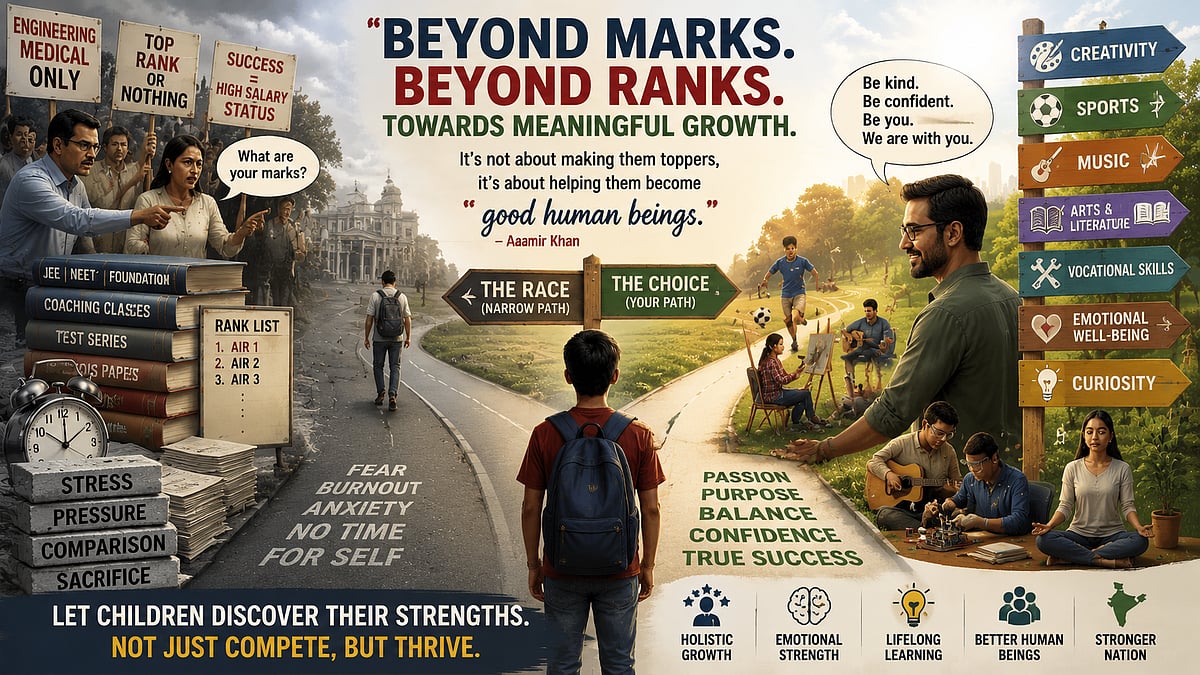
Actor Aamir Khan recently shared his parenting philosophy, emphasizing the importance of raising confident, sensitive, and emotionally strong individuals. He believes that children should be encouraged to be happy and true to themselves, rather than constantly pressured to achieve academic success. This approach resonates with many parents who struggle to raise their children in a competitive environment that prioritizes measurable achievement and academic merit.
In India, the emphasis on academic success starts from a young age, with children being enrolled in tuition classes to sharpen their mathematical and scientific skills. By Class 10, the pressure intensifies, with engineering and medical entrance examinations becoming a major focus. This can lead to a narrow definition of intelligence, where excellence is primarily equated with science and mathematics.
The Indian society tends to view students who pursue humanities, literature, fine arts, or vocational trades as academically inferior. Parents often proudly announce their child's preparation for engineering entrance exams, but rarely boast about their children pursuing other fields. This mindset is limiting and counterproductive, as it prioritizes competition over innovation and creativity.
Novelist Ayn Rand argued that people who are obsessed with staying ahead of others rarely create anything truly original. Instead, they spend their lives reacting to competition rather than pursuing innovation. India's competitive culture emerged as a response to economic insecurity and future uncertainties, where education was seen as a reliable ladder out of poverty. However, with the rise of AI and layoffs in the IT sector, even impressive qualifications offer little reassurance to thousands of science graduates.
Aamir Khan's approach to parenting offers a refreshing alternative to this competitive culture. By prioritizing happiness, emotional strength, and individuality, parents can help their children develop into well-rounded and confident individuals. This approach recognizes that success is not solely defined by grades, rankings, salaries, and social status, but by a person's ability to pursue their passions and interests.
In today's society, it is essential to redefine what it means to be successful and intelligent. By broadening our definition of intelligence and recognizing the value of diverse fields, we can create a more inclusive and supportive environment for children to grow and develop. Aamir Khan's parenting philosophy serves as a reminder that children should be encouraged to be true to themselves and pursue their interests, rather than being pressured to conform to societal expectations.
The impact of this competitive culture on children's mental health and well-being cannot be overstated. The pressure to perform can lead to stress, anxiety, and depression, which can have long-term consequences on a child's emotional and psychological development. By prioritizing happiness and emotional strength, parents can help their children develop coping mechanisms and resilience, which are essential for navigating the challenges of life.
In conclusion, Aamir Khan's parenting approach offers a valuable lesson for parents and society as a whole. By recognizing the importance of happiness, emotional strength, and individuality, we can create a more supportive and inclusive environment for children to grow and develop. It is time to rethink our priorities and redefine what it means to be successful and intelligent, so that we can raise a generation of confident, sensitive, and emotionally strong individuals.
Frequently asked questions
What is Aamir Khan's parenting philosophy?
Aamir Khan believes in raising confident, sensitive, and emotionally strong individuals, prioritizing happiness and emotional strength over academic success.
Why is the Indian education system so competitive?
The Indian education system is competitive due to economic insecurity and future uncertainties, where education is seen as a reliable ladder out of poverty.