Supreme Court Raps Bar Council of India Twice
SC criticizes BCI for overstepping authority, targeting law students
'%3E%3Crect%20width%3D'96'%20height%3D'96'%20fill%3D'%231A5276'%2F%3E%3Ccircle%20cx%3D'30'%20cy%3D'24'%20r%3D'44'%20fill%3D'%23fff'%20opacity%3D'.12'%2F%3E%3Ccircle%20cx%3D'60'%20cy%3D'74'%20r%3D'40'%20fill%3D'%23000'%20opacity%3D'.10'%2F%3E%3C%2Fg%3E%3Cg%20fill%3D'%23fff'%3E%3Cpath%20d%3D'M31%2041%20L48%2031%20L65%2041%20Z'%2F%3E%3Crect%20x%3D'33'%20y%3D'43'%20width%3D'4'%20height%3D'17'%2F%3E%3Crect%20x%3D'41'%20y%3D'43'%20width%3D'4'%20height%3D'17'%2F%3E%3Crect%20x%3D'51'%20y%3D'43'%20width%3D'4'%20height%3D'17'%2F%3E%3Crect%20x%3D'59'%20y%3D'43'%20width%3D'4'%20height%3D'17'%2F%3E%3Crect%20x%3D'30'%20y%3D'62'%20width%3D'36'%20height%3D'4'%20rx%3D'1'%2F%3E%3C%2Fg%3E%3C%2Fsvg%3E)
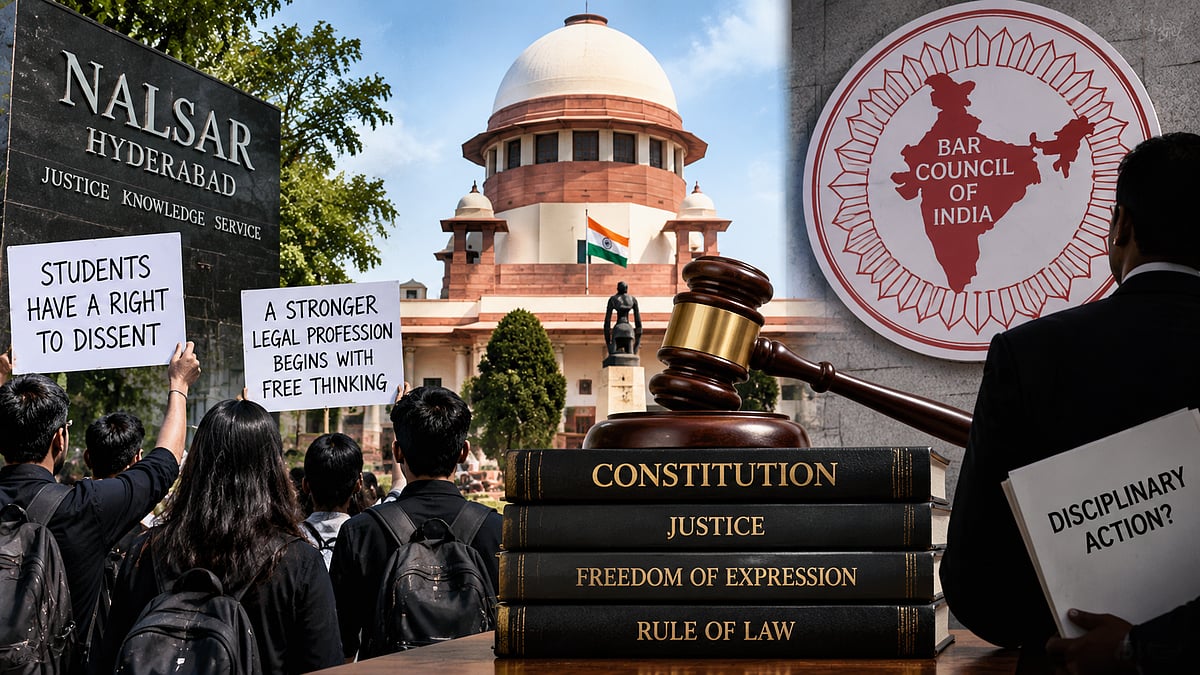
The Supreme Court has reprimanded the Bar Council of India (BCI) on two consecutive days for its actions. The BCI has been accused of playing politics and overstepping its authority.
The issue began when students at the National Academy of Legal Studies and Research (NALSAR) in Hyderabad objected to Chief Justice of India Surya Kant being invited to deliver the convocation address. The students were upset by his previous comments about “cockroaches and parasites”.
The BCI, led by chairman Manan Kumar Mishra, a BJP leader, sought to initiate disciplinary proceedings against the students and even tried to block their enrolment as advocates. However, the Supreme Court made it clear that the BCI's disciplinary authority only begins when a person enters the legal profession as an advocate.
The court's decision was headed by Chief Justice Surya Kant himself, who did not seek punitive action against the students. This has raised questions about the BCI's conduct and its apparent attempt to silence the students.
A day earlier, the court had questioned Mishra's authority, pointing out that he was only a pro tem chief. He and his colleagues were asked to consult the Attorney-General and the Solicitor-General before taking policy decisions.
The two orders expose a larger problem of professional institutions being influenced by political affiliations. The BCI's actions have been seen as an attempt to demonstrate loyalty to those in power, rather than upholding the independence and dignity of the legal profession.
The Supreme Court's decisions have significant implications for the legal profession and the role of the BCI. The Council's actions have been seen as a threat to the independence of law students and the legal profession as a whole.
The incident has also raised questions about the limits of authority and the importance of protecting constitutional freedoms. The BCI's actions have been seen as an attempt to silence dissenting voices and undermine the independence of the legal profession.
In conclusion, the Supreme Court's decisions have highlighted the need for professional institutions to maintain their independence and credibility. The BCI's actions have been seen as a threat to the legal profession and the rule of law, and it is essential that the Council takes steps to restore its credibility and uphold the principles of independence and dignity.
Frequently asked questions
What was the issue with the NALSAR students?
The students objected to Chief Justice of India Surya Kant being invited to deliver the convocation address due to his previous comments.
What action did the BCI take against the students?
The BCI sought to initiate disciplinary proceedings against the students and block their enrolment as advocates.