IIT Guwahati Develops ₹3,500 'E-Eye' To Detect Water Toxins
IIT Guwahati researchers develop a low-cost device to detect toxicants in water. The device can detect arsenic, lead, and E. coli at just ₹2 per test.
'%3E%3Crect%20width%3D'96'%20height%3D'96'%20fill%3D'%23B3261E'%2F%3E%3Ccircle%20cx%3D'30'%20cy%3D'24'%20r%3D'44'%20fill%3D'%23fff'%20opacity%3D'.12'%2F%3E%3Ccircle%20cx%3D'60'%20cy%3D'74'%20r%3D'40'%20fill%3D'%23000'%20opacity%3D'.10'%2F%3E%3C%2Fg%3E%3Cg%20fill%3D'%23fff'%3E%3Crect%20x%3D'29'%20y%3D'49'%20width%3D'8'%20height%3D'19'%20rx%3D'1'%2F%3E%3Crect%20x%3D'39'%20y%3D'40'%20width%3D'9'%20height%3D'28'%20rx%3D'1'%2F%3E%3Crect%20x%3D'50'%20y%3D'45'%20width%3D'8'%20height%3D'23'%20rx%3D'1'%2F%3E%3Crect%20x%3D'60'%20y%3D'53'%20width%3D'7'%20height%3D'15'%20rx%3D'1'%2F%3E%3Crect%20x%3D'41'%20y%3D'34'%20width%3D'5'%20height%3D'6'%2F%3E%3C%2Fg%3E%3C%2Fsvg%3E)
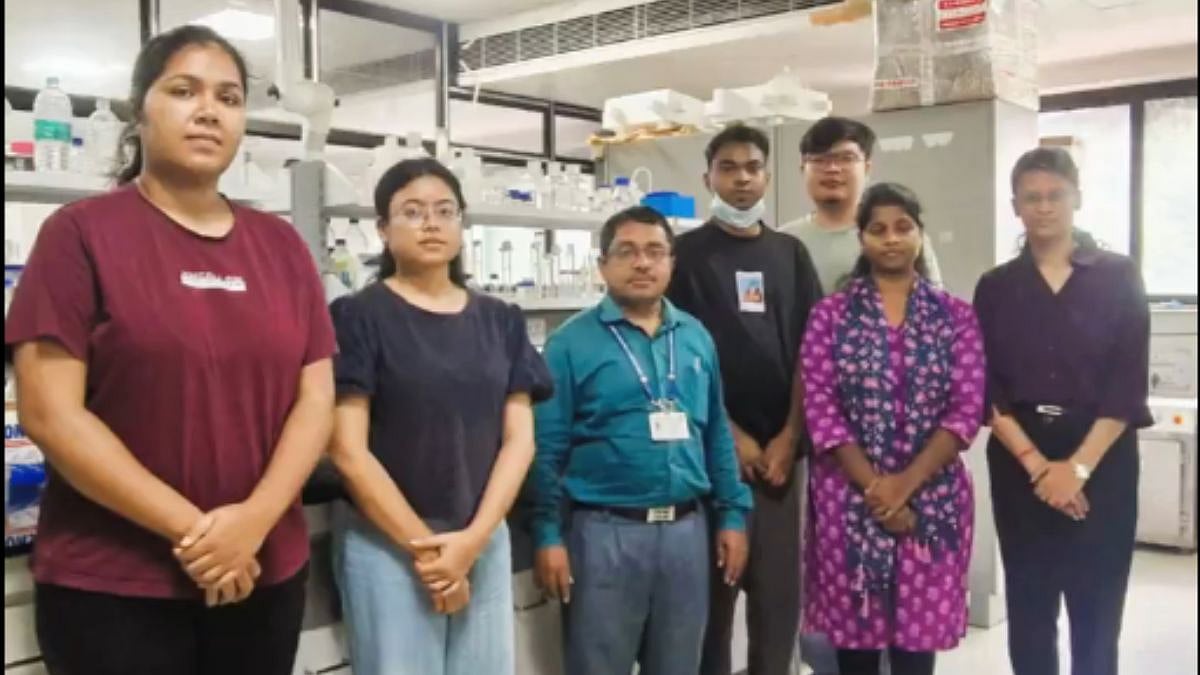
Researchers at the Indian Institute of Technology Guwahati have developed an innovative optical sensing device called 'E-Eye' that can instantly detect a variety of toxicants in water and other biological samples. This development is aligned with the Government of India's Jal Jeevan Mission, which aims to provide tap water to every household.
The E-Eye device is a portable point-of-care testing device that works as an electronic eye to detect multiple toxicants on-site while maintaining high accuracy. It transmits the recorded data wirelessly to water treatment facilities, making it a valuable tool for ensuring safe drinking water.
The device uses a chemical reaction that produces a colored compound, and the color intensity highlights the concentration of the toxicants. Using basic optical principles, the device analyzes the water and converts the sensor's output into digital data, displaying the toxicant concentration.
According to Prof Tapas K Mandal, Professor, Department of Chemical Engineering, IIT Guwahati, the device operates on the Beer-Lambert law and combines optical sensing with digital electronics to generate accurate quantitative measurements.
The E-Eye device has been tested in laboratory settings and has shown results comparable to those of standard UV-Visible and Atomic Absorption spectrophotometers (AAS). However, it offers advanced digital integration functionality, making it suitable for direct field deployment.
The device can detect toxicants such as arsenic, lead, and E. coli at a cost of just ₹2 per test, making it a low-cost and effective solution for water quality monitoring. The research team behind the development of E-Eye includes Prof Harshal B Nemade, Shrikant Kashyap, Smriti Sachan, and Neha Majee from IIT Guwahati, as well as researchers from other institutions.
The findings of this research have been published in the prestigious IEEE Sensors Journal. The development of E-Eye is a significant step towards ensuring safe drinking water, which is a key challenge in India due to different water sources that may contain heavy metals and other disease-causing bacteria.
The Jal Jeevan Mission aims to provide tap water to every household, but maintaining water quality remains a challenge. The E-Eye device can help address this challenge by providing a low-cost and effective solution for water quality monitoring.
In conclusion, the development of E-Eye by IIT Guwahati researchers is a significant innovation that can help ensure safe drinking water for millions of people in India. The device's low cost, high accuracy, and ease of use make it an ideal solution for water quality monitoring, and its potential impact on public health cannot be overstated.
The E-Eye device is a testament to the growing strength of scientific research in India, particularly in the field of environmental technology. As the country continues to grapple with the challenges of providing safe drinking water, innovations like E-Eye can play a crucial role in addressing these challenges and improving public health.
Overall, the development of E-Eye is a significant step towards ensuring safe drinking water, and its potential impact on public health and the environment cannot be overstated. The device's low cost, high accuracy, and ease of use make it an ideal solution for water quality monitoring, and it has the potential to make a significant difference in the lives of millions of people in India.
The research team behind the development of E-Eye is to be commended for their innovative work, and their contribution to the field of environmental technology is significant. The development of E-Eye is a shining example of the impact that scientific research can have on public health and the environment, and it is a testament to the growing strength of scientific research in India.
In the future, the E-Eye device has the potential to be used in a variety of settings, including rural areas where access to safe drinking water is limited. The device's low cost and ease of use make it an ideal solution for water quality monitoring in these areas, and it has the potential to make a significant difference in the lives of millions of people.
The development of E-Eye is also a significant step towards achieving the goals of the Jal Jeevan Mission, which aims to provide tap water to every household. The device's ability to detect toxicants in water makes it an ideal solution for water quality monitoring, and it has the potential to play a crucial role in addressing the challenges of providing safe drinking water in India.
In conclusion, the development of E-Eye by IIT Guwahati researchers is a significant innovation that can help ensure safe drinking water for millions of people in India. The device's low cost, high accuracy, and ease of use make it an ideal solution for water quality monitoring, and its potential impact on public health and the environment cannot be overstated.
Frequently asked questions
What is the cost of the E-Eye device?
The E-Eye device costs ₹3,500.
What toxicants can the E-Eye device detect?
The E-Eye device can detect arsenic, lead, and E. coli.