Maharashtra Enforces Marathi Rule For Auto, Taxi Drivers From August 20
Marathi language knowledge mandatory, badge suspension for non-compliance. Drivers given one month to comply.
'%3E%3Crect%20width%3D'96'%20height%3D'96'%20fill%3D'%23B3261E'%2F%3E%3Ccircle%20cx%3D'30'%20cy%3D'24'%20r%3D'44'%20fill%3D'%23fff'%20opacity%3D'.12'%2F%3E%3Ccircle%20cx%3D'60'%20cy%3D'74'%20r%3D'40'%20fill%3D'%23000'%20opacity%3D'.10'%2F%3E%3C%2Fg%3E%3Cg%20fill%3D'%23fff'%3E%3Crect%20x%3D'29'%20y%3D'49'%20width%3D'8'%20height%3D'19'%20rx%3D'1'%2F%3E%3Crect%20x%3D'39'%20y%3D'40'%20width%3D'9'%20height%3D'28'%20rx%3D'1'%2F%3E%3Crect%20x%3D'50'%20y%3D'45'%20width%3D'8'%20height%3D'23'%20rx%3D'1'%2F%3E%3Crect%20x%3D'60'%20y%3D'53'%20width%3D'7'%20height%3D'15'%20rx%3D'1'%2F%3E%3Crect%20x%3D'41'%20y%3D'34'%20width%3D'5'%20height%3D'6'%2F%3E%3C%2Fg%3E%3C%2Fsvg%3E)
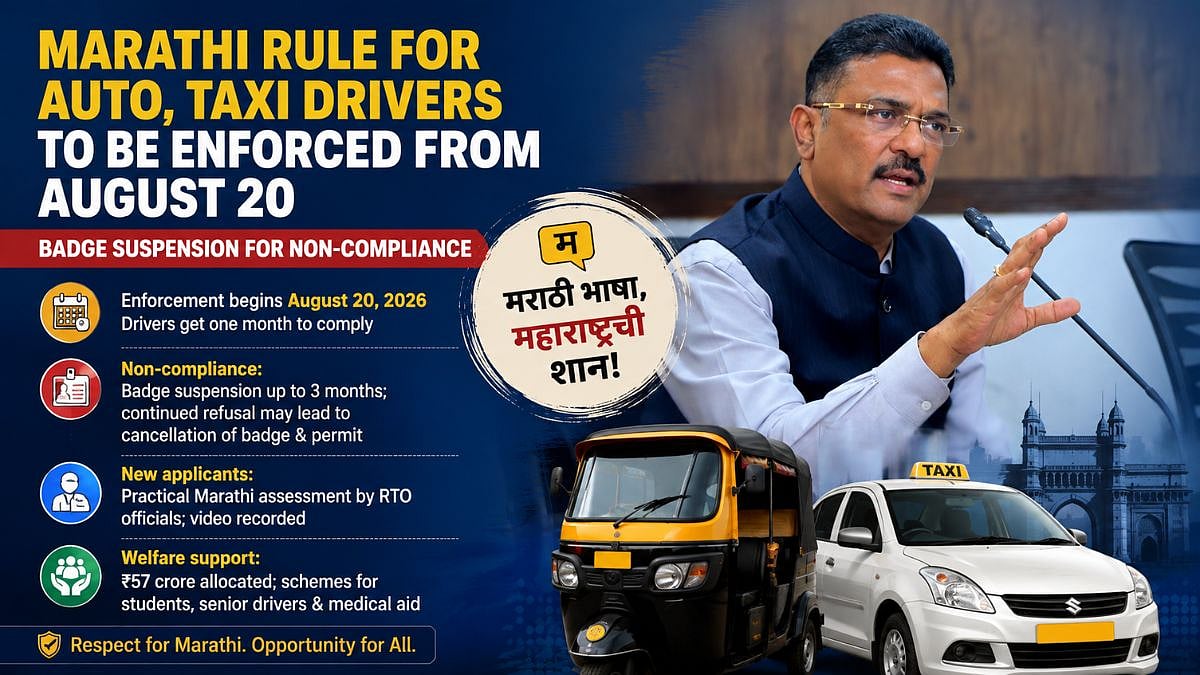
The Maharashtra government will begin enforcing mandatory practical Marathi language knowledge for autorickshaw and taxi drivers from August 20. Transport Minister Pratap Sarnaik announced that drivers who do not have basic working knowledge of Marathi will initially be given one month to comply.
Those who fail to acquire the required language skills during this period will face suspension of their driver badge for up to three months. Continued refusal to learn Marathi could lead to cancellation of both the badge and permit.
The minister said the requirement is based on a rule in force since 1989 and will now be implemented strictly following the relevant legal provision introduced on August 12, 2026. As part of efforts to prepare drivers, the Konkan Marathi Sahitya Parishad and Mumbai Marathi Sahitya Sangh conducted a Marathi language campaign for 105 days.
Around 1.65 lakh non-Marathi-speaking autorickshaw and taxi drivers participated in the training programme and received certificates. The government’s objective, according to Sarnaik, was not to deprive anyone of employment but to ensure respect for Maharashtra’s language and culture.
Mumbai has always welcomed people from across the country, while promoting and preserving Marathi remains equally important. The minister said drivers who deliberately refuse to learn or speak Marathi would face action under the law without any further extension of the deadline.
The government will also introduce stricter checks for new permits and badges. RTO officials will assess an applicant’s practical Marathi through direct interaction and record the assessment on video. A badge will be issued only after the applicant demonstrates the required language proficiency.
The Transport Department has also ordered verification of complaints regarding fake domicile certificates being used to obtain permits and badges. Authorities will verify whether applicants have actually resided in Maharashtra for 15 years and may conduct police inquiries where necessary.
Additional Transport Commissioner Ravi Gaikwad has been assigned responsibility for the implementation drive, with a report expected by the end of next month. The government has also taken welfare measures for autorickshaw and taxi drivers, with more than 37,000 members joining the Anand Dighe-named corporation.
Around Rs 57 crore has been allocated for the welfare of drivers. The enforcement of the Marathi language rule is expected to have a significant impact on the lives of autorickshaw and taxi drivers in Maharashtra, and the government’s efforts to promote the language and culture of the state.
The move is seen as a step towards preserving the cultural heritage of Maharashtra, while also ensuring that drivers are able to communicate effectively with their passengers. With the implementation of the rule, drivers will be required to have a basic understanding of Marathi, which will help to improve their interactions with passengers and enhance their overall experience.
The government’s decision to enforce the Marathi language rule is a significant development in the state’s efforts to promote its language and culture. The move is expected to have far-reaching consequences for autorickshaw and taxi drivers, and the government’s efforts to ensure that they are able to communicate effectively with their passengers.
In conclusion, the enforcement of the Marathi language rule for autorickshaw and taxi drivers in Maharashtra is a significant step towards promoting the language and culture of the state. The government’s efforts to ensure that drivers are able to communicate effectively with their passengers are commendable, and the move is expected to have a positive impact on the lives of drivers and passengers alike.
The implementation of the rule is also expected to have a significant impact on the state’s economy, as it will help to enhance the overall experience of tourists and visitors to the state. With the government’s efforts to promote the language and culture of Maharashtra, the state is expected to become a more attractive destination for tourists and visitors, which will have a positive impact on the local economy.
Overall, the enforcement of the Marathi language rule for autorickshaw and taxi drivers in Maharashtra is a significant development that is expected to have far-reaching consequences for the state’s language, culture, and economy. The government’s efforts to promote the language and culture of the state are commendable, and the move is expected to have a positive impact on the lives of drivers, passengers, and the local economy alike.
Frequently asked questions
What is the penalty for autorickshaw and taxi drivers who do not know Marathi?
Drivers who do not know Marathi will face suspension of their driver badge for up to three months, and continued refusal to learn Marathi could lead to cancellation of both the badge and permit.
How will the government assess an applicant’s practical Marathi for new permits and badges?
RTO officials will assess an applicant’s practical Marathi through direct interaction and record the assessment on video. A badge will be issued only after the applicant demonstrates the required language proficiency.