Mark Zuckerberg Apologises for CSAM and Meta Errors
Meta CEO apologises for CSAM, deepfake content and platform errors.
'%3E%3Crect%20width%3D'96'%20height%3D'96'%20fill%3D'%231A5276'%2F%3E%3Ccircle%20cx%3D'30'%20cy%3D'24'%20r%3D'44'%20fill%3D'%23fff'%20opacity%3D'.12'%2F%3E%3Ccircle%20cx%3D'60'%20cy%3D'74'%20r%3D'40'%20fill%3D'%23000'%20opacity%3D'.10'%2F%3E%3C%2Fg%3E%3Cg%20fill%3D'%23fff'%3E%3Cpath%20d%3D'M31%2041%20L48%2031%20L65%2041%20Z'%2F%3E%3Crect%20x%3D'33'%20y%3D'43'%20width%3D'4'%20height%3D'17'%2F%3E%3Crect%20x%3D'41'%20y%3D'43'%20width%3D'4'%20height%3D'17'%2F%3E%3Crect%20x%3D'51'%20y%3D'43'%20width%3D'4'%20height%3D'17'%2F%3E%3Crect%20x%3D'59'%20y%3D'43'%20width%3D'4'%20height%3D'17'%2F%3E%3Crect%20x%3D'30'%20y%3D'62'%20width%3D'36'%20height%3D'4'%20rx%3D'1'%2F%3E%3C%2Fg%3E%3C%2Fsvg%3E)
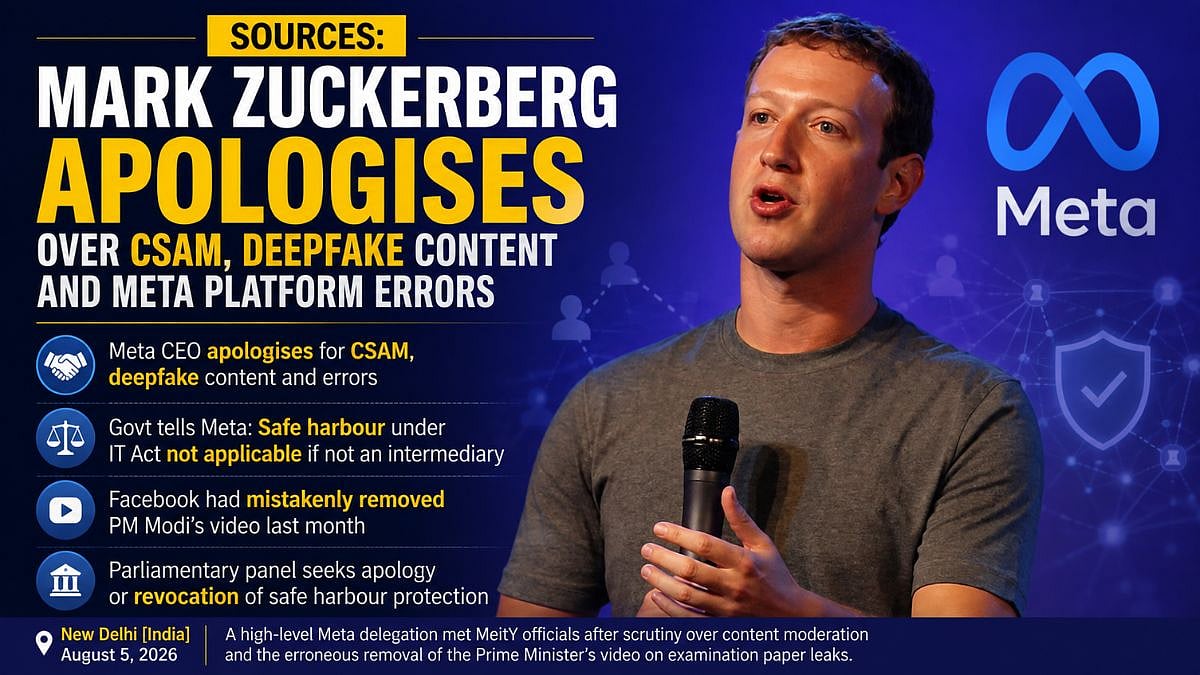
Meta CEO Mark Zuckerberg has apologised for the presence of Child Sexual Abuse Material (CSAM) and deepfake content on the platform, as well as errors in its operation. This apology comes after a meeting between Meta officials and the Indian government, where it was conveyed that the company does not qualify as an intermediary under the Information Technology Act.
The meeting, which lasted around 45 minutes, was attended by a high-level Meta delegation led by Chief Global Affairs Officer Joel Kaplan and MeitY Secretary S. Krishnan. During the meeting, Meta officials explained the reasons behind the erroneous takedown of Prime Minister Narendra Modi's video.
The Parliamentary Standing Committee on Communications had earlier warned Meta that deleting the Prime Minister's video was not the responsibility of an intermediary but that of a publisher. BJP MP Nishikant Dubey, who heads the committee, stated that Mark Zuckerberg must apologise within three days, or else the committee would revoke the 'safe harbour' protection currently provided to social media platforms.
The committee had taken a serious view of the removal of the Prime Minister's video from Facebook last month and had asked Meta founder and CEO Mark Zuckerberg to tender an apology. If this was not done, the safe harbour protection under Section 79 would be withdrawn.
Dubey also raised questions about the viewership algorithm of major social media companies, saying they have a policy of giving preference to newcomers. Meta had admitted that the content of the Prime Minister's video was missing for over four hours.
The Indian government has been critical of social media platforms for their handling of objectionable content. The government has asked these platforms to take responsibility for the content hosted on them and to ensure that they comply with Indian laws.
The apology by Mark Zuckerberg is seen as a significant development in the ongoing debate over the regulation of social media platforms in India. The Indian government has been pushing for greater accountability from these platforms, and the apology is likely to be seen as a step in the right direction.
However, the issue of safe harbour protection for social media platforms remains a contentious one. The government has been arguing that these platforms should not be given blanket immunity for the content hosted on them, and that they should be held responsible for any objectionable content.
The developments come at a time when social media platforms are facing increasing scrutiny over their handling of user data and their role in spreading misinformation. The Indian government has been taking steps to regulate these platforms, including the introduction of new rules for social media intermediaries.
In conclusion, the apology by Mark Zuckerberg is a significant development in the ongoing debate over the regulation of social media platforms in India. The issue of safe harbour protection for these platforms remains a contentious one, and it remains to be seen how the situation will unfold in the coming days.
The Indian government's efforts to regulate social media platforms are likely to have a significant impact on the way these platforms operate in the country. The government's push for greater accountability from these platforms is likely to lead to changes in the way they handle user data and objectionable content.
Overall, the situation highlights the need for social media platforms to be more responsible and accountable in their operations. The Indian government's efforts to regulate these platforms are likely to be watched closely by other countries, and the outcome is likely to have significant implications for the future of social media regulation.
Frequently asked questions
What was Mark Zuckerberg's apology for?
Mark Zuckerberg apologised for the presence of Child Sexual Abuse Material (CSAM) and deepfake content on the platform, as well as errors in its operation.
Why did the Indian government criticize Meta?
The Indian government criticized Meta for deleting Prime Minister Narendra Modi's video, which it said was not the responsibility of an intermediary but that of a publisher.