Supreme Court Rules Electricity Boards Face Strict Liability In Electrocution Cases
Supreme Court sets aside Karnataka High Court orders, distinguishes between strict and absolute liability.
'%3E%3Crect%20width%3D'96'%20height%3D'96'%20fill%3D'%231B5E20'%2F%3E%3Ccircle%20cx%3D'30'%20cy%3D'24'%20r%3D'44'%20fill%3D'%23fff'%20opacity%3D'.12'%2F%3E%3Ccircle%20cx%3D'60'%20cy%3D'74'%20r%3D'40'%20fill%3D'%23000'%20opacity%3D'.10'%2F%3E%3C%2Fg%3E%3Cg%3E%3Ccircle%20cx%3D'48'%20cy%3D'48'%20r%3D'15'%20fill%3D'%23fff'%2F%3E%3Cpath%20d%3D'M43%2034%20Q50%2048%2043%2062'%20fill%3D'none'%20stroke%3D'%238a94a6'%20stroke-width%3D'2.4'%2F%3E%3Cpath%20d%3D'M47%2033%20Q54%2048%2047%2063'%20fill%3D'none'%20stroke%3D'%238a94a6'%20stroke-width%3D'1.8'%20stroke-dasharray%3D'1.5%203'%2F%3E%3C%2Fg%3E%3C%2Fsvg%3E)
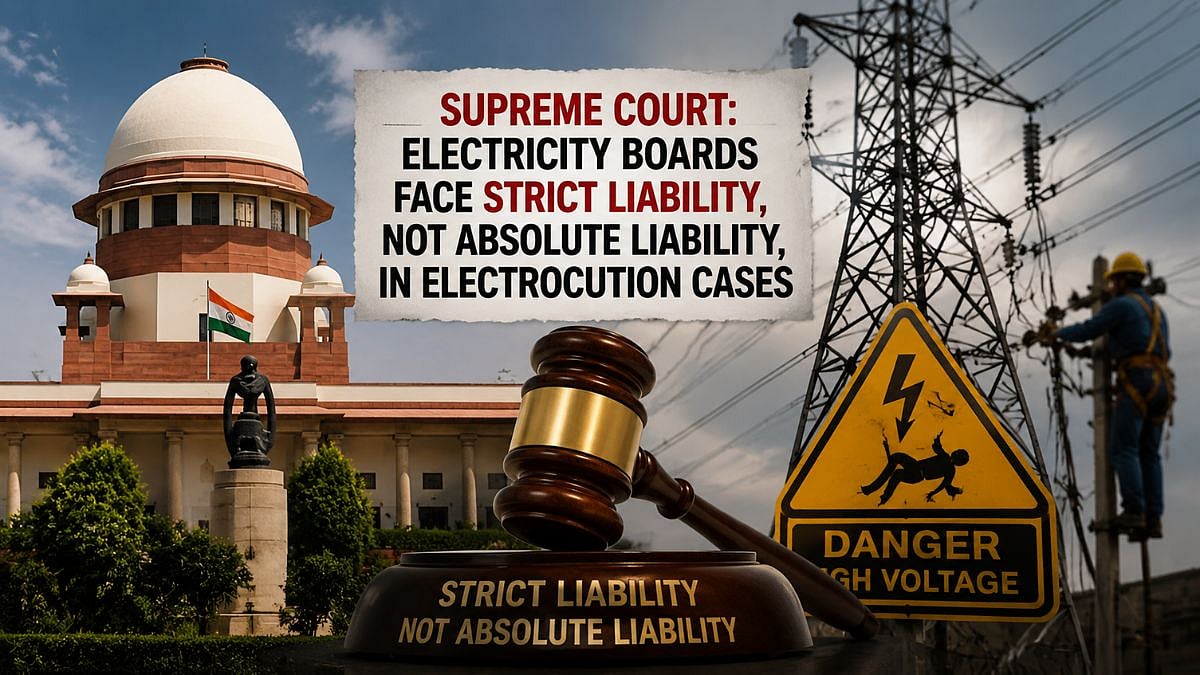
The Supreme Court has ruled that electricity authorities can be held strictly liable for deaths and injuries caused by electrocution. This decision was made by a Bench of Justice Sanjay Karol and Justice Nongmeikapam Kotiswar Singh, who set aside concurrent orders of the Single and Division Benches of the Karnataka High Court.
The Karnataka High Court had imposed absolute liability on the Karnataka Power Transmission Corporation in electrocution cases. However, the Supreme Court drew an important distinction between holding electricity authorities responsible for the risks inherent in transmitting power and making them liable in every case regardless of the circumstances.
The cases arose from two electrocution incidents in Karnataka. In one incident, a man died after coming into contact with an 11 kV transmission line. In the other incident, a person suffered severe injuries after coming into contact with a 66 kV line while trying to retrieve a cricket ball.
The Supreme Court held that strict liability, rather than absolute liability, was the appropriate standard in such cases. This is because electricity transmission is inherently dangerous, but circumstances may arise in which an electricity board cannot be held liable.
The Court observed that those carrying out inherently dangerous activities should bear the burden of the risks involved and that the State was no exception. Such enterprises are in the best position to distribute losses through mechanisms such as insurance or higher prices and can be expected to account for such risks.
The principle of strict liability was laid down in Rylands v Fletcher, which states that a person who brings onto their land something likely to cause harm can be held liable for the natural consequences if it escapes. However, this principle allows certain exceptions.
In contrast, absolute liability goes further and leaves no scope for such exceptions. It applies to enterprises engaged in inherently dangerous or hazardous activities when harm results from an accident arising from those activities.
The Supreme Court's decision is significant as it distinguishes between strict and absolute liability in electrocution cases. The Court's ruling will have implications for electricity authorities and their liability in such cases.
The decision is also a reminder of the importance of ensuring public safety in the transmission of electricity. Electricity authorities must take necessary precautions to prevent electrocution incidents and compensate those affected in case of an accident.
In conclusion, the Supreme Court's ruling on strict liability in electrocution cases is a significant development in the law. It highlights the importance of holding electricity authorities responsible for the risks inherent in transmitting power, while also allowing for recognised exceptions.
The ruling will have far-reaching implications for electricity authorities, consumers, and the general public. It is a reminder of the need for electricity authorities to prioritize public safety and take necessary precautions to prevent electrocution incidents.
The Supreme Court's decision is a step in the right direction, as it seeks to balance the need for electricity authorities to be held accountable for their actions with the need for flexibility in exceptional circumstances. The ruling will likely be welcomed by consumers and public safety advocates, who have long argued for greater accountability from electricity authorities.
Overall, the Supreme Court's ruling on strict liability in electrocution cases is a significant development in the law, with important implications for electricity authorities, consumers, and the general public.
The decision is a reminder of the importance of prioritizing public safety in the transmission of electricity and the need for electricity authorities to take necessary precautions to prevent electrocution incidents. It is also a reminder of the need for flexibility in exceptional circumstances and the importance of balancing accountability with fairness.
In the end, the Supreme Court's ruling is a step in the right direction, as it seeks to promote public safety, accountability, and fairness in the transmission of electricity.
Frequently asked questions
What is the difference between strict and absolute liability?
Strict liability holds a person or entity responsible for the risks inherent in an activity, while absolute liability holds them liable in every case regardless of the circumstances.
What are the implications of the Supreme Court's ruling on electricity authorities?
The ruling will have implications for electricity authorities and their liability in electrocution cases, and will likely lead to increased accountability and a greater emphasis on public safety.