FSSAI Proposes Red Warnings For Unhealthy Foods
FSSAI proposes red warning labels on packaged foods high in fat, sugar, and salt. The labels will help consumers identify unhealthy products.
'%3E%3Crect%20width%3D'96'%20height%3D'96'%20fill%3D'%231B5E20'%2F%3E%3Ccircle%20cx%3D'30'%20cy%3D'24'%20r%3D'44'%20fill%3D'%23fff'%20opacity%3D'.12'%2F%3E%3Ccircle%20cx%3D'60'%20cy%3D'74'%20r%3D'40'%20fill%3D'%23000'%20opacity%3D'.10'%2F%3E%3C%2Fg%3E%3Cg%3E%3Ccircle%20cx%3D'48'%20cy%3D'48'%20r%3D'15'%20fill%3D'%23fff'%2F%3E%3Cpath%20d%3D'M43%2034%20Q50%2048%2043%2062'%20fill%3D'none'%20stroke%3D'%238a94a6'%20stroke-width%3D'2.4'%2F%3E%3Cpath%20d%3D'M47%2033%20Q54%2048%2047%2063'%20fill%3D'none'%20stroke%3D'%238a94a6'%20stroke-width%3D'1.8'%20stroke-dasharray%3D'1.5%203'%2F%3E%3C%2Fg%3E%3C%2Fsvg%3E)
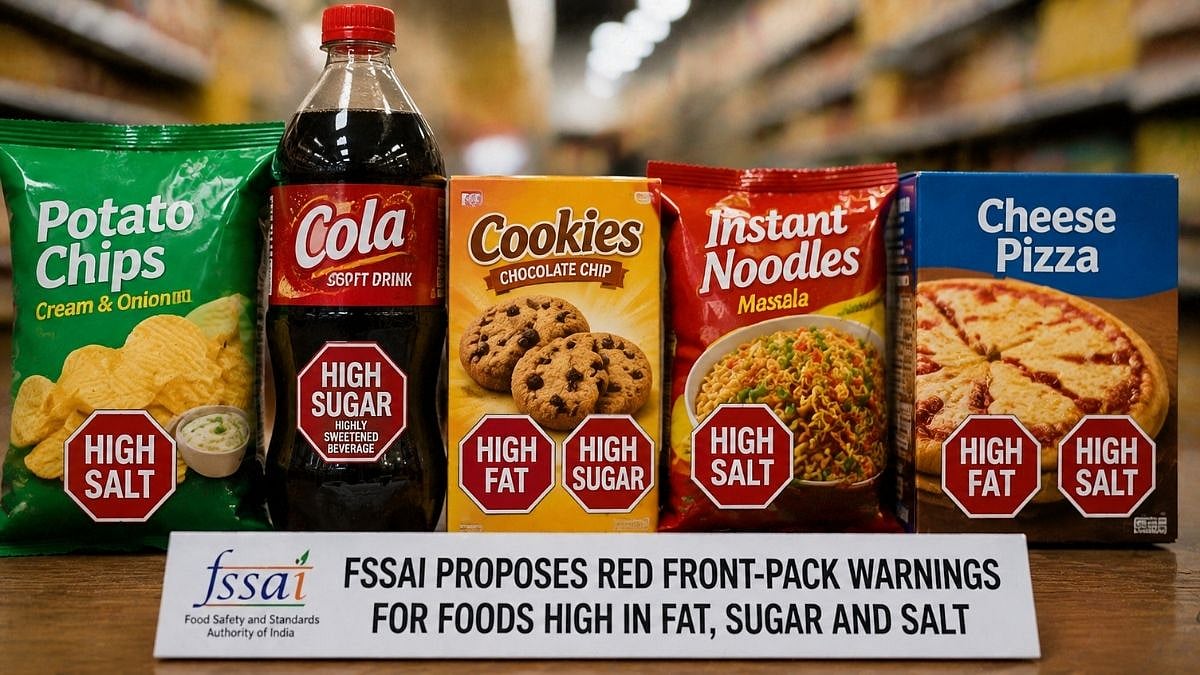
The Food Safety and Standards Authority of India (FSSAI) has proposed prominent red warning labels on packaged foods high in fat, sugar, or salt. This move follows directions from the Supreme Court to act against unhealthy food products.
The proposal outlines warnings such as 'HIGH FAT', 'HIGH SUGAR', and 'HIGH SALT' in red hexagonal boxes on the front of food packs. This will help consumers easily identify products containing high levels of specified nutrients.
FSSAI outlined the proposal in an affidavit filed before the Supreme Court, which had directed the food regulator to make such labels mandatory. The court's directive was in response to a plea linking excessive consumption of these nutrients to health problems, including diabetes, obesity, cardiovascular diseases, and certain cancers.
The regulator proposed that products high in any two or more specified nutrients, including saturated fat, added sugar, and salt, display the warning in a red-colored hexagonal shape. The warning label will indicate the applicable declaration(s), such as 'HIGH FAT', 'HIGH SUGAR', 'HIGH SALT', and/or 'HIGHLY SWEETENED BEVERAGE'.
FSSAI also proposed that the warning be displayed in a font larger than the one used in the nutrition information table on the back of the pack. Some single-ingredient foods may be exempt from the proposal, such as ghee, edible oil, salt, sugar, jaggery, and honey.
The regulator has recommended implementing the labeling system in phases to facilitate consumer acceptability and provide industry adequate time for reformulation. In the first phase, warnings would apply to products high in two or more specified nutrients, including added fat, added sugar, and salt, as well as specified sweetened beverages.
The second phase would extend the warning requirement to products high in any one of these nutrients. The classification of products would be based on thresholds laid down in the Dietary Guidelines for Indians, 2024, issued by the Indian Council of Medical Research-National Institute of Nutrition (ICMR-NIN).
This proposal is a significant step towards promoting healthier food choices and reducing the risk of diet-related health problems in India. By providing clear and prominent warnings on packaged foods, consumers will be better informed and able to make more informed decisions about their diet.
The implementation of the labeling system will also encourage food manufacturers to reformulate their products to reduce the levels of unhealthy nutrients. This, in turn, will contribute to a healthier food environment and help to reduce the burden of diet-related health problems in India.
In conclusion, the FSSAI's proposal for red warning labels on unhealthy foods is a welcome move towards promoting public health and reducing the risk of diet-related health problems. The proposal is a significant step towards creating a healthier food environment in India and will have a positive impact on the health and wellbeing of consumers.
Frequently asked questions
What is the purpose of the FSSAI's proposal for red warning labels on foods?
The purpose of the proposal is to help consumers identify products high in fat, sugar, and salt, and to promote healthier food choices.
Which products will be exempt from the proposal?
Some single-ingredient foods, such as ghee, edible oil, salt, sugar, jaggery, and honey, may be exempt from the proposal.