Karnataka HC Rejects Husband's Divorce Plea
Hindu marriage is a sacrament, not a contract. Karnataka HC dismisses divorce appeal.
'%3E%3Crect%20width%3D'96'%20height%3D'96'%20fill%3D'%23B3261E'%2F%3E%3Ccircle%20cx%3D'30'%20cy%3D'24'%20r%3D'44'%20fill%3D'%23fff'%20opacity%3D'.12'%2F%3E%3Ccircle%20cx%3D'60'%20cy%3D'74'%20r%3D'40'%20fill%3D'%23000'%20opacity%3D'.10'%2F%3E%3C%2Fg%3E%3Cg%20fill%3D'%23fff'%3E%3Crect%20x%3D'29'%20y%3D'49'%20width%3D'8'%20height%3D'19'%20rx%3D'1'%2F%3E%3Crect%20x%3D'39'%20y%3D'40'%20width%3D'9'%20height%3D'28'%20rx%3D'1'%2F%3E%3Crect%20x%3D'50'%20y%3D'45'%20width%3D'8'%20height%3D'23'%20rx%3D'1'%2F%3E%3Crect%20x%3D'60'%20y%3D'53'%20width%3D'7'%20height%3D'15'%20rx%3D'1'%2F%3E%3Crect%20x%3D'41'%20y%3D'34'%20width%3D'5'%20height%3D'6'%2F%3E%3C%2Fg%3E%3C%2Fsvg%3E)
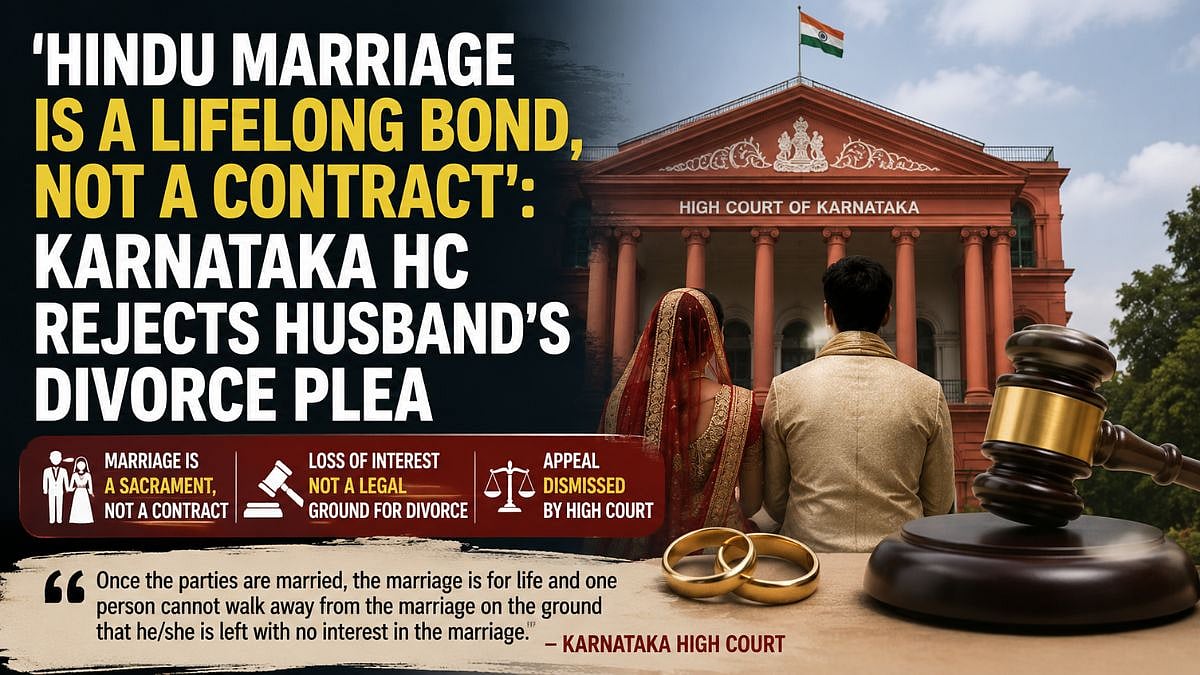
The Karnataka High Court has dismissed a husband's appeal for divorce, stating that a Hindu marriage is a lifelong bond and not a contract. The court made this observation while rejecting an appeal filed under the Hindu Marriage Act, 1955.
The case involved a couple who had entered into an inter-caste love marriage on December 15, 2003, and have a daughter who is now almost a major. The husband had sought divorce, while the wife filed a petition seeking restitution of conjugal rights under Section 9 of the Act.
The Family Court had earlier dismissed the husband's divorce petition and allowed the wife's plea for restitution of conjugal rights. The husband later approached the court again, arguing that the parties had not resumed cohabitation despite the restitution decree. He claimed he had made efforts to persuade his wife to return, but the marriage had irretrievably broken down.
However, the wife denied allegations of cruelty or incompatibility. She told the court that she had cared for both her husband and his parents and had never demanded a separate residence. The Family Court had already found that the husband failed to establish cruelty under Section 13(1)(ia) of the Hindu Marriage Act.
The High Court observed that the husband was attempting to take advantage of his own wrong. The Bench pointed out that the man had married the respondent out of love, fathered a daughter who is now almost an adult, and later approached the court only because he had lost interest in the marriage.
The court's decision highlights the importance of understanding the sanctity of Hindu marriage. The ruling emphasizes that marriage under Hindu law is meant to be a lifelong bond and one party cannot simply walk away after deciding they no longer wish to remain married.
This decision is significant as it sets a precedent for future cases involving divorce petitions under the Hindu Marriage Act. The court's observation that a husband cannot seek divorce merely because he has lost interest in continuing the relationship is a crucial aspect of this ruling.
The Karnataka High Court's decision is a reminder that marriage is a sacred institution in Hindu law and should not be taken lightly. The court's emphasis on the importance of lifelong commitment in a Hindu marriage is a significant aspect of this ruling.
In conclusion, the Karnataka High Court's decision to reject the husband's divorce plea is a significant ruling that highlights the importance of understanding the sanctity of Hindu marriage. The court's observation that a Hindu marriage is a lifelong bond and not a contract is a crucial aspect of this decision.
The decision is also a reminder that the courts will not entertain divorce petitions that are filed solely because one party has lost interest in the marriage. The court's emphasis on the importance of lifelong commitment in a Hindu marriage is a significant aspect of this ruling.
The Karnataka High Court's decision is a significant development in the realm of family law and is likely to have far-reaching implications for future cases involving divorce petitions under the Hindu Marriage Act.
Frequently asked questions
What was the basis of the husband's divorce plea?
The husband claimed that the marriage had irretrievably broken down and that he had lost interest in continuing the relationship.
What was the court's decision?
The Karnataka High Court dismissed the husband's divorce plea, stating that a Hindu marriage is a lifelong bond and not a contract.