Deep-Sea Crustacean Uses Aluminum Shield to Survive
Scientists discover aluminum-coated exoskeleton in deep-sea crustacean. Helps resist calcium dissolution under immense pressure.
'%3E%3Crect%20width%3D'96'%20height%3D'96'%20fill%3D'%23B3261E'%2F%3E%3Ccircle%20cx%3D'30'%20cy%3D'24'%20r%3D'44'%20fill%3D'%23fff'%20opacity%3D'.12'%2F%3E%3Ccircle%20cx%3D'60'%20cy%3D'74'%20r%3D'40'%20fill%3D'%23000'%20opacity%3D'.10'%2F%3E%3C%2Fg%3E%3Cg%20fill%3D'%23fff'%3E%3Crect%20x%3D'29'%20y%3D'49'%20width%3D'8'%20height%3D'19'%20rx%3D'1'%2F%3E%3Crect%20x%3D'39'%20y%3D'40'%20width%3D'9'%20height%3D'28'%20rx%3D'1'%2F%3E%3Crect%20x%3D'50'%20y%3D'45'%20width%3D'8'%20height%3D'23'%20rx%3D'1'%2F%3E%3Crect%20x%3D'60'%20y%3D'53'%20width%3D'7'%20height%3D'15'%20rx%3D'1'%2F%3E%3Crect%20x%3D'41'%20y%3D'34'%20width%3D'5'%20height%3D'6'%2F%3E%3C%2Fg%3E%3C%2Fsvg%3E)
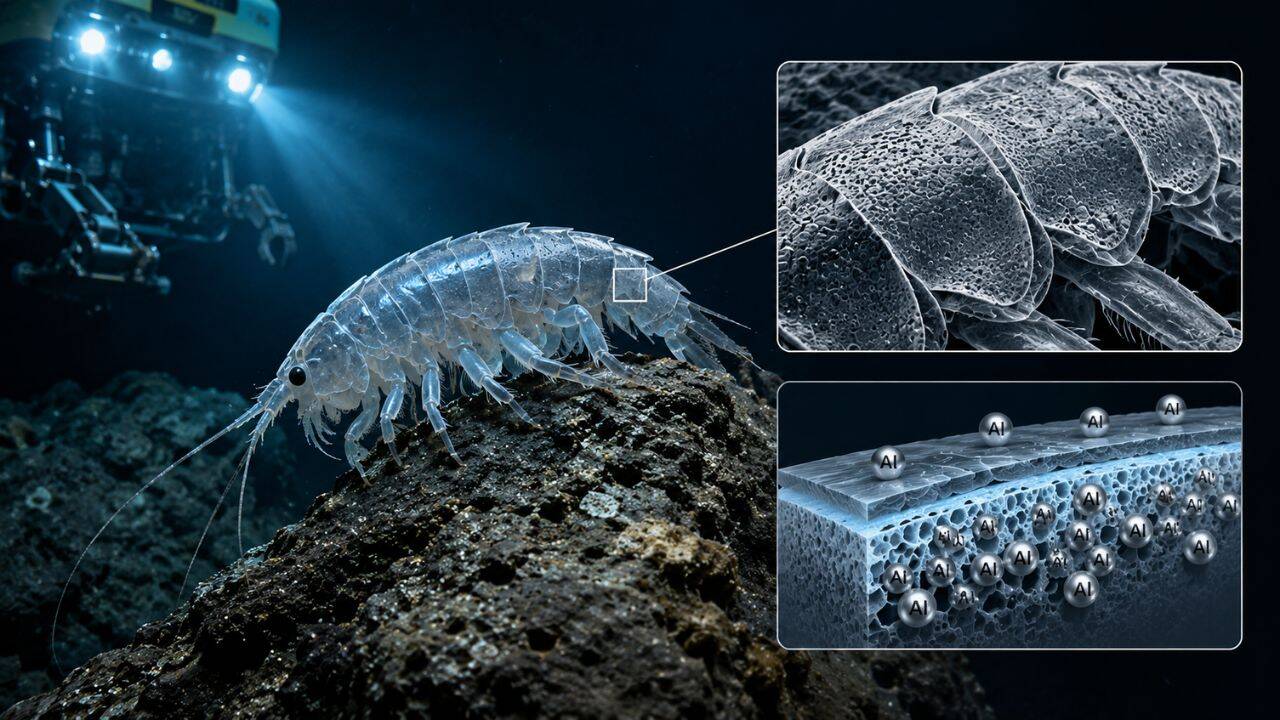
A team of scientists has made a groundbreaking discovery in the Mariana Trench, one of the most extreme environments on Earth. They have identified a deep-sea crustacean, the amphipod Hirondellea gigas, which uses aluminum to survive in this harsh environment.
The unique feature of this crustacean is its aluminum-coated exoskeleton, which helps resist calcium dissolution under immense pressure. This adaptation allows the crustacean to thrive in an environment where life was previously deemed impossible.
The Mariana Trench is the deepest point in the ocean, with pressures reaching over 1,000 times that of the atmospheric pressure at sea level. The conditions in this environment are so extreme that only a few species have been able to adapt and survive.
The discovery of the aluminum-coated exoskeleton in the Hirondellea gigas is a significant finding, as it showcases the innovative survival mechanisms that exist in the deep ocean. This discovery can help scientists better understand how life can thrive in extreme environments and can potentially lead to new discoveries and a greater understanding of the ocean's ecosystem.
The use of aluminum in the exoskeleton of the Hirondellea gigas is a remarkable example of the unique adaptations that exist in the deep sea. The aluminum coating helps to protect the crustacean's exoskeleton from the corrosive effects of the seawater, allowing it to maintain its structure and function in the extreme conditions of the Mariana Trench.
This discovery is not only significant for our understanding of the deep ocean and its ecosystem, but it also highlights the importance of continued exploration and research into the world's oceans. The deep sea is a vast and largely unexplored environment, and continued research is necessary to fully understand its many secrets and wonders.
In conclusion, the discovery of the aluminum-coated exoskeleton in the Hirondellea gigas is a significant finding that highlights the innovative survival mechanisms that exist in the deep ocean. This discovery can help scientists better understand how life can thrive in extreme environments and can potentially lead to new discoveries and a greater understanding of the ocean's ecosystem.
Frequently asked questions
What is the name of the deep-sea crustacean that uses aluminum to survive?
The deep-sea crustacean is called Hirondellea gigas, an amphipod.
Where does the Hirondellea gigas live?
The Hirondellea gigas lives in the Mariana Trench, one of the most extreme environments on Earth.