Bombay High Court Challenged Over Marathi Language Rule
PIL filed against Maharashtra's Marathi language requirement for cab drivers
'%3E%3Crect%20width%3D'96'%20height%3D'96'%20fill%3D'%23B3261E'%2F%3E%3Ccircle%20cx%3D'30'%20cy%3D'24'%20r%3D'44'%20fill%3D'%23fff'%20opacity%3D'.12'%2F%3E%3Ccircle%20cx%3D'60'%20cy%3D'74'%20r%3D'40'%20fill%3D'%23000'%20opacity%3D'.10'%2F%3E%3C%2Fg%3E%3Cg%20fill%3D'%23fff'%3E%3Crect%20x%3D'29'%20y%3D'49'%20width%3D'8'%20height%3D'19'%20rx%3D'1'%2F%3E%3Crect%20x%3D'39'%20y%3D'40'%20width%3D'9'%20height%3D'28'%20rx%3D'1'%2F%3E%3Crect%20x%3D'50'%20y%3D'45'%20width%3D'8'%20height%3D'23'%20rx%3D'1'%2F%3E%3Crect%20x%3D'60'%20y%3D'53'%20width%3D'7'%20height%3D'15'%20rx%3D'1'%2F%3E%3Crect%20x%3D'41'%20y%3D'34'%20width%3D'5'%20height%3D'6'%2F%3E%3C%2Fg%3E%3C%2Fsvg%3E)
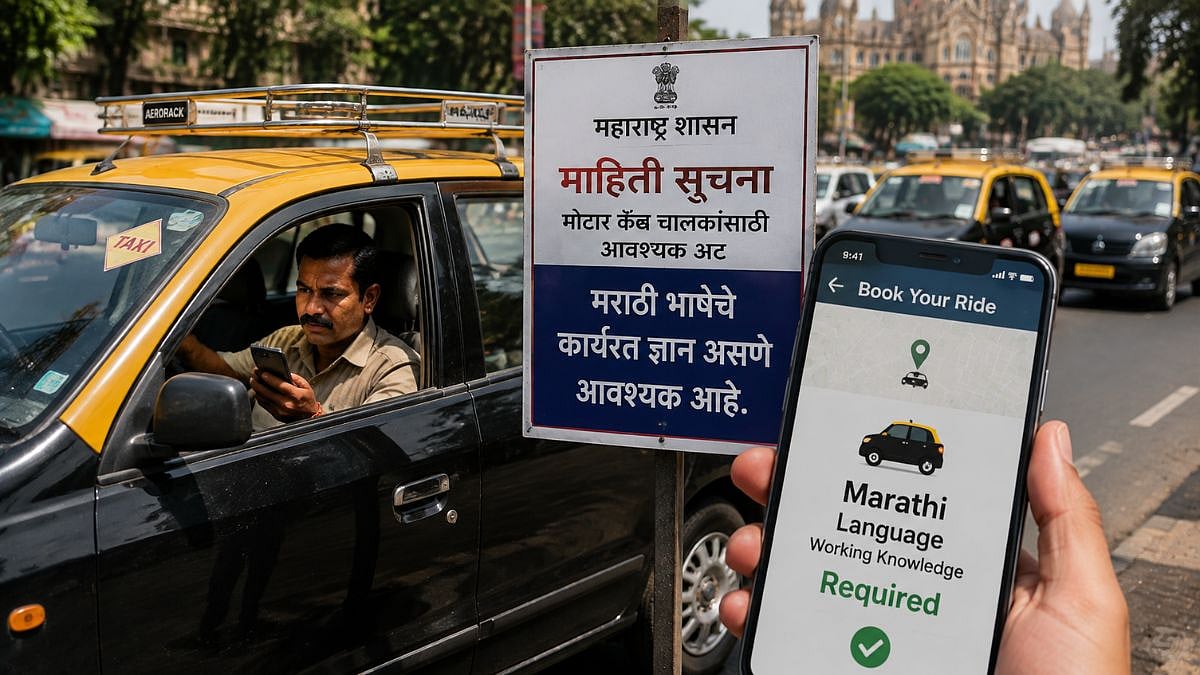
Mumbai, August 28, 2026, saw the filing of a public interest litigation before the Bombay High Court, challenging the Maharashtra government's decision to make a 'working knowledge of Marathi language' a condition for drivers and permit holders of motor cabs.
The government introduced this requirement through a notification dated August 12, as part of the Maharashtra Motor Vehicles (Third Amendment) Rules, 2026. The amendment affects authorisation to drive motor cabs, permit holders, and renewal of permits.
Advocate Ghanshyam Upadhyay, who filed the PIL, argues that the requirement is undefined and lacks an objective proficiency standard, uniform test, or syllabus. He also challenges provisions that allow for suspension and eventual cancellation of authorisation due to continued non-compliance.
According to the petition, this requirement could harm the livelihood of economically vulnerable drivers. It argues that making language proficiency a condition for continuing an occupation violates constitutional guarantees under Articles 14, 19(1)(g), and 21, and is disproportionate.
The petition clarifies that the challenge is not against Marathi or its promotion as the official language of Maharashtra. Instead, it argues that converting linguistic promotion into an occupational disability for a selected class of citizens is unfair.
The petitioner relies on a 2017 Bombay High Court judgment that struck down a Marathi-language condition for auto-rickshaw permits due to lack of statutory support. The PIL acknowledges that the 2026 amendment was introduced to address this issue.
The petitioner seeks quashing of the amendments that make Marathi proficiency a condition for livelihood. Alternatively, he seeks that the provisions be read down to prescribe only a minimal, objective communication standard, with multilingual alternatives, and without suspension or cancellation solely for language deficiency.
Earlier, on August 25, four cab drivers who operate through mobile-based cab aggregator platforms approached the High Court, challenging the Maharashtra government's decision to make knowledge of Marathi compulsory for auto-rickshaw, taxi, and app-based cab drivers. They argued that the decision violates their fundamental rights under Articles 14, 19, and 21 of the Constitution.
The introduction of the Marathi language requirement has sparked debate about the balance between promoting the official language and protecting the livelihoods of drivers. The Bombay High Court will now consider the petitions and determine the fate of the Maharashtra government's decision.
The outcome of this case will have significant implications for cab drivers and permit holders in Maharashtra, as well as the state's language policy. It remains to be seen how the court will balance the competing interests and interpret the constitutional provisions at play.
In the meantime, the petitions have highlighted the need for a nuanced approach to language policy, one that promotes the official language while also protecting the rights of citizens. The case serves as a reminder of the importance of carefully considering the impact of policy decisions on vulnerable populations.
As the Bombay High Court deliberates on the matter, it is likely that the decision will have far-reaching consequences for the state's language policy and the livelihoods of those affected. The court's ruling will be closely watched, and its implications will be felt across the state.
In conclusion, the challenge to the Marathi language requirement for cab drivers and permit holders has brought to the forefront important questions about language policy, constitutional rights, and the balance between promoting the official language and protecting the livelihoods of citizens. The outcome of this case will be significant, and its implications will be felt for years to come.
The Maharashtra government's decision to make Marathi language proficiency a condition for cab drivers and permit holders has sparked a heated debate. While the government argues that the move is necessary to promote the official language, critics argue that it is unfair and violates the constitutional rights of drivers. The Bombay High Court will now have to weigh in on the matter and determine the fate of the government's decision.
The case has also raised questions about the procedure followed by the government in introducing the amended rules. The petitioners argue that the government did not follow the mandatory procedure of previous publication under Section 212 of the Motor Vehicles Act. The court will have to consider this argument and determine whether the government followed the proper procedure.
The implications of the case are far-reaching, and the outcome will have significant consequences for the state's language policy and the livelihoods of cab drivers and permit holders. The case serves as a reminder of the importance of carefully considering the impact of policy decisions on vulnerable populations and the need for a nuanced approach to language policy.
What it means: The challenge to the Marathi language requirement for cab drivers and permit holders has significant implications for the state's language policy and the livelihoods of those affected. The outcome of the case will be closely watched, and its implications will be felt across the state. The case highlights the need for a balanced approach to language policy, one that promotes the official language while also protecting the rights of citizens.
Frequently asked questions
What is the Marathi language requirement for cab drivers?
The Maharashtra government has made 'working knowledge of Marathi language' a condition for drivers and permit holders of motor cabs.
Why are cab drivers challenging the Marathi language requirement?
Cab drivers are challenging the requirement because they argue it violates their fundamental rights under Articles 14, 19, and 21 of the Constitution and is disproportionate.