BMC Introduces Peer Review System For Civic Hospitals
BMC to make civic hospital deans review each other’s functioning. Aimed at improving accountability and functioning.
'%3E%3Crect%20width%3D'96'%20height%3D'96'%20fill%3D'%23B3261E'%2F%3E%3Ccircle%20cx%3D'30'%20cy%3D'24'%20r%3D'44'%20fill%3D'%23fff'%20opacity%3D'.12'%2F%3E%3Ccircle%20cx%3D'60'%20cy%3D'74'%20r%3D'40'%20fill%3D'%23000'%20opacity%3D'.10'%2F%3E%3C%2Fg%3E%3Cg%20fill%3D'%23fff'%3E%3Crect%20x%3D'29'%20y%3D'49'%20width%3D'8'%20height%3D'19'%20rx%3D'1'%2F%3E%3Crect%20x%3D'39'%20y%3D'40'%20width%3D'9'%20height%3D'28'%20rx%3D'1'%2F%3E%3Crect%20x%3D'50'%20y%3D'45'%20width%3D'8'%20height%3D'23'%20rx%3D'1'%2F%3E%3Crect%20x%3D'60'%20y%3D'53'%20width%3D'7'%20height%3D'15'%20rx%3D'1'%2F%3E%3Crect%20x%3D'41'%20y%3D'34'%20width%3D'5'%20height%3D'6'%2F%3E%3C%2Fg%3E%3C%2Fsvg%3E)
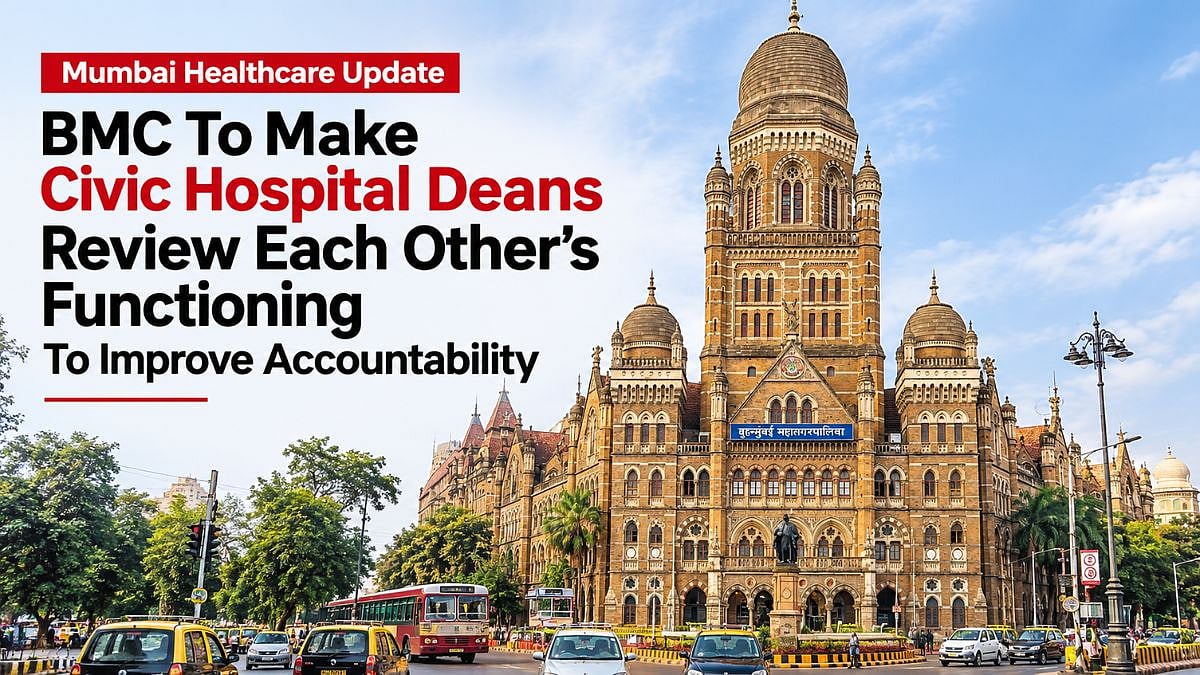
The Brihanmumbai Municipal Corporation (BMC) has introduced a peer-review system for civic hospitals in Mumbai. Under this system, deans of one municipal hospital will visit another civic hospital, assess its functioning, identify shortcomings, and suggest corrective measures.
This move is aimed at strengthening accountability and improving the functioning of civic hospitals. Prajakta Verma Lavangare, Additional Municipal Commissioner (City), who also holds charge of the health department, said the system would involve senior medical administrators reviewing the functioning of their “sister” hospitals.
For instance, the dean of Sion Hospital could visit KEM Hospital and review its functioning. Verma Lavangare said the mechanism would allow one medical administrator to point out shortcomings to another at a peer level.
The proposed system comes amid concerns over attendance and availability of doctors and other medical staff at civic hospitals. Verma Lavangare said deans had been told that doctors should not only be available at hospitals but should also be seen performing their assigned duties.
While she said most doctors were attending their duties on time, she acknowledged that some cases required intervention. The civic administration will follow due procedure, including inquiries and disciplinary action, wherever violations related to attendance or duty are established.
Health activist Chetan Kothari said the peer-review mechanism should not become a routine exercise in which visiting teams overlook shortcomings at the hospital being inspected. He suggested that the BMC prepare a standard checklist covering key parameters and make it mandatory for visiting deans to submit detailed reports identifying deficiencies and recommending corrective measures.
The BMC has also formally involved assistant municipal commissioners in health-related field visits. They will monitor primary healthcare facilities as well as outsourced and public-private partnership services in their respective wards.
Verma Lavangare said the civic administration was also working towards introducing performance-based monitoring of several outsourced services through a Quality-and-Cost-Based Selection (QCBS) mechanism, with service-level indicators to assess the performance of private operators.
This move is expected to improve the overall functioning of civic hospitals in Mumbai and ensure better healthcare services to the citizens. The BMC's efforts to strengthen accountability and improve the functioning of civic hospitals are a step in the right direction.
The introduction of the peer-review system and performance-based monitoring of outsourced services will help identify shortcomings and suggest corrective measures, ultimately leading to better healthcare services in Mumbai.
The BMC's decision to involve assistant municipal commissioners in health-related field visits will also help monitor primary healthcare facilities and outsourced services, ensuring that they are functioning effectively.
In conclusion, the BMC's initiatives to improve the functioning of civic hospitals are a positive step towards providing better healthcare services to the citizens of Mumbai.
The move is expected to have a significant impact on the healthcare sector in Mumbai, and it will be interesting to see how the peer-review system and performance-based monitoring of outsourced services are implemented and their effects on the functioning of civic hospitals.
Frequently asked questions
What is the purpose of the peer review system introduced by BMC?
The purpose of the peer review system is to improve accountability and functioning of civic hospitals in Mumbai.
Who will be involved in the peer review process?
Deans of one municipal hospital will visit another civic hospital, assess its functioning, identify shortcomings, and suggest corrective measures.