India May Reach $20 Trillion Economy By 2036: Equirus
India could become $20 trillion economy, 14.2% rupee growth needed, says Equirus report.
'%3E%3Crect%20width%3D'96'%20height%3D'96'%20fill%3D'%230B6E4F'%2F%3E%3Ccircle%20cx%3D'30'%20cy%3D'24'%20r%3D'44'%20fill%3D'%23fff'%20opacity%3D'.12'%2F%3E%3Ccircle%20cx%3D'60'%20cy%3D'74'%20r%3D'40'%20fill%3D'%23000'%20opacity%3D'.10'%2F%3E%3C%2Fg%3E%3Cg%20fill%3D'none'%20stroke%3D'%23fff'%20stroke-width%3D'3.2'%20stroke-linecap%3D'round'%20stroke-linejoin%3D'round'%3E%3Cpolyline%20points%3D'31%2C59%2041%2C49%2049%2C54%2063%2C37'%2F%3E%3Cpolyline%20points%3D'55%2C37%2063%2C37%2063%2C45'%2F%3E%3C%2Fg%3E%3C%2Fsvg%3E)
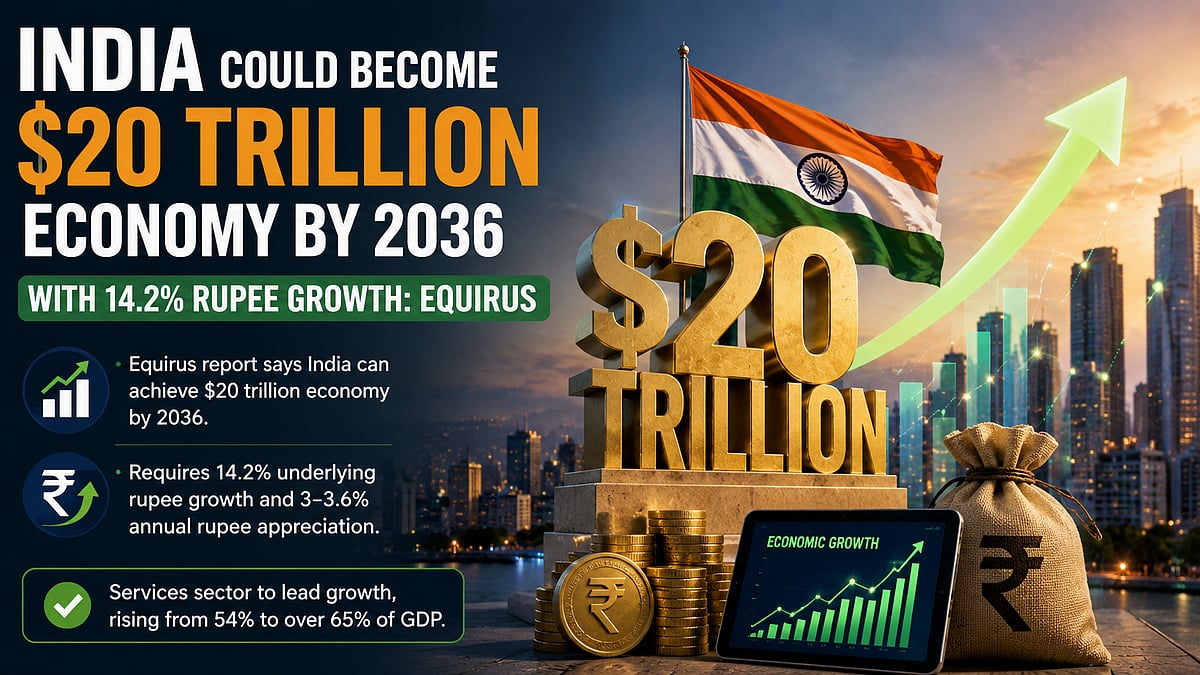
India could reach a $20 trillion economy by 2036 if it achieves 14.2% rupee growth and 3-3.6% annual rupee appreciation, according to a research report by Equirus.
The report lays out a 20-step reform agenda to lift India's growth trajectory and strengthen its external balance. India has already shown significant growth, taking 67 years to build its first $2 trillion of GDP and nearly doubling its economy in the decade after 2014.
To reach $20 trillion from the current base of $3.7 trillion, the economy would need to expand roughly 5.5 times and sustain nominal dollar growth of around 18% annually. Services are expected to drive growth, accounting for about 54% of GDP and needing to rise beyond 65%.
The proposed reforms span multiple sectors, including the real economy, capital markets, human capital, services, and urban governance. They include bringing fuel under GST, enforcing state capital-expenditure floors, and listing the Railways.
The report estimates that abolishing advance tax could release around Rs 10 trillion of working capital, while a flat 5% TDS could unlock another Rs 13.4 trillion. Services-focused reforms, such as a National GCC policy and tourism promotion, could provide a further growth boost.
The brokerage estimates that the reform package would generate about Rs 7.9 trillion in annual direct gains against costs of roughly Rs 3.4 trillion, implying a net gain of Rs 4.5 trillion. Achieving the $20 trillion milestone will ultimately depend on execution across multiple fronts rather than any single policy lever.
India's growth trajectory has been impressive, with the economy expanding rapidly in recent years. However, to sustain this growth and reach the ambitious target of $20 trillion, the country will need to implement significant reforms and invest in key sectors such as services and manufacturing.
The report highlights the importance of services in driving growth, with the sector expected to account for more than 65% of GDP by 2036. This will require significant investment in areas such as education, healthcare, and infrastructure.
Overall, the report provides a roadmap for India to achieve its ambitious economic goals and become a $20 trillion economy by 2036. However, it will require careful planning, execution, and investment in key sectors to make this vision a reality.
In conclusion, India's potential to become a $20 trillion economy by 2036 is significant, but it will require sustained efforts and reforms to achieve this goal. The report by Equirus provides a comprehensive roadmap for the country to follow, and its implementation will be crucial in determining India's economic future.
The Indian government has already taken several steps to boost economic growth, including implementing policies to attract foreign investment and promote entrepreneurship. However, more needs to be done to address the country's infrastructure gaps, improve the business environment, and increase access to education and healthcare.
As India continues to grow and develop, it is likely to face several challenges, including managing its rapid urbanization, addressing environmental concerns, and ensuring that the benefits of growth are shared equitably among its population. However, with careful planning and execution, the country can overcome these challenges and achieve its ambitious economic goals.
In the coming years, India's economic growth is expected to be driven by several factors, including its large and growing consumer market, its rapidly expanding middle class, and its increasing integration into global trade and investment flows. However, the country will need to continue to invest in key sectors such as education, healthcare, and infrastructure to sustain this growth and achieve its long-term economic goals.
The report by Equirus provides a valuable insight into India's economic potential and the steps that need to be taken to achieve its ambitious goals. It highlights the importance of services in driving growth and the need for significant investment in areas such as education, healthcare, and infrastructure. As India continues to grow and develop, it is likely to play an increasingly important role in the global economy, and its economic success will have significant implications for the rest of the world.
In terms of its implications for the global economy, India's growth is likely to have a significant impact on trade and investment flows. The country's large and growing consumer market, its rapidly expanding middle class, and its increasing integration into global trade and investment flows make it an attractive destination for foreign investors. As India continues to grow and develop, it is likely to become an increasingly important player in the global economy, and its economic success will have significant implications for the rest of the world.
Overall, the report by Equirus provides a comprehensive roadmap for India to achieve its ambitious economic goals and become a $20 trillion economy by 2036. While there are several challenges that need to be addressed, the country has the potential to overcome these challenges and achieve its long-term economic goals. With careful planning and execution, India can sustain its rapid economic growth, invest in key sectors, and become a major player in the global economy.
The Indian government has already taken several steps to boost economic growth, including implementing policies to attract foreign investment and promote entrepreneurship. However, more needs to be done to address the country's infrastructure gaps, improve the business environment, and increase access to education and healthcare. As India continues to grow and develop, it is likely to face several challenges, including managing its rapid urbanization, addressing environmental concerns, and ensuring that the benefits of growth are shared equitably among its population.
In conclusion, India's potential to become a $20 trillion economy by 2036 is significant, but it will require sustained efforts and reforms to achieve this goal. The report by Equirus provides a comprehensive roadmap for the country to follow, and its implementation will be crucial in determining India's economic future. With careful planning and execution, India can overcome the challenges it faces, sustain its rapid economic growth, and become a major player in the global economy.
India's economic growth has been impressive in recent years, with the country expanding rapidly and becoming an increasingly important player in the global economy. However, to sustain this growth and achieve its long-term economic goals, the country will need to continue to invest in key sectors such as education, healthcare, and infrastructure.
The report by Equirus highlights the importance of services in driving growth, with the sector expected to account for more than 65% of GDP by 2036. This will require significant investment in areas such as education, healthcare, and infrastructure, as well as policies to promote entrepreneurship and attract foreign investment.
Overall, the report provides a valuable insight into India's economic potential and the steps that need to be taken to achieve its ambitious goals. It highlights the importance of services in driving growth and the need for significant investment in areas such as education, healthcare, and infrastructure. As India continues to grow and develop, it is likely to play an increasingly important role in the global economy, and its economic success will have significant implications for the rest of the world.
The Indian government has already taken several steps to boost economic growth, including implementing policies to attract foreign investment and promote entrepreneurship. However, more needs to be done to address the country's infrastructure gaps, improve the business environment, and increase access to education and healthcare. As India continues to grow and develop, it is likely to face several challenges, including managing its rapid urbanization, addressing environmental concerns, and ensuring that the benefits of growth are shared equitably among its population.
In terms of its implications for the global economy, India's growth is likely to have a significant impact on trade and investment flows. The country's large and growing consumer market, its rapidly expanding middle class, and its increasing integration into global trade and investment flows make it an attractive destination for foreign investors. As India continues to grow and develop, it is likely to become an increasingly important player in the global economy, and its economic success will have significant implications for the rest of the world.
The report by Equirus provides a comprehensive roadmap for India to achieve its ambitious economic goals and become a $20 trillion economy by 2036. While there are several challenges that need to be addressed, the country has the potential to overcome these challenges and achieve its long-term economic goals. With careful planning and execution, India can sustain its rapid economic growth, invest in key sectors, and become a major player in the global economy.
In conclusion, India's potential to become a $20 trillion economy by 2036 is significant, but it will require sustained efforts and reforms to achieve this goal. The report by Equirus provides a comprehensive roadmap for the country to follow, and its implementation will be crucial in determining India's economic future. With careful planning and execution, India can overcome the challenges it faces, sustain its rapid economic growth, and become a major player in the global economy.
What it means for India is that the country has the potential to become a major player in the global economy, with significant implications for trade and investment flows. The report by Equirus provides a valuable insight into India's economic potential and the steps that need to be taken to achieve its ambitious goals. It highlights the importance of services in driving growth and the need for significant investment in areas such as education, healthcare, and infrastructure. As India continues to grow and develop, it is likely to play an increasingly important role in the global economy, and its economic success will have significant implications for the rest of the world.
The Indian government has already taken several steps to boost economic growth, including implementing policies to attract foreign investment and promote entrepreneurship. However, more needs to be done to address the country's infrastructure gaps, improve the business environment, and increase access to education and healthcare. As India continues to grow and develop, it is likely to face several challenges, including managing its rapid urbanization, addressing environmental concerns, and ensuring that the benefits of growth are shared equitably among its population.
Overall, the report provides a comprehensive roadmap for India to achieve its ambitious economic goals and become a $20 trillion economy by 2036. With careful planning and execution, India can sustain its rapid economic growth, invest in key sectors, and become a major player in the global economy. The country's economic success will have significant implications for the rest of the world, and its growth is likely to have a major impact on trade and investment flows.
In terms of its implications for the global economy, India's growth is likely to have a significant impact on trade and investment flows. The country's large and growing consumer market, its rapidly expanding middle class, and its increasing integration into global trade and investment flows make it an attractive destination for foreign investors. As India continues to grow and develop, it is likely to become an increasingly important player in the global economy, and its economic success will have significant implications for the rest of the world.
The report by Equirus provides a valuable insight into India's economic potential and the steps that need to be taken to achieve its ambitious goals. It highlights the importance of services in driving growth and the need for significant investment in areas such as education, healthcare, and infrastructure. As India continues to grow and develop, it is likely to play an increasingly important role in the global economy, and its economic success will have significant implications for the rest of the world.
In conclusion, India's potential to become a $20 trillion economy by 2036 is significant, but it will require sustained efforts and reforms to achieve this goal. The report by Equirus provides a comprehensive roadmap for the country to follow, and its implementation will be crucial in determining India's economic future. With careful planning and execution, India can overcome the challenges it faces, sustain its rapid economic growth, and become a major player in the global economy.
Frequently asked questions
What is the projected size of India's economy by 2036?
$20 trillion