Indonesia's Biodiesel Policy Unlikely to Hurt India
Indonesia's aggressive biofuel push, Indonesia's B60 policy, may not impact India. India turns to alternative oils.
'%3E%3Crect%20width%3D'96'%20height%3D'96'%20fill%3D'%23B3261E'%2F%3E%3Ccircle%20cx%3D'30'%20cy%3D'24'%20r%3D'44'%20fill%3D'%23fff'%20opacity%3D'.12'%2F%3E%3Ccircle%20cx%3D'60'%20cy%3D'74'%20r%3D'40'%20fill%3D'%23000'%20opacity%3D'.10'%2F%3E%3C%2Fg%3E%3Cg%20fill%3D'%23fff'%3E%3Crect%20x%3D'29'%20y%3D'49'%20width%3D'8'%20height%3D'19'%20rx%3D'1'%2F%3E%3Crect%20x%3D'39'%20y%3D'40'%20width%3D'9'%20height%3D'28'%20rx%3D'1'%2F%3E%3Crect%20x%3D'50'%20y%3D'45'%20width%3D'8'%20height%3D'23'%20rx%3D'1'%2F%3E%3Crect%20x%3D'60'%20y%3D'53'%20width%3D'7'%20height%3D'15'%20rx%3D'1'%2F%3E%3Crect%20x%3D'41'%20y%3D'34'%20width%3D'5'%20height%3D'6'%2F%3E%3C%2Fg%3E%3C%2Fsvg%3E)
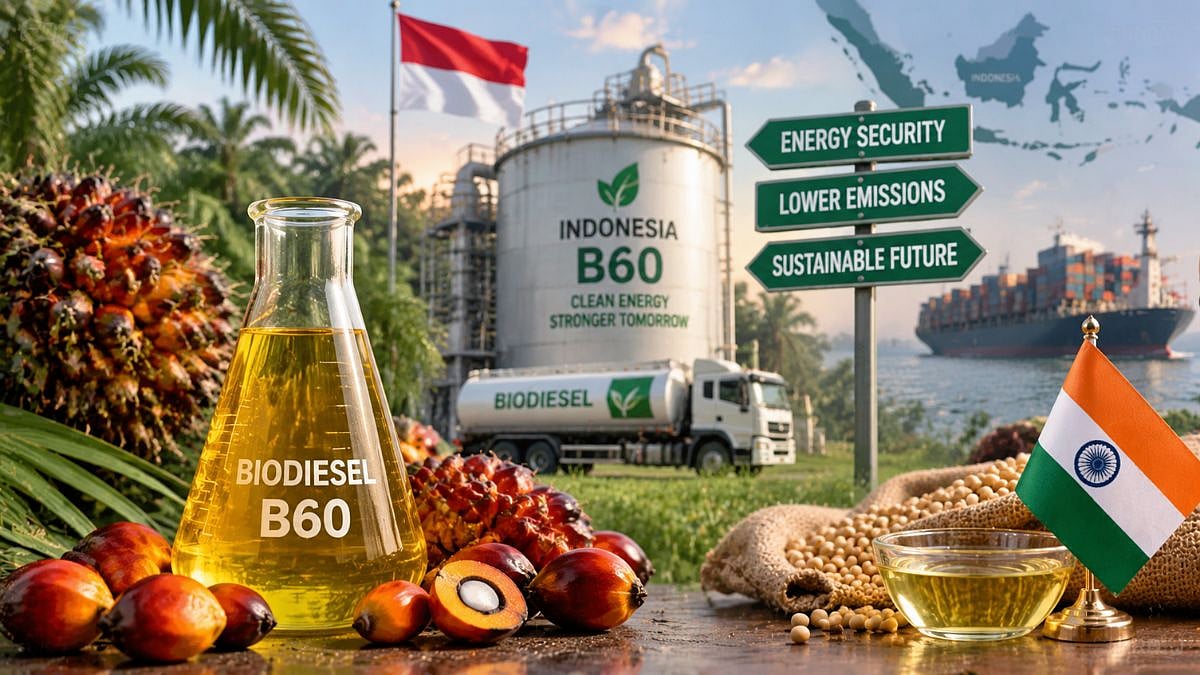
Indonesia has announced plans to implement B60, a blend of conventional mineral diesel and 60% vegetable oil-based biodiesel, by 2027. This move is part of the country's efforts to reduce carbon emissions, advance national energy security, and eliminate diesel imports. The plan builds on Indonesia's earlier launch of the B30, B35, and B40 programmes.
Indonesia's growing biodiesel programme may have a ripple effect on the global vegetable trade, particularly on India, due to its possible impact on the established supply chain. Indonesia and Malaysia dominate the global palm oil market, accounting for nearly 80% of the world's annual production of roughly 81.5 million metric tonnes (MMT) of palm oil.
The ongoing Persian Gulf conflict and El Nino weather conditions have caused crude oil prices to spike, making domestic blending programmes for large vegetable oil producers fiscally more attractive. However, Indonesia's progressive rise in blending programme is currently attracting heightened global attention due to concerns over palm oil supply.
While Indonesia has rolled out B50, it is still assessing crude palm oil (CPO) supply and biodiesel capacity ahead of the planned B60 mandate in 2027. The country needs to consolidate upstream CPO supplies and assess whether additional oil-palm planting or productivity increases are necessary.
India, the world's single largest importer of vegetable oils, is unlikely to be hurt by Indonesia's biodiesel policy. India imports 16-17 MMT of vegetable oils every year, and palm oil used to be its preferred oil due to its price discount over competing oils like soy oil and sun oil. However, palm oil prices have spiked in recent months, prompting India to gradually move to importing soft oils like soy and sun, which are relatively abundant in availability.
India's shift to alternative oils is a result of the price-conscious market, and the country is likely to continue importing soft oils in the future. The Indonesian biodiesel policy may not have a significant impact on India's vegetable oil imports, as the country has already started diversifying its imports.
In conclusion, Indonesia's aggressive biofuel push, including the B60 policy, is unlikely to hurt India's vegetable oil imports. India's shift to alternative oils and its diversification of imports will help the country navigate any potential disruptions in the global vegetable oil market.
The Indonesian government's efforts to reduce carbon emissions and advance national energy security are commendable, and the country's biodiesel programme is a significant step towards achieving these goals. However, the programme's impact on the global vegetable oil market and India's imports will depend on various factors, including the availability of palm oil and the prices of alternative oils.
Overall, India's vegetable oil imports are likely to remain stable, despite Indonesia's biodiesel policy. The country's diversification of imports and its shift to alternative oils will help mitigate any potential risks associated with the Indonesian programme.
In the long run, India's vegetable oil imports will depend on various factors, including global demand, production, and prices. The country's ability to navigate the complex global vegetable oil market and adapt to changing circumstances will be crucial in ensuring a stable supply of vegetable oils.
The Indonesian biodiesel policy is a significant development in the global vegetable oil market, and its impact will be closely watched by India and other major importers. However, for now, it appears that India's vegetable oil imports will remain unaffected by the policy.
The future of India's vegetable oil imports will depend on various factors, including the country's economic growth, population growth, and changing consumer preferences. The government's policies and regulations will also play a crucial role in shaping the country's vegetable oil imports.
In conclusion, Indonesia's biodiesel policy is unlikely to hurt India's vegetable oil imports. The country's shift to alternative oils and its diversification of imports will help navigate any potential disruptions in the global vegetable oil market.
Frequently asked questions
Will Indonesia's B60 policy affect India's vegetable oil imports?
No, India's vegetable oil imports are unlikely to be affected by Indonesia's B60 policy.
Why is India shifting to alternative oils?
India is shifting to alternative oils due to the price-conscious market and the spike in palm oil prices.