Bombay HC: State Cannot Declare Private Forest Without Due Process
Bombay HC rules on private forest declaration, orders review of similar cases. State government must follow due process.
'%3E%3Crect%20width%3D'96'%20height%3D'96'%20fill%3D'%23B3261E'%2F%3E%3Ccircle%20cx%3D'30'%20cy%3D'24'%20r%3D'44'%20fill%3D'%23fff'%20opacity%3D'.12'%2F%3E%3Ccircle%20cx%3D'60'%20cy%3D'74'%20r%3D'40'%20fill%3D'%23000'%20opacity%3D'.10'%2F%3E%3C%2Fg%3E%3Cg%20fill%3D'%23fff'%3E%3Crect%20x%3D'29'%20y%3D'49'%20width%3D'8'%20height%3D'19'%20rx%3D'1'%2F%3E%3Crect%20x%3D'39'%20y%3D'40'%20width%3D'9'%20height%3D'28'%20rx%3D'1'%2F%3E%3Crect%20x%3D'50'%20y%3D'45'%20width%3D'8'%20height%3D'23'%20rx%3D'1'%2F%3E%3Crect%20x%3D'60'%20y%3D'53'%20width%3D'7'%20height%3D'15'%20rx%3D'1'%2F%3E%3Crect%20x%3D'41'%20y%3D'34'%20width%3D'5'%20height%3D'6'%2F%3E%3C%2Fg%3E%3C%2Fsvg%3E)
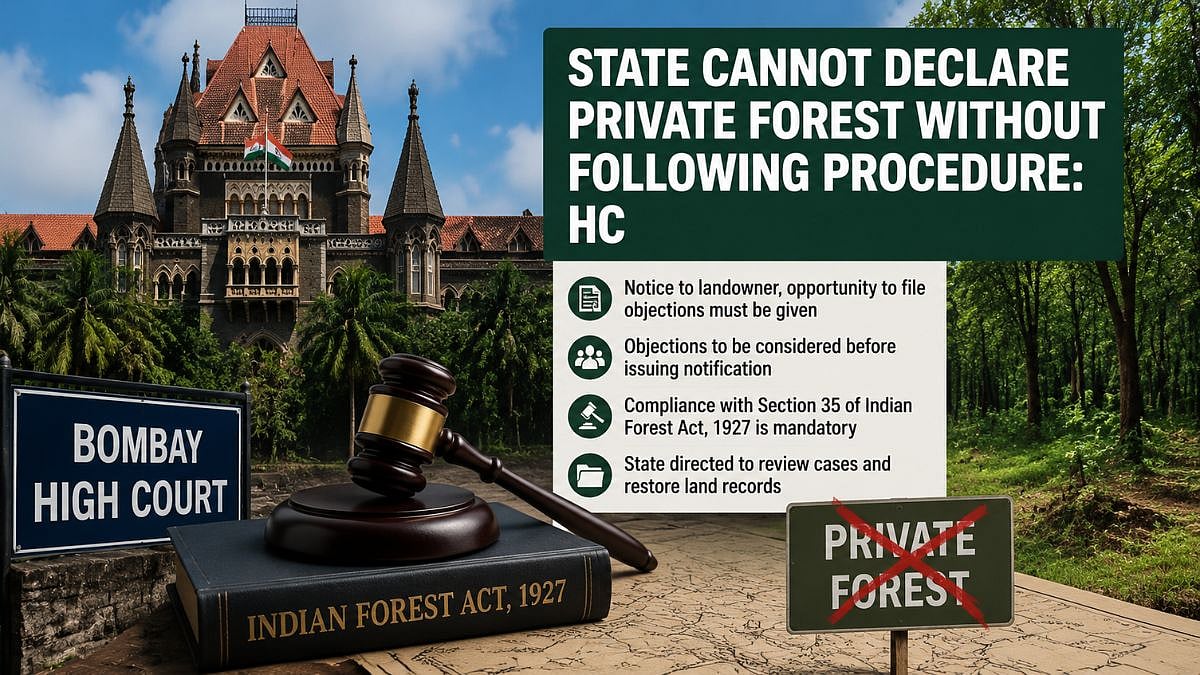
The Bombay High Court has ruled that the State government cannot declare land as a 'private forest' without following the procedure prescribed under the Indian Forest Act, 1927.
In a significant judgment pronounced on July 23, a bench of Justices Bharati Dangre and Manjusha Deshpande held that authorities must comply with Section 35 of the Indian Forest Act before any land can vest in the State as a private forest under the Maharashtra Private Forests (Acquisition) Act, 1975.
This includes issuing a notice to the landowner, giving an opportunity to file objections, considering those objections, and thereafter issuing a notification under Section 35(1). Without this process, land cannot vest in the State under the 1975 Act.
The court found that in several cases, no notice had been issued under Section 35(3) and no valid notification had been published under Section 35(1). It consequently quashed the mutation entries recording the land as private forest and directed revenue authorities to restore the names of the landowners.
The bench expressed concern that despite clear Supreme Court rulings, the State continued to proceed on the misconception that every forest land existing on August 30, 1975, automatically became private forest vested in the government.
The judges observed that it is really unfortunate that even after the apex court settled the issue in 2014 and reiterated it in 2025, the State Government continued with its obstinacy.
The court directed the State to constitute a committee headed by an officer not below the rank of Deputy Conservator of Forest to scrutinise all cases involving private forest claims.
The bench noted that the State Government should be conscious of the fact that if a flaw lies at its end, there can be no declaration about any land to be 'Private Forest'.
The court further directed the State to review all pending cases and, wherever the legal principles laid down in the judgment apply, instruct the Revenue Department to restore the names of owners in the revenue records.
This judgment could impact hundreds of land disputes across Maharashtra.
The State government has been reminded of its constitutional obligations, and the court expects it to follow the mandate laid down by the Apex Court.
No one is above the law, the judges observed.
The detailed 177-page order was made available on Monday, and the State government is expected to take immediate action to review similar cases and restore revenue records wherever landowners were wrongly deprived of their rights.
This ruling is significant, as it could prevent similar disputes from repeatedly reaching the High Court.
The court's decision is a victory for landowners who have been fighting for their rights for years.
The judgment is also a reminder to the State government to follow the due process and respect the rights of citizens.
In conclusion, the Bombay High Court's ruling is a significant development in the realm of land disputes in Maharashtra, and it is expected to have far-reaching implications for the State government and landowners alike.
Frequently asked questions
What is the procedure for declaring private forest under the Indian Forest Act, 1927?
The procedure includes issuing a notice to the landowner, giving an opportunity to file objections, considering those objections, and thereafter issuing a notification under Section 35(1).
What is the impact of the Bombay HC ruling on land disputes in Maharashtra?
The ruling could impact hundreds of land disputes across Maharashtra, and it is expected to prevent similar disputes from repeatedly reaching the High Court.