Experts Stress Exchange Rate Risk Management
India must manage exchange rate risks. Experts discuss strategies.
'%3E%3Crect%20width%3D'96'%20height%3D'96'%20fill%3D'%230B6E4F'%2F%3E%3Ccircle%20cx%3D'30'%20cy%3D'24'%20r%3D'44'%20fill%3D'%23fff'%20opacity%3D'.12'%2F%3E%3Ccircle%20cx%3D'60'%20cy%3D'74'%20r%3D'40'%20fill%3D'%23000'%20opacity%3D'.10'%2F%3E%3C%2Fg%3E%3Cg%20fill%3D'none'%20stroke%3D'%23fff'%20stroke-width%3D'3.2'%20stroke-linecap%3D'round'%20stroke-linejoin%3D'round'%3E%3Cpolyline%20points%3D'31%2C59%2041%2C49%2049%2C54%2063%2C37'%2F%3E%3Cpolyline%20points%3D'55%2C37%2063%2C37%2063%2C45'%2F%3E%3C%2Fg%3E%3C%2Fsvg%3E)
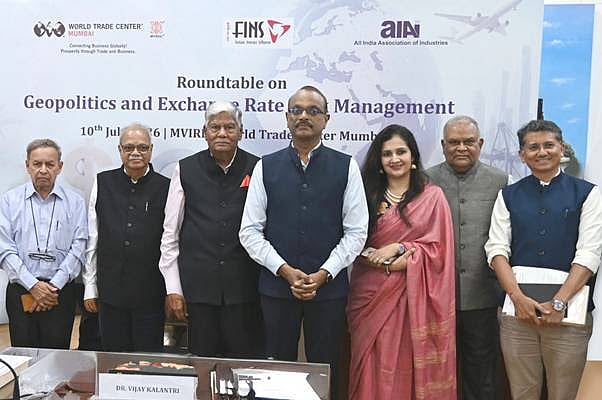
A recent round table discussion in Mumbai highlighted the importance of exchange rate risk management for India's economic growth. According to Prof. Ananth Narayan, former Whole-Time Director of SEBI, India has a unique opportunity to position itself as a trusted manufacturing and investment partner as global trade patterns undergo significant realignment.
Prof. Narayan emphasized that India must sustain a growth rate of around 7.5-8% to strengthen its global relevance and achieve its economic potential. He also stressed the need for prudent hedging and exchange-rate risk management strategies for exporters, importers, and companies with foreign currency exposure.
The discussion, organized by the All India Association of Industries and MVIRDC World Trade Center Mumbai, also featured Dr. Vijay Kalantri, President of the All India Association of Industries. Dr. Kalantri noted that India's strong foreign exchange reserves of around USD 667 billion provide an important cushion against external volatility. However, he also cautioned that exchange-rate and geopolitical volatility can translate into higher import costs and pressure on export margins for businesses.
Adv. Bal Desai, Secretary General of the Forum for Integrated National Security, emphasized the far-reaching implications of exchange-rate movements for India's trade competitiveness, inflation, energy imports, foreign investment, and overall macroeconomic stability. He noted that geopolitical tensions, economic sanctions, and disruptions to global supply chains can exert a major influence on exchange rates, making geopolitical risk assessment crucial for central banks, exporters, importers, treasury managers, financial institutions, and investors.
The discussion highlighted the need for India to strengthen its economic resilience and competitiveness to build on its growing trade sector momentum. With merchandise and services exports crossing USD 860 billion in FY 2025-26, India must sustain GDP growth of around 7-8% to achieve its economic potential.
The experts also emphasized the importance of communicating a strong and credible growth story to attract international capital. As interest rates, equity valuations, foreign investment, capital flows, and exchange rates are closely interconnected, businesses must make prudent hedging and exchange-rate risk management an integral part of their strategy.
In the current global economic landscape, India's ability to manage exchange rate risks will be crucial in determining its economic growth and stability. The discussion provided valuable insights into the strategies that India can adopt to mitigate these risks and achieve its economic potential.
The round table discussion was a significant step towards highlighting the importance of exchange rate risk management for India's economic growth. It brought together experts from various fields to discuss the challenges and opportunities facing India in the current global economic landscape.
In conclusion, the discussion emphasized the need for India to adopt a proactive approach to managing exchange rate risks. By doing so, India can strengthen its economic resilience and competitiveness, achieve its economic potential, and emerge as a trusted manufacturing and investment partner in the global economy.
The implications of exchange rate movements on India's economy are far-reaching, and it is essential for businesses, policymakers, and regulators to work together to mitigate these risks. The discussion provided a valuable platform for experts to share their insights and recommendations on how India can manage exchange rate risks effectively.
As India continues to grow and integrate into the global economy, managing exchange rate risks will be crucial in determining its economic stability and growth. The discussion highlighted the need for a coordinated approach to managing these risks and emphasized the importance of prudent hedging and exchange-rate risk management strategies for businesses.
In the end, the discussion provided a clear message: India must prioritize exchange rate risk management to achieve its economic potential and emerge as a trusted partner in the global economy.