India Gifts CERN Shiva Statue
India gifted CERN a Shiva statue in 2004. It symbolizes cosmic creation and destruction.
'%3E%3Crect%20width%3D'96'%20height%3D'96'%20fill%3D'%23B3261E'%2F%3E%3Ccircle%20cx%3D'30'%20cy%3D'24'%20r%3D'44'%20fill%3D'%23fff'%20opacity%3D'.12'%2F%3E%3Ccircle%20cx%3D'60'%20cy%3D'74'%20r%3D'40'%20fill%3D'%23000'%20opacity%3D'.10'%2F%3E%3C%2Fg%3E%3Cg%20fill%3D'%23fff'%3E%3Crect%20x%3D'29'%20y%3D'49'%20width%3D'8'%20height%3D'19'%20rx%3D'1'%2F%3E%3Crect%20x%3D'39'%20y%3D'40'%20width%3D'9'%20height%3D'28'%20rx%3D'1'%2F%3E%3Crect%20x%3D'50'%20y%3D'45'%20width%3D'8'%20height%3D'23'%20rx%3D'1'%2F%3E%3Crect%20x%3D'60'%20y%3D'53'%20width%3D'7'%20height%3D'15'%20rx%3D'1'%2F%3E%3Crect%20x%3D'41'%20y%3D'34'%20width%3D'5'%20height%3D'6'%2F%3E%3C%2Fg%3E%3C%2Fsvg%3E)
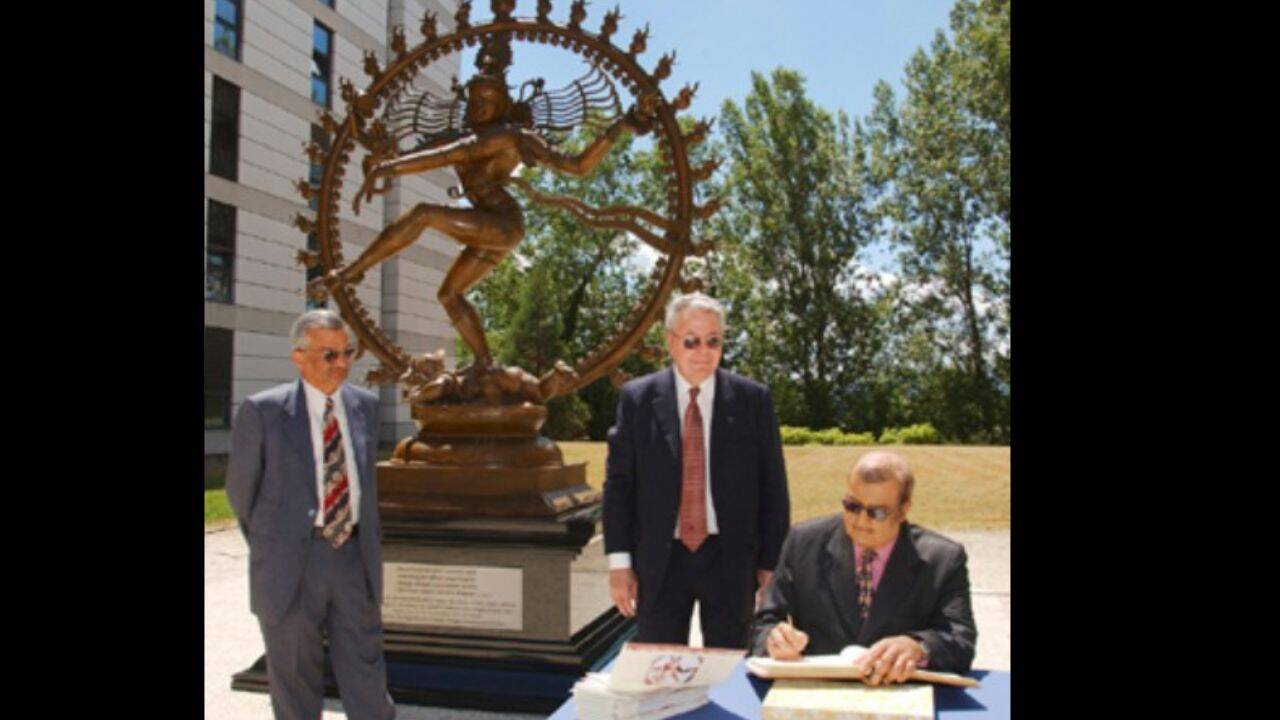
In 2004, India presented the European Organization for Nuclear Research, CERN, with a statue of Shiva Nataraja, a powerful symbol of cosmic creation and destruction. This statue serves as a metaphor for the essence of scientific exploration, where researchers delve into the universe's tiniest components and its earliest moments.
The statue of Shiva Nataraja is a representation of the ever-changing behavior of subatomic particles. At CERN, scientists view Shiva's dance as a symbol of the dynamic nature of the universe, weaving together ancient mythology and contemporary scientific knowledge.
CERN is home to the world's largest and most complex scientific instruments, including the Large Hadron Collider. The organization's research focuses on understanding the fundamental nature of matter and the universe. The gift of the Shiva Nataraja statue highlights the connection between ancient Indian mythology and modern scientific inquiry.
The statue is a bronze sculpture of Shiva in his cosmic dance form, surrounded by a circle of fire. It represents the cyclical nature of creation and destruction, where matter and energy are constantly being transformed. This concept is reflected in the scientific pursuit of understanding the universe, where researchers seek to uncover the underlying laws and principles that govern the behavior of matter and energy.
The gift of the Shiva Nataraja statue to CERN is a testament to the enduring power of Indian mythology and its relevance to modern scientific inquiry. It serves as a reminder of the deep connections between ancient wisdom and contemporary knowledge, and the importance of interdisciplinary approaches to understanding the universe.
In the context of Indian culture, the Shiva Nataraja statue is a revered symbol of spiritual and philosophical inquiry. The dance of Shiva is said to represent the five activities of the universe: creation, preservation, destruction, concealment, and revelation. This mythological concept has been interpreted and reinterpreted over the centuries, influencing various aspects of Indian art, literature, and philosophy.
The intersection of ancient mythology and modern science is a fascinating area of study, where researchers can gain insights into the fundamental nature of reality. The gift of the Shiva Nataraja statue to CERN represents a significant milestone in this journey, highlighting the importance of interdisciplinary approaches to understanding the universe.
The significance of the Shiva Nataraja statue at CERN lies in its ability to inspire scientists and researchers to think beyond the boundaries of their discipline. By embracing the symbolism and mythology of ancient cultures, scientists can gain a deeper understanding of the universe and its mysteries. As a symbol of cosmic creation and destruction, the Shiva Nataraja statue serves as a powerful reminder of the awe-inspiring complexity and beauty of the universe.
In conclusion, the gift of the Shiva Nataraja statue to CERN is a meaningful gesture that highlights the connection between ancient Indian mythology and modern scientific inquiry. It serves as a testament to the enduring power of Indian culture and its relevance to contemporary knowledge, inspiring scientists and researchers to explore the mysteries of the universe with a deeper sense of wonder and awe.
Frequently asked questions
What is the significance of the Shiva Nataraja statue at CERN?
The statue serves as a metaphor for the essence of scientific exploration and represents the dynamic nature of the universe.
Why was the Shiva Nataraja statue gifted to CERN?
The statue was gifted to CERN to highlight the connection between ancient Indian mythology and modern scientific inquiry.