Uddhav Thackeray Slams NDA Govt At Shivaji Park Protest
Shiv Sena chief Uddhav Thackeray attacks NDA government, supports hunger-striker Sonam Wangchuk
'%3E%3Crect%20width%3D'96'%20height%3D'96'%20fill%3D'%231A5276'%2F%3E%3Ccircle%20cx%3D'30'%20cy%3D'24'%20r%3D'44'%20fill%3D'%23fff'%20opacity%3D'.12'%2F%3E%3Ccircle%20cx%3D'60'%20cy%3D'74'%20r%3D'40'%20fill%3D'%23000'%20opacity%3D'.10'%2F%3E%3C%2Fg%3E%3Cg%20fill%3D'%23fff'%3E%3Cpath%20d%3D'M31%2041%20L48%2031%20L65%2041%20Z'%2F%3E%3Crect%20x%3D'33'%20y%3D'43'%20width%3D'4'%20height%3D'17'%2F%3E%3Crect%20x%3D'41'%20y%3D'43'%20width%3D'4'%20height%3D'17'%2F%3E%3Crect%20x%3D'51'%20y%3D'43'%20width%3D'4'%20height%3D'17'%2F%3E%3Crect%20x%3D'59'%20y%3D'43'%20width%3D'4'%20height%3D'17'%2F%3E%3Crect%20x%3D'30'%20y%3D'62'%20width%3D'36'%20height%3D'4'%20rx%3D'1'%2F%3E%3C%2Fg%3E%3C%2Fsvg%3E)
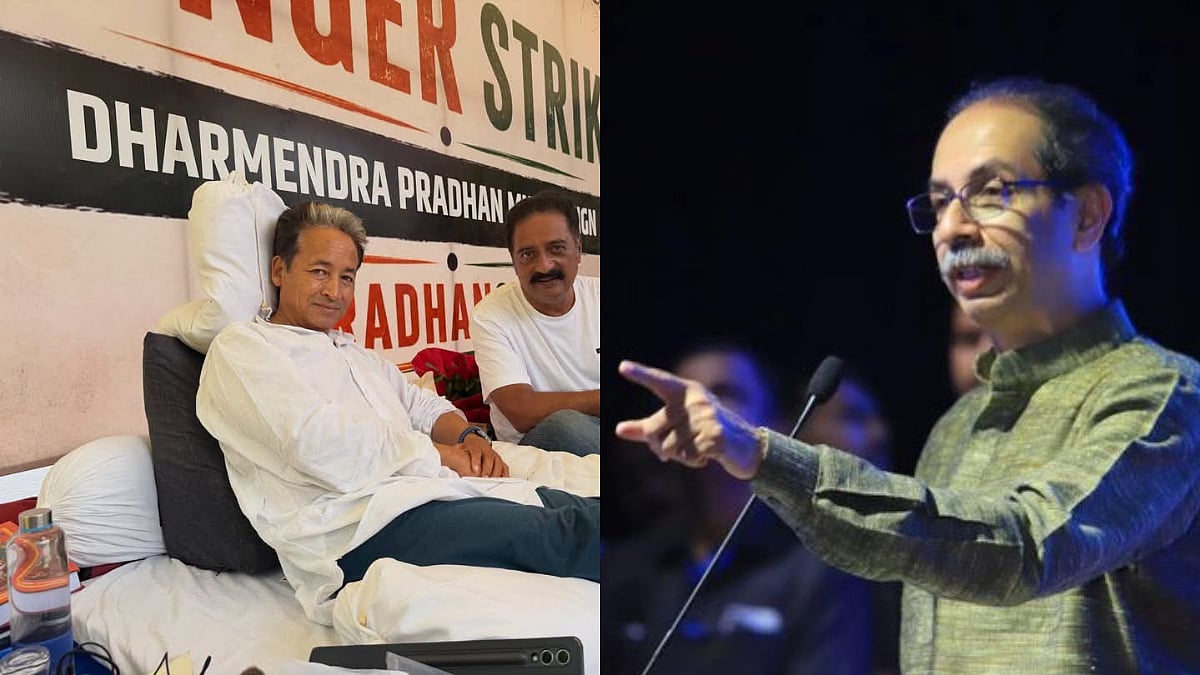
On Sunday, Shiv Sena (UBT) chief Uddhav Thackeray launched a scathing attack on the Narendra Modi-led NDA government at a protest held at Shivaji Park in Mumbai. The protest was organised in support of environmental activist Sonam Wangchuk, who is on an indefinite hunger strike and was arrested by the government in Delhi.
The protest witnessed the participation of senior party leaders, including Aditya Thackeray, MP Sanjay Raut, and Sushma Andhare, as well as several party workers. They raised slogans in support of Wangchuk and activist Abhijit Deepke. Thackeray extended his support to Wangchuk's agitation, accusing the Centre of suppressing dissent and refusing to engage with a citizen working for the country's welfare.
Thackeray alleged that the government was willing to hold talks with Pakistan but not with Wangchuk, who had contributed to national causes by developing solar camps for soldiers stationed in Ladakh and creating artificial ice reservoirs to tackle water scarcity. He questioned the government's priorities, referring to past statements by RSS leaders Dattatreya Hosabale and Mohan Bhagwat advocating dialogue with Pakistan.
Thackeray also recalled the Anna Hazare anti-corruption movement, saying the then UPA government had engaged in dialogue with Hazare instead of branding him anti-national. He accused the BJP-led government of failing to provide employment, education, and answers to people's concerns. Thackeray urged citizens to transform their anger into a movement to change the government, alleging that it had 'stolen the future' of the youth.
Taking a swipe at the Centre, Thackeray said attempts to suppress Wangchuk's protest would not hide the truth. He challenged the Modi government to announce fresh elections if it had the courage, asserting that the opposition was ready to fight with full strength. Thackeray also criticised the BJP for allegedly poaching leaders from opposition parties and reiterated his appeal to remove the present Union government through democratic means.
The protest at Shivaji Park is a significant development in the ongoing saga of Sonam Wangchuk's hunger strike. Wangchuk, an environmental activist, has been on an indefinite hunger strike, demanding action on various environmental issues. His arrest by the government in Delhi has sparked widespread outrage and criticism.
The Shiv Sena (UBT) has been vocal in its support for Wangchuk, with Thackeray and other senior leaders extending their solidarity to the activist. The party has accused the Centre of suppressing dissent and refusing to engage with citizens who are working for the country's welfare.
The developments at Shivaji Park have significant implications for the political landscape of Maharashtra and the country at large. The protest has brought together various opposition parties and civil society groups, who are demanding action on environmental issues and criticizing the government's handling of the situation.
In conclusion, the protest at Shivaji Park, led by Uddhav Thackeray, is a significant development in the ongoing saga of Sonam Wangchuk's hunger strike. The Shiv Sena (UBT) chief's scathing attack on the NDA government has highlighted the growing discontent among citizens and the opposition parties. The developments have significant implications for the political landscape of Maharashtra and the country, and it remains to be seen how the government will respond to the growing criticism.
The issue has also sparked a debate about the government's priorities and its handling of environmental issues. The Centre's refusal to engage with Wangchuk and other activists has been widely criticized, with many accusing the government of suppressing dissent and ignoring the concerns of citizens. As the situation continues to unfold, it is likely that the protest at Shivaji Park will be seen as a significant moment in the growing movement against the government's handling of environmental issues.
The protest has also highlighted the importance of democratic means of expression and the need for the government to engage with citizens who are working for the country's welfare. Thackeray's appeal to remove the present Union government through democratic means has resonated with many, and it remains to be seen how the government will respond to the growing criticism.
In the end, the protest at Shivaji Park is a reminder that the power of democracy lies with the people, and that citizens have the right to express their dissent and demand action from their government. As the situation continues to unfold, it is likely that the protest will be seen as a significant moment in the ongoing struggle for environmental justice and democratic expression in India.