Centre To Introduce Sex Education In Schools
Comprehensive sex education may soon be part of school curriculum, Centre tells Supreme Court. The move aims to educate children about health, safety, and relationships.
'%3E%3Crect%20width%3D'96'%20height%3D'96'%20fill%3D'%23B3261E'%2F%3E%3Ccircle%20cx%3D'30'%20cy%3D'24'%20r%3D'44'%20fill%3D'%23fff'%20opacity%3D'.12'%2F%3E%3Ccircle%20cx%3D'60'%20cy%3D'74'%20r%3D'40'%20fill%3D'%23000'%20opacity%3D'.10'%2F%3E%3C%2Fg%3E%3Cg%20fill%3D'%23fff'%3E%3Crect%20x%3D'29'%20y%3D'49'%20width%3D'8'%20height%3D'19'%20rx%3D'1'%2F%3E%3Crect%20x%3D'39'%20y%3D'40'%20width%3D'9'%20height%3D'28'%20rx%3D'1'%2F%3E%3Crect%20x%3D'50'%20y%3D'45'%20width%3D'8'%20height%3D'23'%20rx%3D'1'%2F%3E%3Crect%20x%3D'60'%20y%3D'53'%20width%3D'7'%20height%3D'15'%20rx%3D'1'%2F%3E%3Crect%20x%3D'41'%20y%3D'34'%20width%3D'5'%20height%3D'6'%2F%3E%3C%2Fg%3E%3C%2Fsvg%3E)
The Indian government has announced its readiness to introduce comprehensive sex education in schools and colleges across the country. This move is expected to bring significant changes to how children learn about health, safety, and relationships.
The announcement was made by Additional Solicitor General Aishwarya Bhati before a bench of Justices B V Nagarathna and R Mahadevan on Monday. The government has accepted the recommendations of an expert committee and will implement them after receiving the Supreme Court's approval.
The expert committee was formed after the Supreme Court asked the Centre to examine how consensual relationships between adolescents and cases involving minor pregnancies are dealt with under the Protection of Children from Sexual Offences (POCSO) Act. The court had asked the government to explore ways to ensure such cases are not automatically treated as criminal offences while balancing children's rights and legal safeguards.
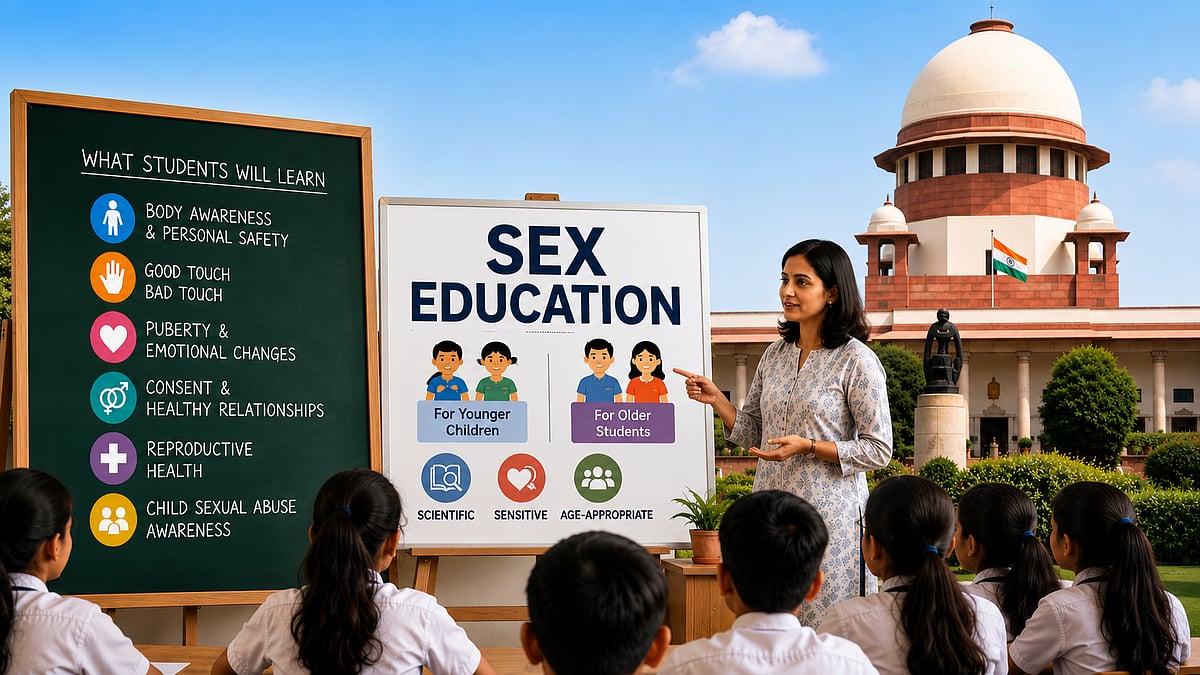
The 26-member panel, which included representatives from various organizations and ministries, has suggested introducing comprehensive sex education and child sexual abuse awareness as part of the core curriculum. For younger children, the panel has proposed age-appropriate lessons on personal hygiene, body awareness, personal safety, and good touch and bad touch.
For older students, topics such as puberty, emotional and physical changes, reproductive health, consent, healthy relationships, and respect have been recommended in line with the National Education Policy (NEP) 2020. The committee has also asked the National Council of Educational Research and Training (NCERT) to revise the curriculum accordingly.
Educators believe that many schools have already been conducting awareness sessions, but a structured curriculum would ensure that all students receive scientifically accurate and age-appropriate information. Sharmila Thakur, Principal of The Orchids International School, Dombivli, described the proposal as 'positive and much needed.'
According to Thakur, comprehensive sex education goes beyond the subject itself and equips children with essential life skills. It helps children understand personal safety, body autonomy, puberty, consent, and how to seek help if something feels wrong. It also encourages respect for others and reduces misconceptions.
The introduction of comprehensive sex education in schools is expected to have a positive impact on children's understanding of health, safety, and relationships. It will provide them with accurate and age-appropriate information, helping them make informed decisions and develop healthy relationships.
The move is also expected to reduce the number of cases involving minor pregnancies and consensual relationships between adolescents being treated as criminal offences. By educating children about consent, healthy relationships, and respect, the government aims to promote a culture of mutual respect and understanding.
In conclusion, the introduction of comprehensive sex education in schools is a significant step towards promoting children's health, safety, and well-being. It is expected to have a positive impact on their understanding of relationships and will help them develop essential life skills.
The Centre's decision to introduce sex education in schools is a welcome move, and its implementation will be closely watched by educators, parents, and the general public. As the government moves forward with the implementation, it is essential to ensure that the curriculum is age-appropriate, scientifically accurate, and sensitive to the needs of children.
The Supreme Court's approval is awaited, and once it is received, the government will proceed with the implementation of the comprehensive sex education program. This move is expected to bring about a significant change in the way children learn about health, safety, and relationships, and it will have a lasting impact on their lives.
In the context of India's growing population and the need to educate children about health, safety, and relationships, the introduction of comprehensive sex education in schools is a timely and necessary move. It will help promote a culture of mutual respect, understanding, and consent, and will equip children with the essential life skills they need to navigate the complexities of relationships and adulthood.