CIA Chief Warns Russia Against Attacking NATO
CIA Director John Ratcliffe visits Moscow, warns Russia against attacking NATO member states.
'%3E%3Crect%20width%3D'96'%20height%3D'96'%20fill%3D'%234A235A'%2F%3E%3Ccircle%20cx%3D'30'%20cy%3D'24'%20r%3D'44'%20fill%3D'%23fff'%20opacity%3D'.12'%2F%3E%3Ccircle%20cx%3D'60'%20cy%3D'74'%20r%3D'40'%20fill%3D'%23000'%20opacity%3D'.10'%2F%3E%3C%2Fg%3E%3Cg%20fill%3D'none'%20stroke%3D'%23fff'%20stroke-width%3D'3'%3E%3Ccircle%20cx%3D'48'%20cy%3D'48'%20r%3D'16'%2F%3E%3Cellipse%20cx%3D'48'%20cy%3D'48'%20rx%3D'6.5'%20ry%3D'16'%2F%3E%3Cline%20x1%3D'32'%20y1%3D'42'%20x2%3D'64'%20y2%3D'42'%2F%3E%3Cline%20x1%3D'32'%20y1%3D'54'%20x2%3D'64'%20y2%3D'54'%2F%3E%3C%2Fg%3E%3C%2Fsvg%3E)
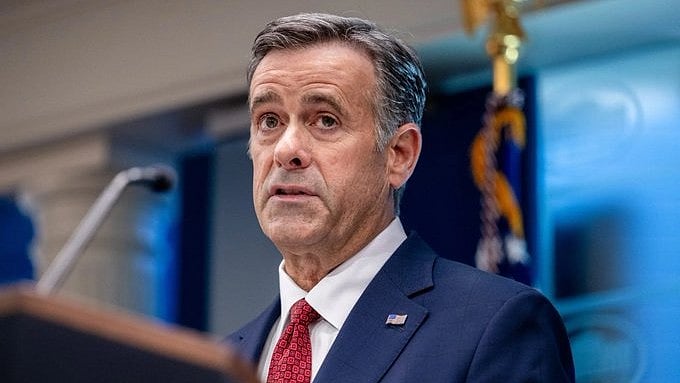
CIA Director John Ratcliffe warned Russia against attacking NATO member states during a secretive visit to Moscow this week. The visit came amid US intelligence assessments that Moscow could seek to test the military alliance. Ratcliffe also raised concerns about Iran and the Strait of Hormuz, warning Russia of additional sanctions if the strait was not reopened to shipping traffic.
The visit, Ratcliffe's first known trip to Russia as CIA director, was kept under wraps until a US Air Force jet was spotted arriving at a Moscow airport. A diplomatic motorcade was also seen moving through the city. Ukraine was informed of the visit and was asked to refrain from strikes for the duration.
US President Donald Trump confirmed the Moscow trip, describing it as a 'semi-routine' visit. Trump said the visit was not related to Iran or Russian intentions to test NATO, but rather an effort to end Russia's war with Ukraine. The CIA declined to comment on the reasons for Ratcliffe's visit.
Kremlin spokesperson Dmitry Peskov said Ratcliffe held talks with Russian intelligence officials, but did not meet Russian President Vladimir Putin. Peskov dismissed media reports about the purpose of Ratcliffe's trip, saying they were 'scare stories' with no basis in reality.
Recent US intelligence assessments indicate that Putin could be willing to authorise provocative actions on NATO territory, including cyberattacks and hybrid operations. These actions would not necessarily be intended to trigger a war, but could seek to test NATO's unity and the Trump administration's willingness to defend its allies.
The US has raised concerns about a series of recent Russian actions, including drone incursions into Romania and a Russian missile that crossed into Poland last month. There has also been an increase in alleged sabotage operations and cyberattacks in Europe.
Under Article 5 of the treaty establishing NATO, alliance members are expected to come to one another's defence if attacked. The US invoked this provision after the September 11, 2001, terrorist attacks. Trump has long questioned NATO's reliability and criticised member states for what he considers insufficient contributions towards their own defence.
The visit highlights the ongoing tensions between the US and Russia, and the concerns about Russia's intentions towards NATO. The US will continue to monitor the situation and take steps to defend its allies and interests.
The visit also underscores the complex relationships between the US, Russia, and Ukraine. The US has been working to end Russia's war with Ukraine, and Ratcliffe's visit may be a step towards achieving this goal. However, the situation remains volatile, and the US will need to continue to engage with Russia and Ukraine to find a resolution.
In conclusion, the CIA Director's visit to Moscow highlights the ongoing tensions between the US and Russia, and the concerns about Russia's intentions towards NATO. The US will continue to monitor the situation and take steps to defend its allies and interests.
Frequently asked questions
What was the purpose of CIA Director John Ratcliffe's visit to Moscow?
The purpose of the visit was to warn Russia against attacking NATO member states and to raise concerns about Iran and the Strait of Hormuz.
What are the implications of Russia's actions on NATO territory?
Russia's actions could seek to test NATO's unity and the Trump administration's willingness to defend its allies, and could potentially lead to a conflict.