India's Education Crisis Sparks Youth Protests
Protests over NEET exam leak reveal deeper issues in education system. Youth demand change amid growing unemployment and unfulfilled expectations.
'%3E%3Crect%20width%3D'96'%20height%3D'96'%20fill%3D'%231B5E20'%2F%3E%3Ccircle%20cx%3D'30'%20cy%3D'24'%20r%3D'44'%20fill%3D'%23fff'%20opacity%3D'.12'%2F%3E%3Ccircle%20cx%3D'60'%20cy%3D'74'%20r%3D'40'%20fill%3D'%23000'%20opacity%3D'.10'%2F%3E%3C%2Fg%3E%3Cg%3E%3Ccircle%20cx%3D'48'%20cy%3D'48'%20r%3D'15'%20fill%3D'%23fff'%2F%3E%3Cpath%20d%3D'M43%2034%20Q50%2048%2043%2062'%20fill%3D'none'%20stroke%3D'%238a94a6'%20stroke-width%3D'2.4'%2F%3E%3Cpath%20d%3D'M47%2033%20Q54%2048%2047%2063'%20fill%3D'none'%20stroke%3D'%238a94a6'%20stroke-width%3D'1.8'%20stroke-dasharray%3D'1.5%203'%2F%3E%3C%2Fg%3E%3C%2Fsvg%3E)
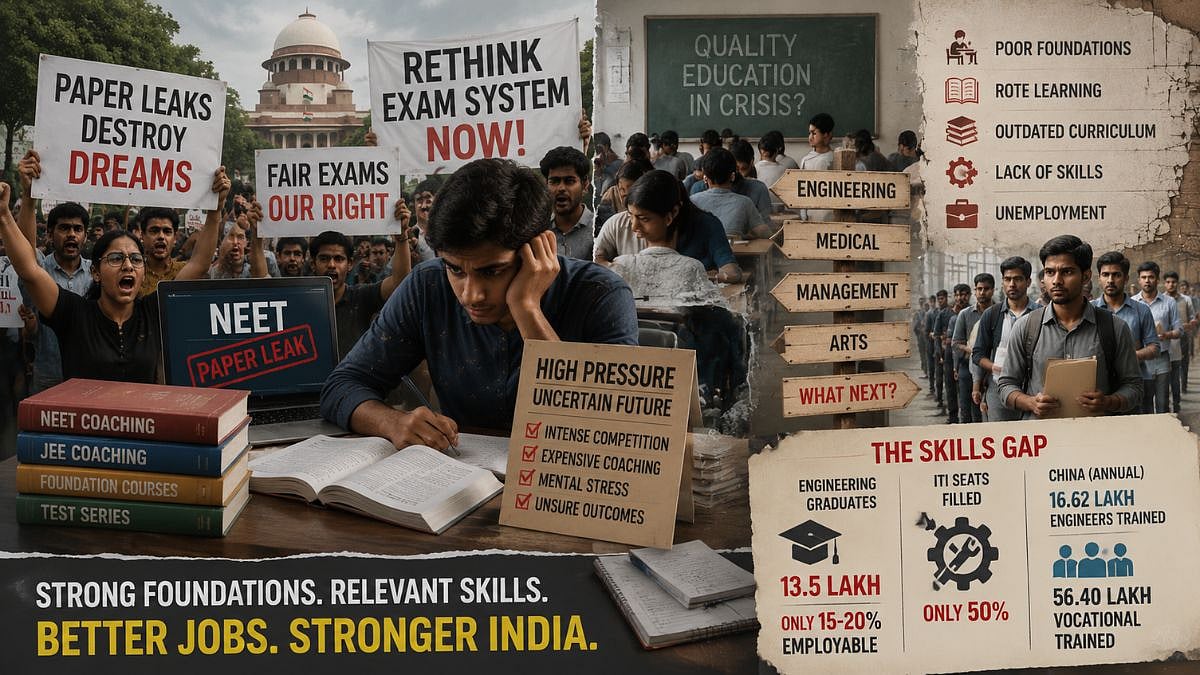
The recent protests in Delhi, sparked by the NEET examination question paper leak, have highlighted a deeper crisis in India's education system.
The leak has become a catalyst for youth to express their frustration over growing white-collar unemployment and unfulfilled expectations.
The Union government introduced the NEET exam in 2016, following a Supreme Court directive, to standardize admissions to medical colleges. However, the exam has become a symbol of the flaws in the education system.
About 80% of students who pass out of schools lack a strong foundation in their subjects, having relied on rote learning and mass copying. This has led to a reliance on competitive entrance tests for sought-after STEM courses.
The states have struggled to conduct credible tests, resulting in varying standards at the state board level. This has necessitated a uniform nationwide test for standardization and fair assessment.
Despite the increase in medical colleges, only a few are capable of providing quality training to students. This has led to a scramble for admission to top colleges, with 1,36,000 seats available.
Coaching centers have mushroomed to prepare students for competitive medical entrance tests, subjecting young students to intense pressure. The leak of examination papers has devastating consequences for these students and their parents.
The Union government's response to the crisis has been inadequate, treating it as a managerial and administrative problem rather than a potential spark for mass mobilization.
The failure of the political system to address the issue has resulted in a lack of systemic correctives and public engagement. The education-skills-jobs cycle is in crisis, with even those joining prestigious courses lacking the necessary skills to add value to the economy.
The protests are a wake-up call for the government to address the deeper issues in the education system. It is essential to reform the education pipeline, improve evaluation systems, and provide students with the necessary skills to succeed in the job market.
The crisis in education is not just a matter of concern for the students and parents affected but also has significant implications for the country's economic growth and development.
It is crucial for the government to take a holistic approach to address the issue, involving all stakeholders, including educators, policymakers, and industry experts.
Only by working together can we create an education system that provides students with the skills and knowledge necessary to succeed in the 21st century.
Frequently asked questions
What is the NEET exam and why is it important?
The NEET exam is a nationwide entrance test for admissions to medical colleges, introduced in 2016 to standardize admissions.
What are the underlying issues in India's education system?
The education system is plagued by flaws, including a reliance on rote learning, poor evaluation systems, and a lack of quality training in medical colleges.