UP Detects 1.85 Lakh TB Patients in 100-Day Campaign
Uttar Pradesh screens 31 lakh people, detects 1.85 lakh TB patients, including 52,000 asymptomatic cases.
'%3E%3Crect%20width%3D'96'%20height%3D'96'%20fill%3D'%23B3261E'%2F%3E%3Ccircle%20cx%3D'30'%20cy%3D'24'%20r%3D'44'%20fill%3D'%23fff'%20opacity%3D'.12'%2F%3E%3Ccircle%20cx%3D'60'%20cy%3D'74'%20r%3D'40'%20fill%3D'%23000'%20opacity%3D'.10'%2F%3E%3C%2Fg%3E%3Cg%20fill%3D'%23fff'%3E%3Crect%20x%3D'29'%20y%3D'49'%20width%3D'8'%20height%3D'19'%20rx%3D'1'%2F%3E%3Crect%20x%3D'39'%20y%3D'40'%20width%3D'9'%20height%3D'28'%20rx%3D'1'%2F%3E%3Crect%20x%3D'50'%20y%3D'45'%20width%3D'8'%20height%3D'23'%20rx%3D'1'%2F%3E%3Crect%20x%3D'60'%20y%3D'53'%20width%3D'7'%20height%3D'15'%20rx%3D'1'%2F%3E%3Crect%20x%3D'41'%20y%3D'34'%20width%3D'5'%20height%3D'6'%2F%3E%3C%2Fg%3E%3C%2Fsvg%3E)
Uttar Pradesh has successfully screened over 31 lakh people and detected 1.85 lakh new tuberculosis patients during the 100-day TB Mukt Bharat Abhiyaan 2.0 campaign.
The campaign, which was launched on March 24 this year, aimed to eliminate tuberculosis in the state. According to senior health officials, the state covered 94 percent of its identified high-risk villages during the campaign, reaching 25,073 of the targeted 26,722 villages.
The state deployed 308 AI-enabled handheld X-ray machines that carried out 30.4 lakh chest X-rays, exceeding the target of 27.3 lakh scans. Screening also included asymptomatic individuals to improve early detection. Officials said the campaign was supported by 1,414 upfront Nucleic Acid Amplification Test (NAAT) centres, where 7.52 lakh people out of 8.19 lakh enrolled individuals underwent confirmatory testing.
Additional Chief Secretary, Medical Health, Family Welfare and Medical Education, Amit Kumar Ghosh, said innovation, technology, partnerships and community ownership were central to Uttar Pradesh's TB elimination strategy. He stressed the need to move beyond symptom-based screening towards proactive, population-level and risk-based surveillance.
State TB Officer and Joint Director (TB), Dr Rishi Kumar Saxena, said Uttar Pradesh was leading the country's TB elimination drive on the back of the recently concluded 100-Day TB Mukt Bharat Abhiyaan 2.0. He said that between January and June 2026, the state notified 3.37 lakh TB cases against an annual target of seven lakh, achieving 48 percent of the yearly target and 96 percent of the pro-rata target for the period.
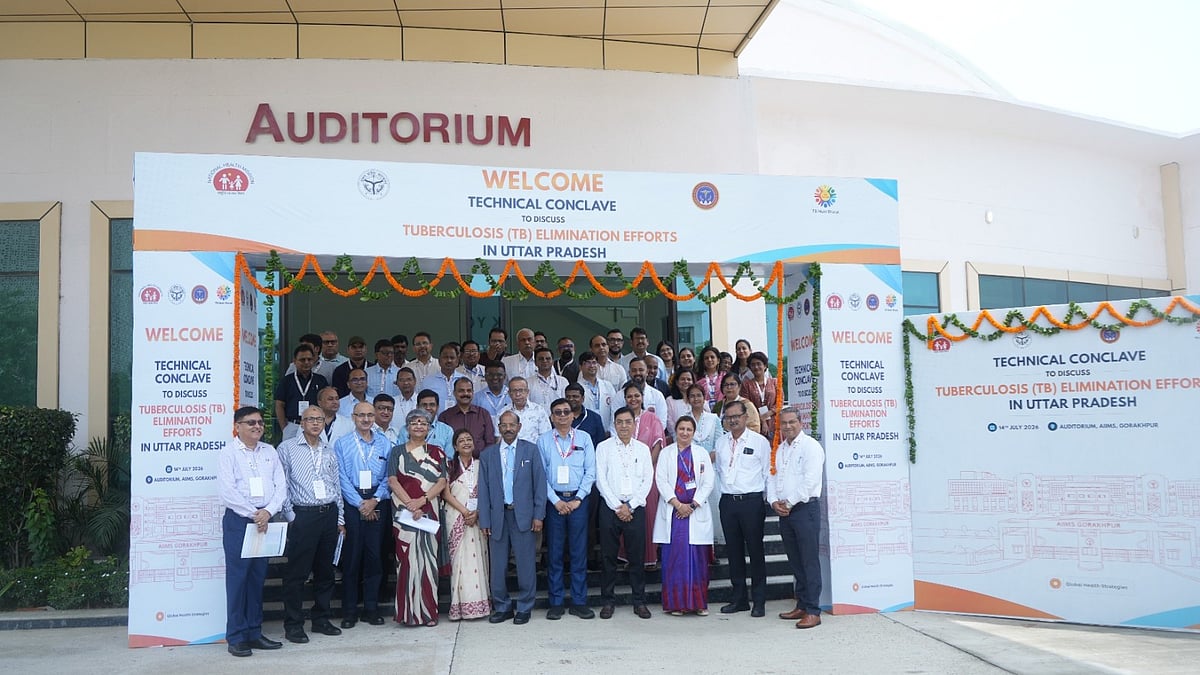
The achievements were highlighted during a Technical Conclave on TB Elimination held at AIIMS Gorakhpur, where state government officials, clinicians, public health experts, private sector representatives and development partners reviewed the state's progress and discussed strategies for accelerating TB elimination.
The conclave, organised by AIIMS Gorakhpur, was attended by more than 60 participants, including senior government officials, clinicians, researchers and development partners. The event aimed to prepare an evidence-based roadmap for both Uttar Pradesh and the country to achieve TB elimination.
Uttar Pradesh's success in the 100-day campaign is a significant step towards achieving the goal of a tuberculosis-free India. The state's focus on technology, surveillance, and community ownership has yielded positive results, and its strategies can serve as a model for other states to follow.
The campaign's emphasis on early detection, early diagnosis, prompt treatment, and continuous surveillance has helped identify and treat thousands of TB patients, including those who were asymptomatic. This approach has not only improved the health outcomes of individuals but also helped prevent the spread of the disease in the community.
As India continues to work towards eliminating tuberculosis, Uttar Pradesh's achievements serve as a beacon of hope. The state's commitment to TB elimination and its innovative approaches to addressing the disease can inspire other states to follow suit, ultimately contributing to a healthier and more prosperous India.
In conclusion, Uttar Pradesh's success in the 100-day TB Mukt Bharat Abhiyaan 2.0 campaign is a significant milestone in the country's journey towards TB elimination. The state's strategies and achievements can serve as a model for other states, and its commitment to public health can inspire meaningful change in the years to come.
The impact of this campaign will be felt for years to come, and it is a testament to the power of collaborative efforts and innovative approaches in addressing public health challenges. As India continues to strive for a tuberculosis-free future, Uttar Pradesh's achievements will remain a shining example of what can be achieved through determination, hard work, and a commitment to improving the health and wellbeing of its citizens.