Maharashtra Issues Guidelines For Custodial Death Probes
New guidelines for investigating custodial deaths, mandatory CCTV preservation and medical safeguards
'%3E%3Crect%20width%3D'96'%20height%3D'96'%20fill%3D'%23B3261E'%2F%3E%3Ccircle%20cx%3D'30'%20cy%3D'24'%20r%3D'44'%20fill%3D'%23fff'%20opacity%3D'.12'%2F%3E%3Ccircle%20cx%3D'60'%20cy%3D'74'%20r%3D'40'%20fill%3D'%23000'%20opacity%3D'.10'%2F%3E%3C%2Fg%3E%3Cg%20fill%3D'%23fff'%3E%3Crect%20x%3D'29'%20y%3D'49'%20width%3D'8'%20height%3D'19'%20rx%3D'1'%2F%3E%3Crect%20x%3D'39'%20y%3D'40'%20width%3D'9'%20height%3D'28'%20rx%3D'1'%2F%3E%3Crect%20x%3D'50'%20y%3D'45'%20width%3D'8'%20height%3D'23'%20rx%3D'1'%2F%3E%3Crect%20x%3D'60'%20y%3D'53'%20width%3D'7'%20height%3D'15'%20rx%3D'1'%2F%3E%3Crect%20x%3D'41'%20y%3D'34'%20width%3D'5'%20height%3D'6'%2F%3E%3C%2Fg%3E%3C%2Fsvg%3E)
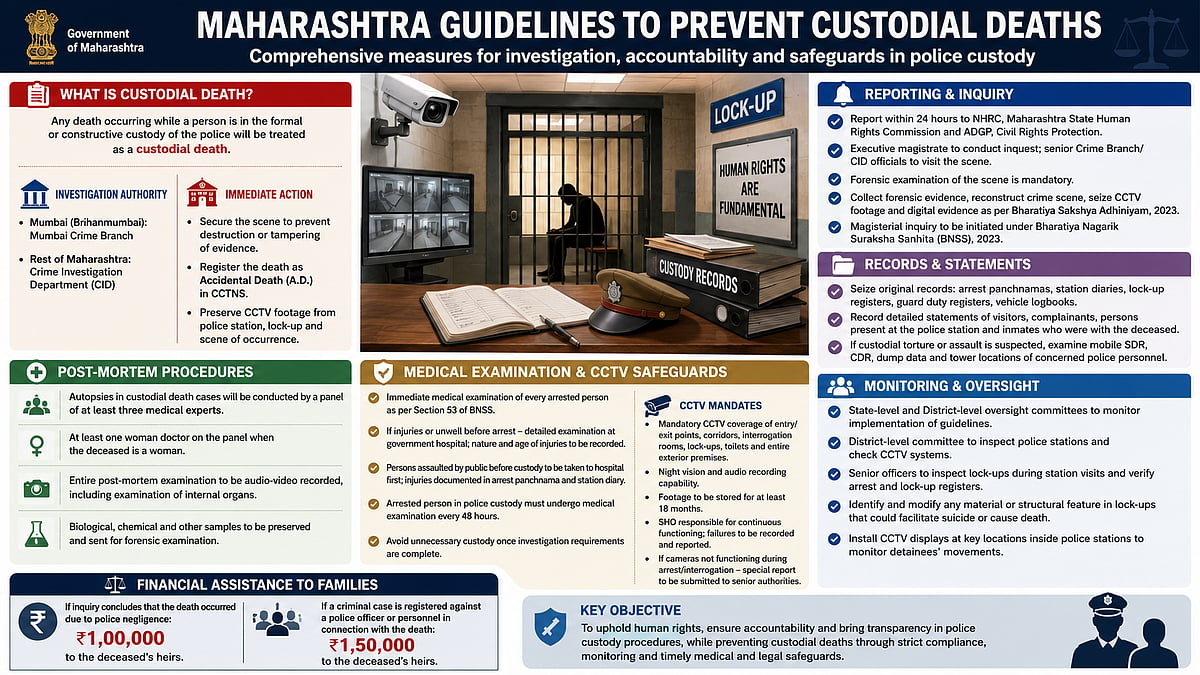
The Maharashtra government has issued comprehensive guidelines for investigating deaths in police custody, making it mandatory for police authorities to preserve CCTV and digital evidence, conduct detailed medical examinations, and ensure close monitoring of detainees.
The guidelines were issued by the Home Department through a government resolution, consolidating various directions issued over the years by the Supreme Court, the National Human Rights Commission (NHRC), and the Maharashtra State Human Rights Commission.
Any death occurring while a person is in police custody will be treated as a custodial death, and the investigation will be conducted by the Mumbai Crime Branch if the incident occurs within Brihanmumbai, or the Crime Investigation Department (CID) for other parts of the state.
The police station concerned must immediately secure the scene of occurrence to prevent destruction or tampering with evidence. The death must be registered as an accidental death in the CCTNS system, and CCTV footage from the police station, lock-up, and scene of occurrence must be preserved securely.
The incident must also be reported within 24 hours to the NHRC, Maharashtra State Human Rights Commission, and the Additional Director General of Police, Civil Rights Protection. An executive magistrate will be deputed to conduct the inquest, and the investigating officer and senior Crime Branch/CID officials will visit the scene.
The guidelines make forensic examination of the scene mandatory, and investigators must collect forensic evidence, conduct a crime scene reconstruction, and seize CCTV footage and other digital evidence. A magisterial inquiry will also be initiated under the Bharatiya Nagarik Suraksha Sanhita (BNSS), 2023.
Autopsies in custodial death cases must be conducted by a panel of at least three medical experts, with at least one woman doctor on the panel when the deceased is a woman. The entire post-mortem examination must be audio-video recorded, including examination of internal organs. Biological, chemical, and other samples must also be preserved and sent for forensic examination.
Investigators will also be required to seize original records connected with the arrest and detention, including arrest panchnamas, station diaries, lock-up registers, guard duty registers, and vehicle logbooks. Statements of visitors, complainants, and other persons present at the police station, as well as inmates who were with the deceased, must be recorded.
The new guidelines aim to prevent custodial deaths and ensure that investigations are thorough and transparent. The Maharashtra government's move is seen as a step towards protecting human rights and promoting accountability within the police force.
The implementation of these guidelines will be closely monitored, and any lapses will be addressed promptly. The government's decision is expected to have a positive impact on the state's law and order situation, and will help to build trust between the police and the public.
In conclusion, the Maharashtra government's new guidelines for investigating custodial deaths are a significant step towards ensuring that such incidents are thoroughly investigated and that those responsible are held accountable. The guidelines will help to promote transparency and accountability within the police force, and will contribute to a safer and more just society for all citizens of Maharashtra.
Frequently asked questions
What are the new guidelines for investigating custodial deaths in Maharashtra?
The new guidelines make it mandatory for police authorities to preserve CCTV and digital evidence, conduct detailed medical examinations, and ensure close monitoring of detainees.
Which agency will investigate custodial deaths in Brihanmumbai?
The Mumbai Crime Branch will investigate custodial deaths in Brihanmumbai, while the Crime Investigation Department (CID) will investigate cases in other parts of the state.