BMC Birth Certificate SOP Faces Legal Challenge
BMC's new SOP for birth and death certificate corrections is under legal scrutiny. A Mumbai advocate has served a notice, warning of Bombay High Court proceedings.
'%3E%3Crect%20width%3D'96'%20height%3D'96'%20fill%3D'%23B3261E'%2F%3E%3Ccircle%20cx%3D'30'%20cy%3D'24'%20r%3D'44'%20fill%3D'%23fff'%20opacity%3D'.12'%2F%3E%3Ccircle%20cx%3D'60'%20cy%3D'74'%20r%3D'40'%20fill%3D'%23000'%20opacity%3D'.10'%2F%3E%3C%2Fg%3E%3Cg%20fill%3D'%23fff'%3E%3Crect%20x%3D'29'%20y%3D'49'%20width%3D'8'%20height%3D'19'%20rx%3D'1'%2F%3E%3Crect%20x%3D'39'%20y%3D'40'%20width%3D'9'%20height%3D'28'%20rx%3D'1'%2F%3E%3Crect%20x%3D'50'%20y%3D'45'%20width%3D'8'%20height%3D'23'%20rx%3D'1'%2F%3E%3Crect%20x%3D'60'%20y%3D'53'%20width%3D'7'%20height%3D'15'%20rx%3D'1'%2F%3E%3Crect%20x%3D'41'%20y%3D'34'%20width%3D'5'%20height%3D'6'%2F%3E%3C%2Fg%3E%3C%2Fsvg%3E)
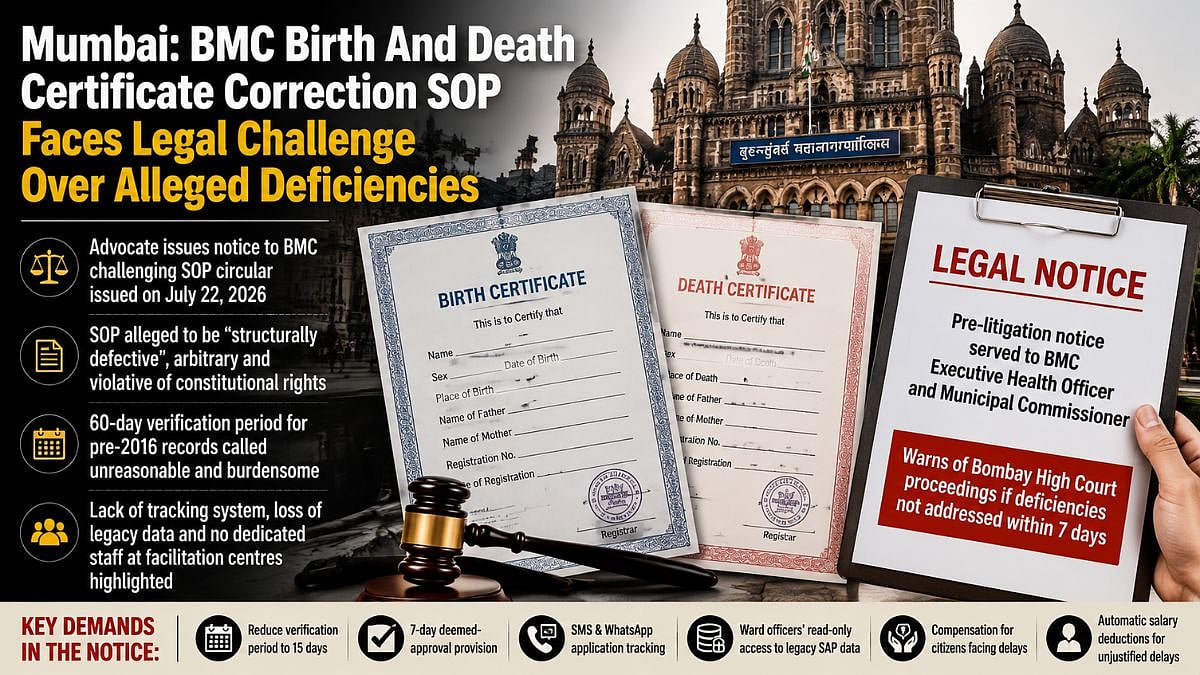
The Brihanmumbai Municipal Corporation's (BMC) newly introduced Standard Operating Procedure (SOP) for corrections to birth and death certificates has come under legal scrutiny. On August 4, 2026, Advocate Shaikh Faiyaz Alam issued a statutory pre-litigation notice to the BMC's Executive Health Officer and Municipal Commissioner, challenging the SOP circular issued on July 22, 2026.
The SOP was introduced to streamline record corrections following the migration of legacy data from the civic body's SAP system to the Central Civil Registration System (CRS) portal. However, the notice alleges that the SOP is structurally defective, arbitrary, and violative of constitutional rights. It claims that the data migration exercise has resulted in operational failures across all 24 municipal wards, including the loss of legacy records and the absence of a transparent application-tracking mechanism.
Advocate Alam has also questioned the 60-day verification period prescribed for records created before 2016, describing it as unreasonable and burdensome for applicants. The notice further alleges that, despite assurances of a single-window system, citizen facilitation centres lack dedicated personnel and adequate public information.
Among the key demands raised by Advocate Alam are reducing the verification period for legacy records from 60 days to 15 days, introducing a seven-day deemed-approval provision, providing SMS- and WhatsApp-based application tracking, granting ward officers read-only access to the legacy SAP database, creating a compensation mechanism for citizens affected by delays, and imposing automatic salary deductions on municipal officials responsible for unjustified delays.
The BMC's new SOP has been introduced to address the issues faced by citizens in obtaining corrected birth and death certificates. However, the alleged deficiencies in the SOP have raised concerns about the effectiveness of the system. If left uncorrected, the SOP will continue to deny citizens timely access to identity documents, resulting in financial loss, denial of essential services, and serious administrative injustice.
The BMC has been given seven days to address the alleged deficiencies in the SOP. If the issues are not resolved, Advocate Alam has warned of Bombay High Court proceedings. The development highlights the need for a more efficient and transparent system for corrections to birth and death certificates in Mumbai.
The introduction of the new SOP is part of the BMC's efforts to improve its services and make them more citizen-friendly. However, the legal challenge to the SOP underscores the importance of ensuring that such systems are fair, efficient, and transparent. The outcome of this case will be closely watched, as it has implications for the delivery of civic services in Mumbai.
In recent years, the BMC has faced several challenges in providing efficient services to citizens. The introduction of the new SOP was seen as a step towards addressing these issues. However, the legal challenge to the SOP has raised questions about the effectiveness of the system and the need for further reforms.
The BMC's response to the notice will be crucial in determining the next course of action. If the alleged deficiencies in the SOP are not addressed, it could lead to further legal action and delays in the delivery of services to citizens. On the other hand, if the BMC is able to address the issues raised by Advocate Alam, it could help to improve the efficiency and transparency of the system.
In conclusion, the legal challenge to the BMC's new SOP for corrections to birth and death certificates highlights the need for a more efficient and transparent system. The outcome of this case will have implications for the delivery of civic services in Mumbai and underscores the importance of ensuring that such systems are fair, efficient, and transparent.
The development is a reminder that the BMC needs to be more proactive in addressing the concerns of citizens and ensuring that its services are delivered efficiently and transparently. The introduction of the new SOP was a step in the right direction, but the legal challenge to the SOP highlights the need for further reforms.
The case also highlights the importance of advocacy and the role that citizens can play in holding the BMC accountable for its actions. Advocate Alam's decision to serve a notice to the BMC is a testament to the power of advocacy and the need for citizens to be vigilant in ensuring that their rights are protected.
In the end, the outcome of this case will depend on the BMC's response to the notice and its willingness to address the alleged deficiencies in the SOP. If the BMC is able to address the issues raised by Advocate Alam, it could help to improve the efficiency and transparency of the system and ensure that citizens have access to timely and efficient services.
Frequently asked questions
What is the issue with the BMC's new SOP for birth and death certificate corrections?
The SOP is alleged to be structurally defective, arbitrary, and violative of constitutional rights, with issues such as loss of legacy records and lack of transparent application-tracking mechanism.
What are the key demands raised by Advocate Alam?
The key demands include reducing the verification period for legacy records, introducing a deemed-approval provision, providing SMS- and WhatsApp-based application tracking, and creating a compensation mechanism for citizens affected by delays.