Indian-Origin Astronaut Anil Menon Launches to ISS
Anil Menon begins 8-month space mission, conducts research on human spaceflight
'%3E%3Crect%20width%3D'96'%20height%3D'96'%20fill%3D'%23B3261E'%2F%3E%3Ccircle%20cx%3D'30'%20cy%3D'24'%20r%3D'44'%20fill%3D'%23fff'%20opacity%3D'.12'%2F%3E%3Ccircle%20cx%3D'60'%20cy%3D'74'%20r%3D'40'%20fill%3D'%23000'%20opacity%3D'.10'%2F%3E%3C%2Fg%3E%3Cg%20fill%3D'%23fff'%3E%3Crect%20x%3D'29'%20y%3D'49'%20width%3D'8'%20height%3D'19'%20rx%3D'1'%2F%3E%3Crect%20x%3D'39'%20y%3D'40'%20width%3D'9'%20height%3D'28'%20rx%3D'1'%2F%3E%3Crect%20x%3D'50'%20y%3D'45'%20width%3D'8'%20height%3D'23'%20rx%3D'1'%2F%3E%3Crect%20x%3D'60'%20y%3D'53'%20width%3D'7'%20height%3D'15'%20rx%3D'1'%2F%3E%3Crect%20x%3D'41'%20y%3D'34'%20width%3D'5'%20height%3D'6'%2F%3E%3C%2Fg%3E%3C%2Fsvg%3E)
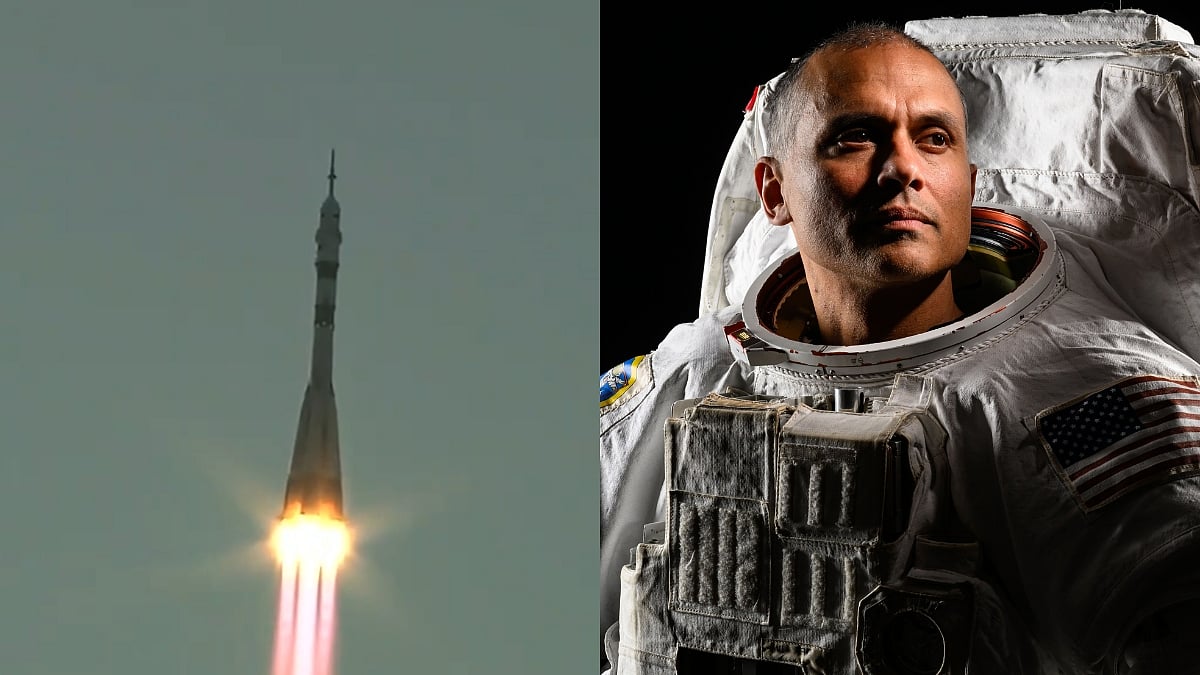
Indian-origin NASA astronaut Anil Menon has embarked on his maiden space mission to the International Space Station (ISS) aboard Russia's Soyuz MS-29 spacecraft. The spacecraft lifted off from the Baikonur Cosmodrome in Kazakhstan at 8:17 pm on Tuesday, carrying Menon alongside Russian cosmonauts Pyotr Dubrov and Anna Kikina.
Menon's mission marks his first journey into space, while Dubrov and Kikina are undertaking their second missions. The Soyuz spacecraft is expected to dock with the ISS just over three hours after launch.
During their eight-month stay aboard the orbital laboratory, the three crew members will conduct a series of scientific investigations and technology demonstrations. Menon's mission will focus on research aimed at improving human spaceflight, including studies on how the human body responds to prolonged exposure to microgravity.
Menon will participate in investigations into blood circulation, vein structure, and blood composition. He will also help evaluate a system designed to produce intravenous fluids from the station's drinking water, a technology that could support future crewed missions to the Moon and Mars.
In addition, Menon will take part in advanced medical demonstrations involving ultrasound procedures assisted by augmented reality and artificial intelligence. This will help develop new capabilities for astronauts on deep-space expeditions.
Anil Menon was born in Minneapolis to Indian and Ukrainian immigrant parents. He has academic qualifications in neurobiology, mechanical engineering, and medicine, and has built a distinguished career combining healthcare expertise with space exploration.
Menon joins the growing list of astronauts contributing to international scientific research aboard the ISS. His mission is expected to contribute significantly to our understanding of human spaceflight and the development of new technologies for future space missions.
The ISS has been continuously occupied by astronauts and cosmonauts since 2000, and has served as a vital platform for scientific research and technological development. Menon's mission is a significant milestone in the ongoing efforts to advance our understanding of space and the human body's response to it.
As Menon and his crewmates begin their eight-month stay aboard the ISS, they will conduct a wide range of scientific experiments and technological demonstrations. Their research will focus on improving our understanding of human spaceflight and the development of new technologies for future space missions.
The success of Menon's mission will have significant implications for future space exploration, including potential missions to the Moon and Mars. His research on the human body's response to microgravity will help inform the development of new technologies and strategies for deep-space expeditions.
In conclusion, Anil Menon's maiden space mission to the ISS marks an important milestone in the ongoing efforts to advance our understanding of space and the human body's response to it. His research and contributions to the ISS program will have a lasting impact on the development of new technologies and strategies for future space missions.