Brother De Paul's House of Charity Inspires
Brother De Paul's faith, Minneapolis charity, serves hot meals
'%3E%3Crect%20width%3D'96'%20height%3D'96'%20fill%3D'%23B3261E'%2F%3E%3Ccircle%20cx%3D'30'%20cy%3D'24'%20r%3D'44'%20fill%3D'%23fff'%20opacity%3D'.12'%2F%3E%3Ccircle%20cx%3D'60'%20cy%3D'74'%20r%3D'40'%20fill%3D'%23000'%20opacity%3D'.10'%2F%3E%3C%2Fg%3E%3Cg%20fill%3D'%23fff'%3E%3Crect%20x%3D'29'%20y%3D'49'%20width%3D'8'%20height%3D'19'%20rx%3D'1'%2F%3E%3Crect%20x%3D'39'%20y%3D'40'%20width%3D'9'%20height%3D'28'%20rx%3D'1'%2F%3E%3Crect%20x%3D'50'%20y%3D'45'%20width%3D'8'%20height%3D'23'%20rx%3D'1'%2F%3E%3Crect%20x%3D'60'%20y%3D'53'%20width%3D'7'%20height%3D'15'%20rx%3D'1'%2F%3E%3Crect%20x%3D'41'%20y%3D'34'%20width%3D'5'%20height%3D'6'%2F%3E%3C%2Fg%3E%3C%2Fsvg%3E)
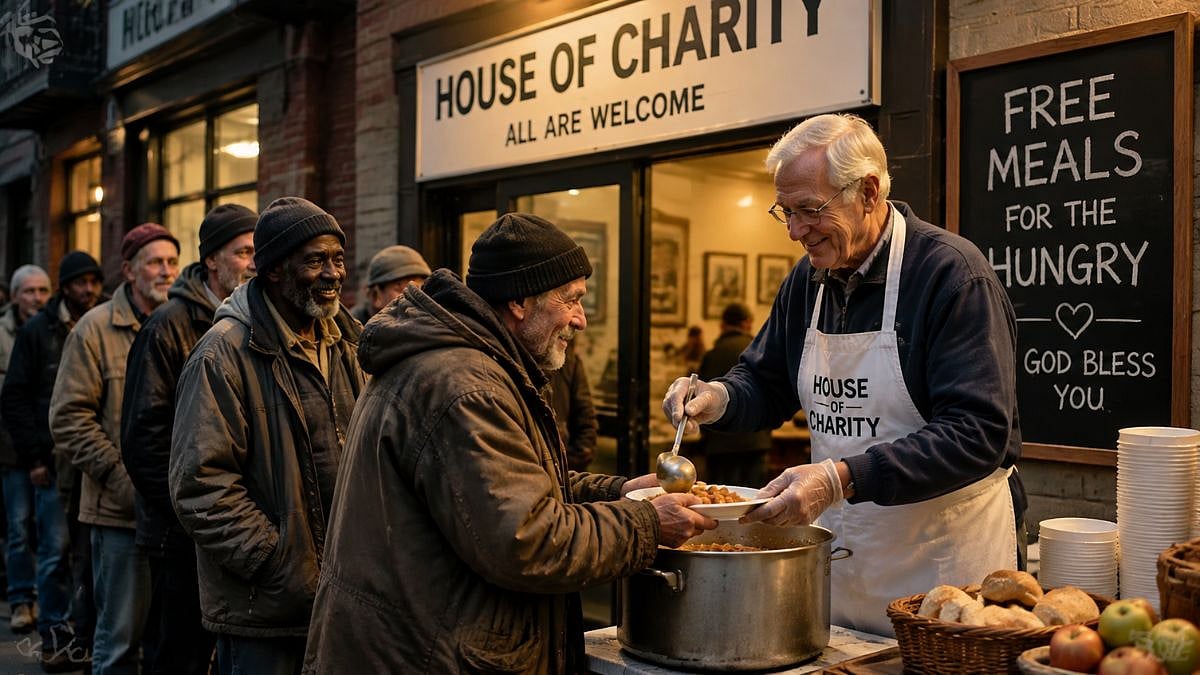
Brother De Paul Kondark, a man of tremendous faith, opened a 'House of Charity' in Minneapolis with just 25 cents.
He used this small amount to provide free hot meals to the poor and starving. The 'House of Charity' became a beacon of hope for those in need, with long queues of people waiting outside to be served.
Despite the uncertainty of whether the charity would last, Brother De Paul's faith and determination kept it going. Day after day, the doors of the 'House of Charity' opened, and the poor were served hot food, often the best they had ever tasted.
The people who visited the charity were grateful to Brother De Paul, who never sought to draw attention to himself. Instead, he attributed the success of the 'House of Charity' to a higher power, saying 'The Lord does it all.'
Brother De Paul's selflessness and devotion to his cause are an inspiration to many. His story raises an important question: 'Is life worth living?' The answer, as seen in the lives of Brother De Paul and others like him, is that a life of surrender and service to others is indeed a life worth living.
In an age marked by confusion and agitation, the example of Brother De Paul and his 'House of Charity' shows that even the smallest acts of kindness can make a significant difference. His faith and commitment to helping others are a testament to the power of surrender and the impact it can have on the lives of those around us.
The 'House of Charity' has never turned away anyone in need, and it has never run out of food. This is a remarkable achievement, considering the humble beginnings of the charity. Brother De Paul's story is a reminder that even the smallest amount of resources can be used to make a big difference when combined with faith, determination, and a willingness to serve others.
As a humanitarian and spiritual leader, Dada J. P. Vaswani, who wrote about Brother De Paul's story, emphasizes the importance of living a life of surrender. He suggests that this is the key to finding meaning and purpose in life. The example of Brother De Paul and his 'House of Charity' supports this idea, showing that a life of service to others can be a truly fulfilling and worthwhile one.
In conclusion, the story of Brother De Paul and his 'House of Charity' is a powerful reminder of the impact that one person can have on the lives of others. It shows that even the smallest acts of kindness and generosity can make a big difference, and that a life of surrender and service to others is indeed a life worth living.
Frequently asked questions
What is the House of Charity?
The House of Charity is a place where Brother De Paul provides free hot meals to the poor and starving.
What is the key to Brother De Paul's success?
Brother De Paul's faith and determination are the key to the success of the House of Charity.