Total Solar Eclipse 2026 Occurs Today
Total solar eclipse visible in parts of Northern Hemisphere, livestream available
'%3E%3Crect%20width%3D'96'%20height%3D'96'%20fill%3D'%23B3261E'%2F%3E%3Ccircle%20cx%3D'30'%20cy%3D'24'%20r%3D'44'%20fill%3D'%23fff'%20opacity%3D'.12'%2F%3E%3Ccircle%20cx%3D'60'%20cy%3D'74'%20r%3D'40'%20fill%3D'%23000'%20opacity%3D'.10'%2F%3E%3C%2Fg%3E%3Cg%20fill%3D'%23fff'%3E%3Crect%20x%3D'29'%20y%3D'49'%20width%3D'8'%20height%3D'19'%20rx%3D'1'%2F%3E%3Crect%20x%3D'39'%20y%3D'40'%20width%3D'9'%20height%3D'28'%20rx%3D'1'%2F%3E%3Crect%20x%3D'50'%20y%3D'45'%20width%3D'8'%20height%3D'23'%20rx%3D'1'%2F%3E%3Crect%20x%3D'60'%20y%3D'53'%20width%3D'7'%20height%3D'15'%20rx%3D'1'%2F%3E%3Crect%20x%3D'41'%20y%3D'34'%20width%3D'5'%20height%3D'6'%2F%3E%3C%2Fg%3E%3C%2Fsvg%3E)
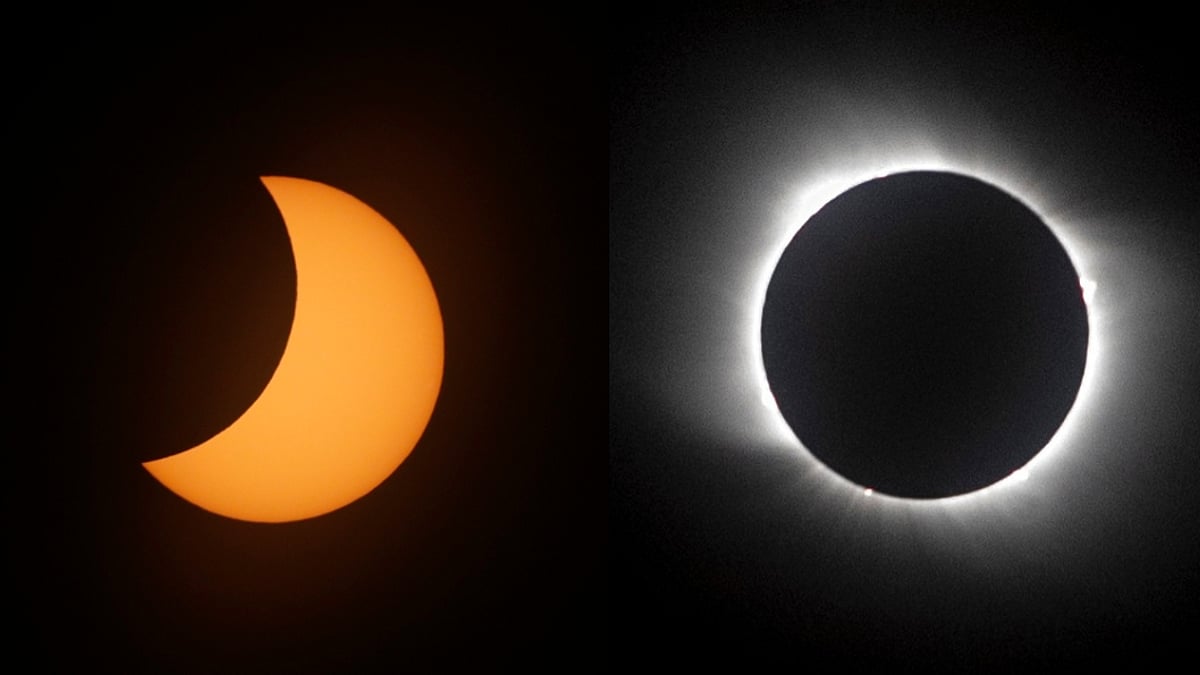
The total solar eclipse of 2026 is taking place today, offering a rare opportunity for skywatchers in parts of the Northern Hemisphere to witness the Moon fully blocking out the Sun.
The path of totality for this eclipse runs through several countries, including Greenland, Iceland, northern Russia, Spain, and a small portion of Portugal.
In addition to these locations, a wider band of territory will experience a partial eclipse, including much of Europe, northwestern Africa, Canada, and parts of the northern United States.
For viewers along the path of totality, the eclipse will last under two minutes, providing a brief window to observe this rare event.
A total solar eclipse occurs when the Moon moves directly between the Sun and Earth, blocking the Sun's face entirely for anyone standing within the Moon's central shadow.
During this period, daylight can dim to a level resembling early dawn or dusk, and observers may also be able to glimpse the Sun's corona, the faint outer atmosphere that is normally overpowered by the brightness of the solar disk.
The path and duration of today's eclipse vary by location, with viewers positioned closer to the centre of the eclipse's path, such as those in Greenland, Russia, and the North Atlantic region, getting a slightly longer view of totality.
Exact timings differ by location, with the partial phase starting at 4:47pm local time in Reykjavik, and totality running from 5:48pm to 5:49pm.
In Leon, the partial eclipse begins at 7:32pm, and totality lasts from 8:28pm to 8:30pm, while in Valencia, totality falls between 8:32pm and 8:33pm local time.
Although India does not fall within the eclipse's visible zone, people in the country can still follow the event through online broadcasts.
NASA's livestream begins at 1:15pm EDT, which corresponds to 10:45pm IST, and will feature footage from multiple points along the eclipse path alongside commentary and expert interviews.
The European Space Agency will also run its own broadcast from around 7:30pm CEST, or roughly 11pm IST, streaming from the Observatorio Astrofisico de Javalambre in Teruel, Spain.
For those watching the eclipse in person, it is essential to use eclipse glasses certified to the ISO 12312-2 standard to ensure safe viewing.
This standard guarantees that the glasses provide sufficient protection for the eyes during the eclipse.
The total solar eclipse of 2026 is a rare and significant event, offering a unique opportunity for scientists and skywatchers to observe the Sun's corona and study the effects of the eclipse on the environment.
As the eclipse takes place today, people around the world can tune in to online broadcasts to witness this rare event and learn more about the science behind it.
In conclusion, the total solar eclipse of 2026 is a significant astronomical event that offers a rare opportunity for people to witness the Moon blocking out the Sun.
With online broadcasts available, people in India and around the world can follow the event and learn more about the science behind it, making it a unique and educational experience for all.
Frequently asked questions
What is the path of totality for the total solar eclipse 2026?
The path of totality runs through Greenland, Iceland, northern Russia, Spain, and a small portion of Portugal.
How can I safely view the total solar eclipse?
Use eclipse glasses certified to the ISO 12312-2 standard to ensure safe viewing.