Mumbai Baby Undergoes Rare Heart Protection Surgery
3-month-old baby girl with rare chest defect undergoes life-saving surgery in Mumbai. Doctors successfully reconstruct chest wall to protect heart.
'%3E%3Crect%20width%3D'96'%20height%3D'96'%20fill%3D'%23B3261E'%2F%3E%3Ccircle%20cx%3D'30'%20cy%3D'24'%20r%3D'44'%20fill%3D'%23fff'%20opacity%3D'.12'%2F%3E%3Ccircle%20cx%3D'60'%20cy%3D'74'%20r%3D'40'%20fill%3D'%23000'%20opacity%3D'.10'%2F%3E%3C%2Fg%3E%3Cg%20fill%3D'%23fff'%3E%3Crect%20x%3D'29'%20y%3D'49'%20width%3D'8'%20height%3D'19'%20rx%3D'1'%2F%3E%3Crect%20x%3D'39'%20y%3D'40'%20width%3D'9'%20height%3D'28'%20rx%3D'1'%2F%3E%3Crect%20x%3D'50'%20y%3D'45'%20width%3D'8'%20height%3D'23'%20rx%3D'1'%2F%3E%3Crect%20x%3D'60'%20y%3D'53'%20width%3D'7'%20height%3D'15'%20rx%3D'1'%2F%3E%3Crect%20x%3D'41'%20y%3D'34'%20width%3D'5'%20height%3D'6'%2F%3E%3C%2Fg%3E%3C%2Fsvg%3E)
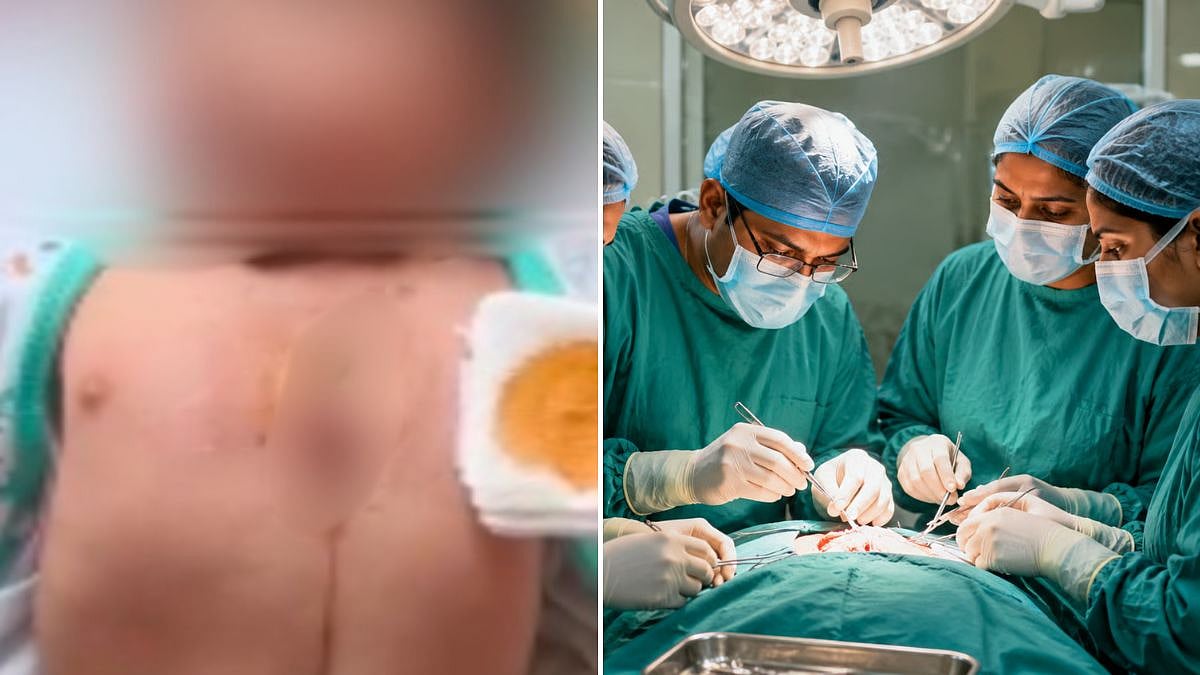
Mumbai witnessed a medical miracle when a three-month-old baby girl, Janki, underwent a complex reconstructive surgery to correct a rare congenital chest-wall defect. The baby was diagnosed with a partial congenital sternal cleft, a condition where the breastbone fails to fuse during foetal development, leaving her heart partially unprotected.
The condition was not detected during pregnancy, and despite the serious defect, Janki was active and feeding normally. However, she experienced intermittent noisy breathing and breathlessness, and had one episode of respiratory infection after birth. Doctors at Narayana Health SRCC Children’s Hospital in Mumbai said the absence of the normal protective breastbone left her heart and major blood vessels vulnerable to injury.
A detailed investigation confirmed the absence of the fused sternum, showing mild enlargement of the right side of the heart, along with small areas of lung collapse and patchy consolidation. Considering the infant’s age and the proximity of the defect to the heart, doctors planned the surgery with extensive precautions. A cardiopulmonary bypass machine was kept on standby throughout the procedure.
During the operation, surgeons mobilised the pectoralis major muscles to provide protective tissue coverage. They also performed carefully planned chondrotomies of the clavicles and upper ribs, allowing the chest wall to be brought together without excessive tension. The sternum was reconstructed using steel wires. The procedure was performed by a team comprising paediatric surgeons, paediatric cardiothoracic and congenital heart surgeons, cardiac anaesthesiologists, radiologists, and paediatric cardiac intensive-care specialists.
Temporary fluctuations in blood pressure occurred while the chest structures were being mobilised but were managed successfully by the medical team. Janki was monitored in the Paediatric Cardiac Intensive Care Unit for four days before being shifted to the ward. She resumed full oral feeds, remained haemodynamically stable, and developed no postoperative complications. She was discharged eight days after surgery, with follow-up showing satisfactory healing of the reconstructed chest wall.
The doctors involved in the surgery, Dr Rasiklal Shah and Dr Pradeep Kumar Kaushik, said that partial sternal cleft is among the rarest congenital chest-wall anomalies and requires early recognition, meticulous planning, and coordinated multidisciplinary care. The successful surgery has given Janki a new lease on life, and her family is grateful for the medical team's expertise and care.
This rare condition highlights the importance of timely medical intervention and the need for advanced medical facilities in the city. The surgery has also showcased the expertise of the medical team at Narayana Health SRCC Children’s Hospital, who worked together to save the life of the three-month-old baby girl.
The incident also underscores the significance of regular health check-ups for infants, especially in the first few months of life. Early detection and treatment of such rare conditions can make a significant difference in the outcome, and in this case, has saved the life of baby Janki.
In conclusion, the successful surgery on baby Janki is a testament to the advances in medical science and the expertise of the medical team in Mumbai. It is a reminder that even in the most complex and rare cases, timely medical intervention can make all the difference, and that with the right care and treatment, even the most vulnerable lives can be saved.
Frequently asked questions
What is partial congenital sternal cleft?
A rare congenital chest-wall defect where the breastbone fails to fuse during foetal development.
What was the outcome of the surgery?
The surgery was successful, and the baby was discharged eight days after surgery with satisfactory healing of the reconstructed chest wall.