Supreme Court Asks Ministry To Examine Poor Road Safety Rule Implementation
Supreme Court seeks action on poor seat belt and child safety rule enforcement.
'%3E%3Crect%20width%3D'96'%20height%3D'96'%20fill%3D'%23B3261E'%2F%3E%3Ccircle%20cx%3D'30'%20cy%3D'24'%20r%3D'44'%20fill%3D'%23fff'%20opacity%3D'.12'%2F%3E%3Ccircle%20cx%3D'60'%20cy%3D'74'%20r%3D'40'%20fill%3D'%23000'%20opacity%3D'.10'%2F%3E%3C%2Fg%3E%3Cg%20fill%3D'%23fff'%3E%3Crect%20x%3D'29'%20y%3D'49'%20width%3D'8'%20height%3D'19'%20rx%3D'1'%2F%3E%3Crect%20x%3D'39'%20y%3D'40'%20width%3D'9'%20height%3D'28'%20rx%3D'1'%2F%3E%3Crect%20x%3D'50'%20y%3D'45'%20width%3D'8'%20height%3D'23'%20rx%3D'1'%2F%3E%3Crect%20x%3D'60'%20y%3D'53'%20width%3D'7'%20height%3D'15'%20rx%3D'1'%2F%3E%3Crect%20x%3D'41'%20y%3D'34'%20width%3D'5'%20height%3D'6'%2F%3E%3C%2Fg%3E%3C%2Fsvg%3E)
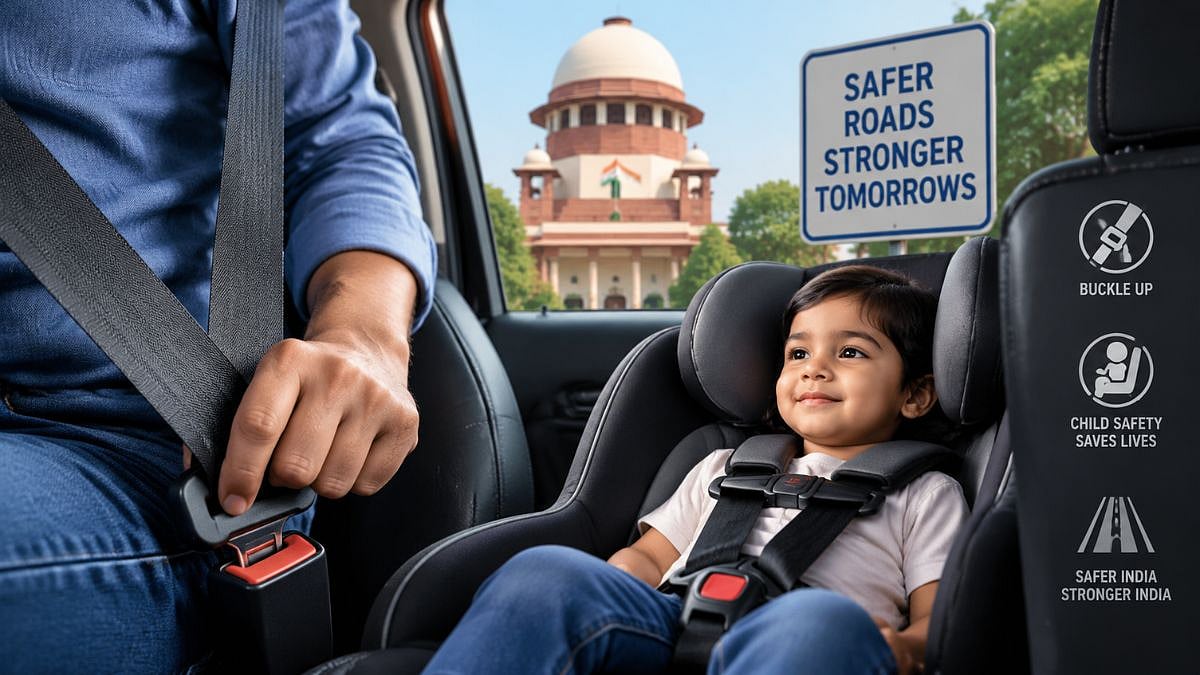
The Supreme Court on Wednesday directed the Union Road Ministry to examine concerns over the poor implementation of seat belt and child safety rules in India.
A three-judge Bench headed by Chief Justice of India Surya Kant was hearing a petition filed by doctor and researcher Jothydev Kesavadev, who highlighted the importance of simple safety measures such as seat belts, child seats, and rear seat belts in preventing fatalities on the road.
The petitioner argued that despite being mandated under the Motor Vehicles Act, 1988, these safety measures remained largely ignored and weakly enforced. The Court observed that deaths and life-altering injuries caused by negligence in road safety measures were highly deplorable.
Chief Justice Surya Kant questioned how the Supreme Court could monitor the safety of every citizen and every driver across the country, stating that the issue fell within the enforcement powers of the Executive and not the judiciary. The Bench said the responsibility of implementing road safety rules rested with law enforcement authorities.
The petitioner's advocate, Wills Mathews, informed the Court that fancy seat covers and other accessories were replacing essential safety equipment in vehicles, putting the fundamental right to life under Article 21 of the Constitution at stake. Mathews also submitted that he had sent a representation to the government on February 16 highlighting the issue but had received no response.
The Bench directed the Ministry to receive and examine the records submitted by the petitioner. The case highlights a wider concern over road safety in India, where rules alone may not be enough unless their enforcement reaches everyday driving practices.
The challenge remains in ensuring that existing safety provisions translate into fewer deaths and injuries on roads. The Supreme Court's directive to the Ministry is a step towards addressing this concern and promoting road safety in the country.
Road safety is a critical issue in India, with a high number of fatalities and injuries occurring on the roads every year. The implementation of seat belt and child safety rules is crucial in reducing the number of accidents and saving lives.
The Supreme Court's order is a reminder of the importance of enforcing road safety rules and the need for law enforcement authorities to take proactive measures to promote road safety. The Court's directive to the Ministry is expected to lead to a review of the current road safety rules and their implementation, with a view to improving road safety in the country.
In conclusion, the Supreme Court's directive to the Ministry is a significant step towards promoting road safety in India. The implementation of seat belt and child safety rules is crucial in reducing the number of accidents and saving lives. The Court's order is a reminder of the importance of enforcing road safety rules and the need for law enforcement authorities to take proactive measures to promote road safety.
Frequently asked questions
What is the current status of road safety rule implementation in India?
The implementation of road safety rules, including seat belt and child safety rules, is poor in India.
What has the Supreme Court directed the Ministry to do?
The Supreme Court has directed the Ministry to examine concerns over the poor implementation of seat belt and child safety rules in India.