Iran's Cyberattacks Target US Water Facilities
Iran escalates cyber war, hits US water facilities. New tactics combine military and psychological ops.
'%3E%3Crect%20width%3D'96'%20height%3D'96'%20fill%3D'%234A235A'%2F%3E%3Ccircle%20cx%3D'30'%20cy%3D'24'%20r%3D'44'%20fill%3D'%23fff'%20opacity%3D'.12'%2F%3E%3Ccircle%20cx%3D'60'%20cy%3D'74'%20r%3D'40'%20fill%3D'%23000'%20opacity%3D'.10'%2F%3E%3C%2Fg%3E%3Cg%20fill%3D'none'%20stroke%3D'%23fff'%20stroke-width%3D'3'%3E%3Ccircle%20cx%3D'48'%20cy%3D'48'%20r%3D'16'%2F%3E%3Cellipse%20cx%3D'48'%20cy%3D'48'%20rx%3D'6.5'%20ry%3D'16'%2F%3E%3Cline%20x1%3D'32'%20y1%3D'42'%20x2%3D'64'%20y2%3D'42'%2F%3E%3Cline%20x1%3D'32'%20y1%3D'54'%20x2%3D'64'%20y2%3D'54'%2F%3E%3C%2Fg%3E%3C%2Fsvg%3E)
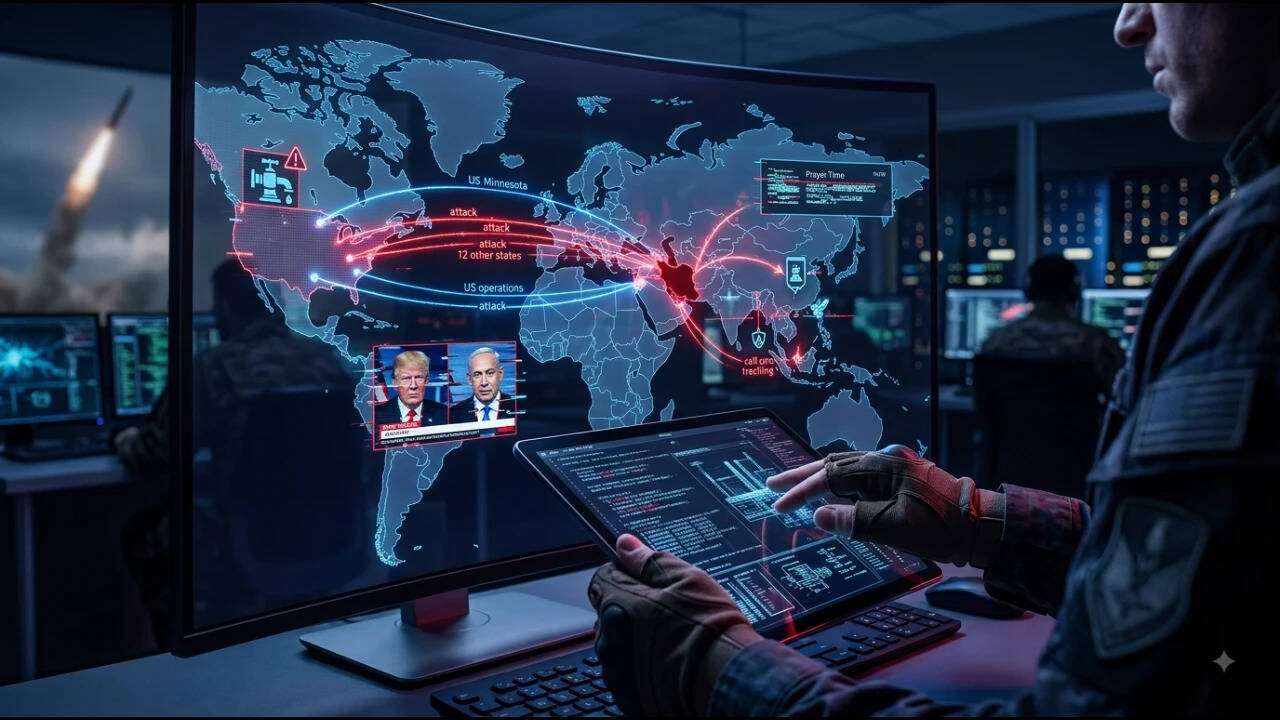
Iran's cyber warfare capabilities are rapidly evolving, with a recent focus on targeting US water facilities. This new front in the ongoing tensions between Iran, the US, and Israel marks a significant shift in the nature of modern warfare. By leveraging cyberattacks, Iran aims to bolster its military initiatives while also influencing international public opinion.
The use of artificial intelligence in these operations has greatly enhanced their efficiency and scope, allowing Iran to pursue asymmetric strategies that are a key component of its military doctrine. This blend of digital and psychological warfare enables Iran to project power beyond its conventional military capabilities, posing a challenge to its adversaries.
The targeting of US water facilities is particularly concerning, as it highlights the vulnerability of critical infrastructure to cyber threats. This development underscores the need for enhanced cybersecurity measures to protect against such attacks, which can have significant consequences for public health and safety.
Iran's cyber warfare program has been underway for several years, with the country investing heavily in the development of its capabilities. The program has been linked to a number of high-profile attacks, including those against US financial institutions and government agencies.
The escalation of Iran's cyberattacks is also driven by the country's desire to demonstrate its capabilities and to deter its adversaries from taking action against it. By showcasing its ability to conduct sophisticated cyber operations, Iran hopes to create uncertainty and doubt among its enemies, thereby gaining a strategic advantage.
The international community is taking notice of Iran's growing cyber capabilities, with many countries expressing concern about the potential consequences of such attacks. The US and Israel, in particular, have been vocal about the need to counter Iran's cyber threats, with both countries investing heavily in their own cybersecurity programs.
As the cyber warfare landscape continues to evolve, it is likely that Iran will remain a major player, using its capabilities to pursue its strategic objectives. The targeting of US water facilities is just one example of the types of attacks that can be expected, and it highlights the need for continued vigilance and cooperation among countries to counter such threats.
The implications of Iran's cyberattacks are far-reaching, with potential consequences for global stability and security. As such, it is essential that countries work together to develop effective countermeasures and to promote a norms-based approach to cyber warfare.
In conclusion, Iran's evolving cyberattacks pose a significant challenge to the US and its allies, and it is essential that these countries take proactive steps to counter such threats. The use of artificial intelligence and other advanced technologies has enhanced Iran's cyber capabilities, making it a major player in the global cyber warfare landscape.
Frequently asked questions
What is the target of Iran's recent cyberattacks?
Iran's recent cyberattacks have targeted US water facilities, highlighting the vulnerability of critical infrastructure to cyber threats.
How has artificial intelligence impacted Iran's cyber warfare capabilities?
The use of artificial intelligence has greatly enhanced the efficiency and scope of Iran's cyber operations, allowing the country to pursue asymmetric strategies and project power beyond its conventional military capabilities.