PM Modi Dedicates Western Freight Corridor Sections
PM Modi to launch freight trains, boost India's rail network. Dedicated corridors to ease pressure on railways.
'%3E%3Crect%20width%3D'96'%20height%3D'96'%20fill%3D'%23B3261E'%2F%3E%3Ccircle%20cx%3D'30'%20cy%3D'24'%20r%3D'44'%20fill%3D'%23fff'%20opacity%3D'.12'%2F%3E%3Ccircle%20cx%3D'60'%20cy%3D'74'%20r%3D'40'%20fill%3D'%23000'%20opacity%3D'.10'%2F%3E%3C%2Fg%3E%3Cg%20fill%3D'%23fff'%3E%3Crect%20x%3D'29'%20y%3D'49'%20width%3D'8'%20height%3D'19'%20rx%3D'1'%2F%3E%3Crect%20x%3D'39'%20y%3D'40'%20width%3D'9'%20height%3D'28'%20rx%3D'1'%2F%3E%3Crect%20x%3D'50'%20y%3D'45'%20width%3D'8'%20height%3D'23'%20rx%3D'1'%2F%3E%3Crect%20x%3D'60'%20y%3D'53'%20width%3D'7'%20height%3D'15'%20rx%3D'1'%2F%3E%3Crect%20x%3D'41'%20y%3D'34'%20width%3D'5'%20height%3D'6'%2F%3E%3C%2Fg%3E%3C%2Fsvg%3E)
Prime Minister Narendra Modi will dedicate three sections of the Western Dedicated Freight Corridor to the nation on September 8, 2026, and flag off freight trains from Jawaharlal Nehru Port Authority.
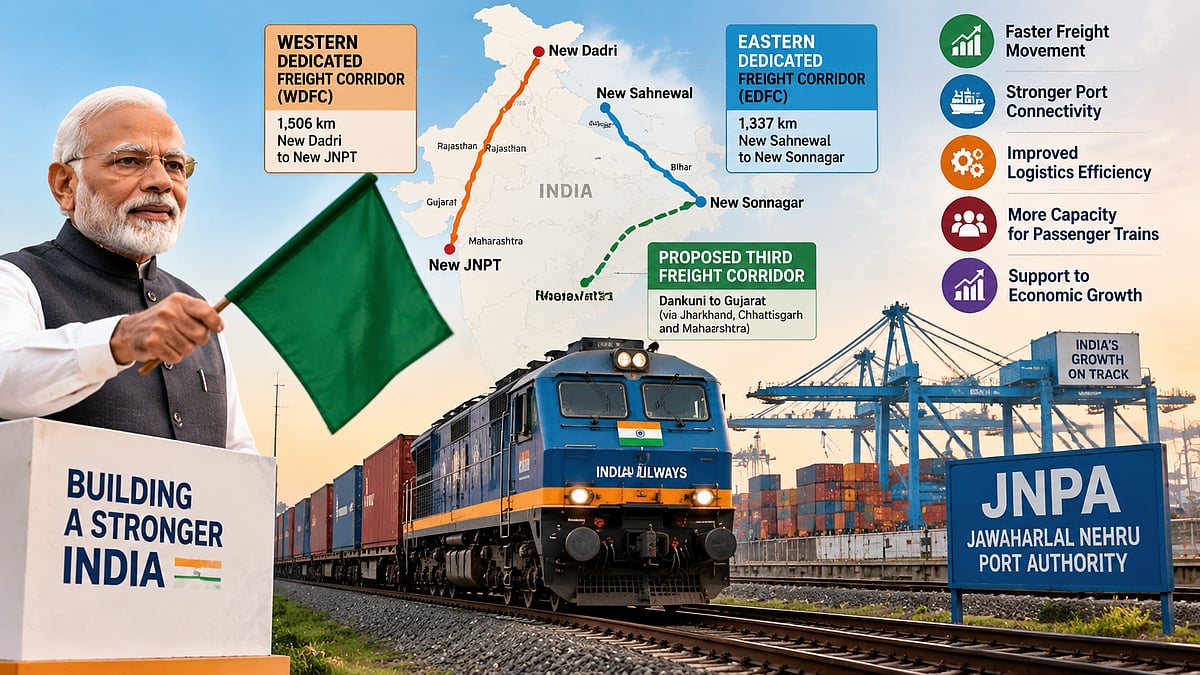
This move aims to strengthen the connection between India's industrial centres and major ports, while easing pressure on the existing railway network. The Western Dedicated Freight Corridor runs for approximately 1,506 km from New Dadri in Uttar Pradesh to New JNPT in Maharashtra, passing through Haryana, Rajasthan, and Gujarat.
The corridor, along with the Eastern Dedicated Freight Corridor, forms a dedicated freight network of approximately 2,843 km. The Eastern Dedicated Freight Corridor runs for around 1,337 km from New Sahnewal in Punjab to New Sonnagar in Bihar, connecting major industrial and manufacturing centres across northern India.
The two corridors are designed to provide faster, higher-capacity, and more reliable freight movement. They allow double-stack container rakes to connect directly with important ports, improving the movement of goods between manufacturing hubs, logistics centres, and export gateways.
The Central Railway has stated that the corridors have helped reduce pressure on the existing rail network, creating additional capacity for passenger trains. The government has also announced a third Dedicated Freight Corridor in this year's Union Budget, which will start from Dankuni in West Bengal and connect to Gujarat through Jharkhand, Chhattisgarh, and Maharashtra.
In Maharashtra, the feasibility of linking the new corridor parallel to the Samruddhi Mahamarg is also being examined. The expansion of the freight corridor comes as freight transport becomes increasingly important to India's logistics and manufacturing ambitions.
Dedicated freight routes separate goods trains from passenger services, allowing freight trains to operate with fewer conflicts on the existing network. The government has said that the corridors will help improve logistics efficiency, strengthen supply chains, and support economic growth.
The September 8 event at JNPA will underline the Centre's effort to build a larger, more integrated freight transport system, with Maharashtra playing a key role as a major industrial and port-linked state. The launch of the Western Dedicated Freight Corridor sections is expected to have a significant impact on India's freight network and economy.
The Western Dedicated Freight Corridor is a crucial part of India's plans to improve its logistics and transportation infrastructure. With the dedication of the three sections, the corridor is expected to increase the efficiency of freight movement and reduce transportation costs.
In conclusion, the dedication of the Western Dedicated Freight Corridor sections by PM Modi is a significant step towards improving India's freight network and supporting the country's economic growth. The expansion of the freight corridor is expected to have a positive impact on the logistics and manufacturing sectors, and will play a key role in shaping the country's transportation infrastructure.
The event on September 8 will be a major milestone in the development of India's freight network, and will highlight the government's commitment to improving the country's logistics and transportation infrastructure. With the launch of the Western Dedicated Freight Corridor sections, India is expected to take a significant step forward in its efforts to become a major player in the global logistics and manufacturing sector.
Frequently asked questions
What is the Western Dedicated Freight Corridor?
The Western Dedicated Freight Corridor is a 1,506 km long corridor that runs from New Dadri in Uttar Pradesh to New JNPT in Maharashtra.
What is the purpose of the Dedicated Freight Corridors?
The purpose of the Dedicated Freight Corridors is to provide faster, higher-capacity, and more reliable freight movement, and to ease pressure on the existing railway network.